WHAT SHOULD CHRISTENDOM CELEBRATE -- PASSOVER OR EASTER?
At creation, GOD made two great luminaries, the greater light to rule the day, and the lesser light to rule the night. He made the stars also.
Chapter 1: INTRODUCTION
At creation, GOD made two great luminaries, the greater light to rule the day, and the lesser light to rule the night. He made the stars also. GOD set them in the firmament of the heaven to give light upon the earth and to rule over the day and over the night, and to divide the light from the darkness, for the text says: "And God made two great lights; the greater light to rule the day, and the lesser light to rule the night: he made the stars also. And GOD set them in the firmament of the heaven to give light upon the earth" (Gen. 1:16-17). That was on the fourth day of creation.
GOD made the Sun, Moon and Stars. What is striking is the Commandment of GOD in verse 14. The text says: "And GOD said, Let there be lights in the firmament of the heaven to divide the day from the night; and let them be for signs, and for seasons, and for days, and years" (Gen. 1:14). This text is rendered in the GOOD NEWS TRANSLATION (GNT) thus: "Let lights appear in the sky to separate day from night and to show the time when days, years, and religious festivals (or seasons) begin."
In Hebrew, the word for "seasons" is Moedim. Moedim means the appointed times of GOD. The phrase "appointed times of GOD" means the Festivals or Feasts of GOD.
The sun, moon and stars are therefore, created, not only to give light to the day and night, but also to determine when GOD's festivals, otherwise known as appointed Feasts or appointed times, would hold.
The secular calendar, referred to as the Gregorian Calendar, was introduced by Pope Gregory Xiii of Rome in 1582 AD. This is the calendar in use in most of the world today. The calendar is based on the movements of the sun, and is therefore, called a solar calendar.
A solar year consists of 365 days because it takes the earth 365 days to revolve around the sun.
The Hebrew calendar, on the other hand, is based on the movements of the moon, and is therefore, called a lunar calendar. The moon makes its trip around the earth in 354 days, eleven days less than the earth takes to travel around the sun.
In the solar calendar, a leap year consists of one additional day every four years. This comes about because there are actually 365 1/4 days in a solar year, the additional day falling on February 29, every four years.
With the lunar calendar, a leap year occurs every two or three years, consisting of one additional month. In every nineteen years circle, a leap year occurs seven times. During a leap year, there are 384 days because of the additional month.
In the lunar calendar, each month contains an average of 29.5 days. It is therefore, necessary to add half a day to one month and to deduct half a day from the next month. Therefore, the months usually alternate in length (29 days in one, 30 days in the next), and the average length of each month is 29.5 days. If one multiplies 29.5 by 12, one has 354 days in a regular year. The thirteenth month of each leap year is called Adar sheni (Hebrew), or the second Adar. The Jewish leap year is known as a shanah me'uberet, a "pregnant year," or an enlarged year. Unlike the Gregorian leap year in which an extra day is added, the Jewish leap year has an entire extra month.
Generally, GOD operates the lunar calendar, beginning the month with the moon. In Num. 10:10, the text says: "Also in the day of your gladness, and in your solemn days, and in the beginnings of your months, ye shall blow with the trumpets over your burnt offerings, and over the sacrifices of your peace offerings; that they may be to you for a memorial before your GOD: I am the LORD your GOD." The text also says: "And in the beginnings of your months ye shall offer a burnt offering unto the LORD; two young bullocks, and one ram, seven lambs of the first year without spot; And three tenth deals of flour for a meat offering, mingled with oil, for one bullock; and two tenth deals of flour for a meat offering, mingled with oil, for one ram; And a several tenth deal of flour mingled with oil for a meat offering unto one lamb; for a burnt offering of a sweet savour, a sacrifice made by fire unto the LORD. And their drink offerings shall be half an hin of wine unto a bullock, and the third part of an hin unto a ram, and a fourth part of an hin unto a lamb: this is the burnt offering of every month throughout the months of the year. And one kid of the goats for a sin offering unto the LORD shall be offered, beside the continual burnt offering, and his drink offering" (Num.28:11-15). The text says: "And David said unto Jonathan, Behold, tomorrow is the new moon, and I should not fail to sit with the king at meat: but let me go, that I may hide myself in the field unto the third day at even" (1 Sam.20:5). The text says: "And he said, Wherefore wilt thou go to him today? It is neither new moon, nor Sabbath. And she said, It shall be well" (2 kgs. 4:23). And the text further says: "Blow up the trumpet in the new moon, in the time appointed, on our solemn Feast day. For this was a statute for Israel, and a law of the GOD of Jacob" (Ps. 81:3-4).
However, the Hebrew calendar is in reality, a somewhat combined solar and lunar calendar, that is, lunisolar. Thus, even though the number of days in a year is lunar (354), the number of hours in a day (twenty-four) is solar. Were it to be an entire lunar calendar, all the appointed Feasts (Festivals) of GOD would fall on new moons. Therefore, during a leap year, an extra month is added in order to adjust that year to the solar calendar, and to ensure that the Feasts of GOD occur in their proper season. In other words, since GOD's festivals are to be observed in their appointed seasons, the lunar year and the solar year had to be adjusted so that all the Feasts would fall in their appointed seasons. The people of GOD (GOD's Covenant children) have been given the divine authority to sanctify the seasons.
Since this is not a lesson on calendar, it suffices to say that GOD spoke to Moses and Aaron in Egypt regarding His calendar, for the text says: "And the LORD spake unto Moses and Aaron in the land of Egypt, saying, This month shall be unto you the beginning of months: it shall be the first month of the year to you" (Ex. 12:1-2). This was the month of the exodus of the children of Israel from Egypt, in the spring season. The month is called Abib, for the text says: "This day came ye out in the month Abib" (Ex. 13:4). See also Ex.23:15; 34:18; Deut. 16:1. This was the birth of the Hebrew liturgical calendar on which all of GOD's religious festivals are appointed. It is a twelve-month calendar in a regular year, running from Abib, ziv, sivan, 4th month, Av, Elul, Ethanim, Bul, kislev, Tivet, Shevat and Adar. An extra month (thirteenth month) is added during a leap year, Adar Sheni or Second Adar as noted earlier on. Abib took on a new name, Nisan after the Babylonian exile of the children of Judah. The same for Ziv (Iyar), Ethanim (Tishrei) and Bul (Heshvan).
GOD's Festivals as contemplated at creation (Gen. 1:14), are listed and Commanded by GOD in Leviticus chapter 23. From the GOOD NEWS TRANSLATION (GNT), we find the following: "The Religious Festivals: The LORD gave Moses the following regulations for the religious festivals, when the people of Israel are to gather for worship. You have six days in which to do your work, but remember that the seventh day, the Sabbath, is a day of rest. On that day do not work, but gather for worship. The Sabbath belongs to the LORD, no matter where you live. Proclaim the following festivals at the appointed times:
Passover and Unleavened Bread (Verses 5-14);
The Feast of Weeks (Verses 15-22);
The Feast of Trumpets (Verses 23-24);
The Day of Atonement (Verses 26-32);
The Feast of Tabernacles (Shelters)" (Verses 33-44) -- Lev. 23:1-end.
As noted previously, celebration of the new moon is also Commanded by GOD.
We are here concerned with the Feast of Passover/Unleavened Bread. Keep in mind that the title of this lesson is the question: WHAT SHOULD CHRISTENDOM CELEBRATE --PASSOVER OR EASTER?"
Nowhere in the entire Laws of GOD is the celebration of Easter commanded by GOD as a religious festival or otherwise.
Chapter 2: THE FEAST OF PASSOVER/UNLEAVENED BREAD
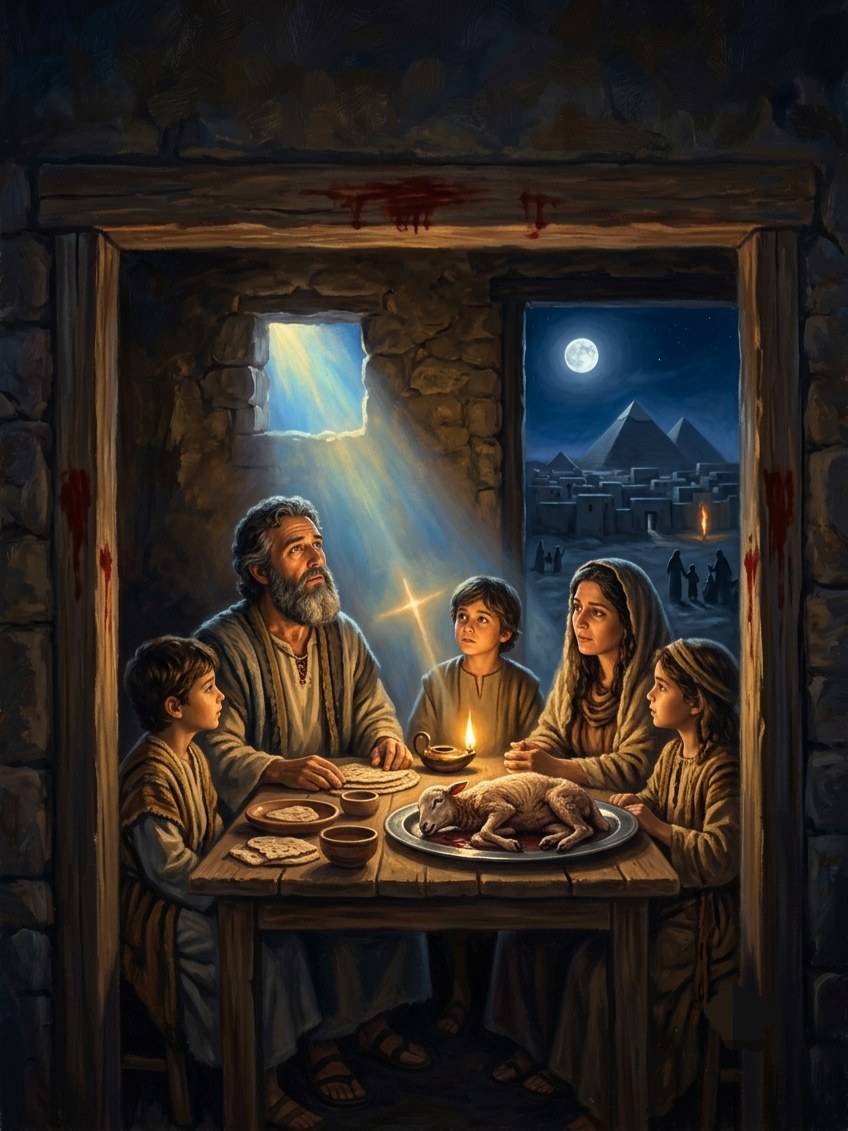
The Feast of Passover, known as Pesach in Hebrew, was instituted by the Almighty GOD in Egypt. The text says: "Speak ye unto all the congregation of Israel, saying, In the tenth day of this month they shall take to them every man a lamb, according to the house of their fathers, a lamb for an house: And if the household be too little for the lamb, let him and his neighbour next unto his house take it according to the number of the souls; every man according to his eating shall make your count for the lamb. Your lamb shall be without blemish, a male of the first year: ye shall take it out from the sheep, or from the goats: And ye shall keep it up until the fourteenth day of the same month: and the whole assembly of the congregation of Israel shall kill it in the evening. And they shall take of the blood, and strike it on the two side posts and on the upper door post of the houses, wherein they shall eat it. And they shall eat the flesh in that night, roast with fire, and unleavened bread; and with bitter herbs they shall eat it. ... And thus shall ye eat it; with your loins girded, your shoes on your feet, and your staff in your hand; and ye shall eat it in haste: it is the LORD\'S Passover. For I will pass through the land of Egypt this night, and will smite all the firstborn in the land of Egypt, both man and beast; and against all the gods of Egypt I will execute judgment: I am the LORD. And the blood shall be to you for a token upon the houses where ye are: and when I see the blood, I will pass over you, and the plague shall not be upon you to destroy you, when I smite the land of Egypt" (Ex. 12:3-8, 11-13). And the text also says: "In the fourteenth day of the first month at even is the LORD\'S Passover" (Lev. 23:5).
The word "Pesach" means skipping over or jump or leaping. It implies that when GOD came to slay the first born Egyptians, He skipped over the homes of the Israelites which were situated among the homes of the Egyptians.
The plagues of Egypt were not only chastisements inflicted to break the Pharaoh's pride, they were also judgments upon the gods of Egypt. The plagues fell on the principal divinities that were worshipped since times immemorial in the Nile valley. The river was a god. It became loathsome to its worshippers. The frog was venerated as a sign of fruitfulness, and it was turned into a horror. The cattle, the sacred ram, the sacred goat, the sacred bull -- were all smitten. The sacred beetle became a torment to those who put their trust in its divinity. When we add to these, the plague of darkness, which showed the eclipse of Ra, the sun god, we see that we have here a contrast between the GOD of Israel, the LORD of the Universe, and the senseless idols of a senile civilization; as it is written (Ex. 12:12), "against all the gods of Egypt I will execute judgment: I am the LORD." (Dr. J.H. Herz.
The plague of the death of the first born of man and beast was the tenth plague and sealed GOD's chastisement. Israel was redeemed and saved from this plague by the blood of sheep and goat, for as the text says: "And the blood shall be to you for a token upon the houses where ye are: and when I see the blood, I will pass over you, and the plague shall not be upon you to destroy you, when I smite the land of Egypt" (Ex. 12:13). What manner of blood! The Almighty skipped over the houses of the Israelites when the plague was delivered upon Egypt. The children of Israel were spared by the angel of death, under the leadership of Moses.
The Pharoah's first born was also smitten by the plague, for the text says: "And it came to pass, that at midnight the LORD smote all the firstborn in the land of Egypt, from the firstborn of Pharaoh that sat on his throne unto the firstborn of the captive that was in the dungeon; and all the firstborn of cattle" (Ex. 12:29). The Pharoah bade Moses and Aaron: "Rise up, and get you forth from among my people, both ye and the children of Israel; and go, serve the LORD, as ye have said. Also take your flocks and your herds, as ye have said, and be gone; and bless me also" (Verses 31-32). Israel then marched out of Egypt while the Egyptians buried their dead, for the text says: "And they departed from Rameses in the first month, on the fifteenth day of the first month; on the morrow after the Passover the children of Israel went out with an high hand in the sight of all the Egyptians. For the Egyptians buried all their firstborn, which the LORD had smitten among them: upon their gods also the LORD executed judgments" (Num. 33:3-4). The Almighty GOD saved Israel and redeemed her from slavery to freedom.
Chapter 3: WHAT PASSOVER MEANS TO ISRAEL
Passover celebrates the redemption of Israel from Egyptian slavery. It means life, for a slave has no life. He exists as the tool of his master who determines how he shall think, act and how long he shall live. Only the free have life.
Passover means the pursuit of justice. Unless each member of society actively pursues the happiness of every other member, none is happy. The outcry of the disinherited will turn into rebellion; and happiness rooted in peace will varnish.
On Passover, the Jewish people were made into a nation. Passover therefore, marks the birth of Israel as a people and their emergence as a nation. They were granted freedom, not merely from slavery but for the task of establishing justice in their midst and to set an example to the nations.
Israel was called to place all her actions under GOD's direction by reason of the redemption from Egyptian bondage. The text says: "I am the LORD thy GOD, which have brought thee out of the land of Egypt, out of the house of bondage" (Ex. 20:2). That is the first sentence of the Ten Commandments. This call is repeated endlessly in the Torah and the Commandment of Tzitzit (Tallit) is also linked to this reminder thus: "I am the LORD your GOD, which brought you out of the land of Egypt, to be your GOD: I am the LORD your GOD" (Num. 15:41).
And when the Torah speaks of the treatment of strangers or of ethics in business practice, it again makes reference to Egypt and to the lesson of the redemption from bondage. The text says: "And if a stranger sojourn with thee in your land, ye shall not vex him. But the stranger that dwelleth with you shall be unto you as one born among you, and thou shalt love him as thyself; for ye were strangers in the land of Egypt: I am the LORD your GOD. Ye shall do no unrighteousness in judgment, in meteyard, in weight, or in measure. Just balances, just weights, a just ephah, and a just hin, shall ye have: I am the LORD your GOD, which brought you out of the land of Egypt" (Lev. 19:33-36).
Israel is free but bonded only to GOD, for the text says: "For they are my servants, which I brought forth out of the land of Egypt: they shall not be sold as bondmen.... For unto me the children of Israel are servants; they are my servants whom I brought forth out of the land of Egypt: I am the LORD your GOD" (Lev. 25:42, 55).
An Israelite is warned not to profane the name of GOD (chillul Hashem), and enjoined to hallow His name (Kiddush Hashem) by his life and, if need be, by his death. Although spoken in reference to Priests as the appointed guardians of the sanctuary, this injunction, both in its positive and negative forms, applies to the whole of Israel. The text says: "Neither shall ye profane my holy name; but I will be hallowed among the children of Israel: I am the LORD which hallow you, That brought you out of the land of Egypt, to be your GOD: I am the LORD" (Lev. 22:32-33). In any event, GOD refers to Israel as a kingdom of Priests, for the text says: "And ye shall be unto me a kingdom of priests, and an holy nation...." (Ex. 19:6).
The Feast of Passover is known by three names, each of which expresses the unique aspects of the day:
- Z'man Cherusainu -- The time of Israelite freedom: The Feast is a commemoration of the liberation of the children of Israel (Bnei Yisrael) from slavery in Egypt over three thousand years ago.
2. Peasch: As notes earlier, the Hebrew word for "Pesach" means to skip, leap or to jump, because the Almighty GOD jumped over or leaped or skipped over the houses of the children of Israel when the tenth plague in which in which the first born in every Egyptian home died, and the children of Israel were spared. Pesach also refers to the Paschal ram (korban Pesach) that was slaughtered on the 14th day of Abib (Nisan) and eaten on the night of the 15th Abib.
3. Chag Ha Matzohs -- The Festival of Matzoh: The Feast is commonly called the Festival of Pesach (Chag Ha Pesach) when it is called Festival of Unleavened Bread (Chag Ha Matzohs) in the Torah. For instance, the text says: "Thou shalt keep the feast of unleavened bread: (thou shalt eat unleavened bread seven days, as I commanded thee, in the time appointed of the month Abib; for in it thou camest out from Egypt: and none shall appear before me empty:)" (Ex. 23:15). The text says: "The feast of unleavened bread shalt thou keep. Seven days thou shalt eat unleavened bread, as I commanded thee, in the time of the month Abib: for in the month Abib thou camest out from Egypt" (Ex. 34:18). And the text says: "And on the fifteenth day of the same month is the feast of unleavened bread unto the LORD: seven days ye must eat unleavened bread" (Lev. 23:6). This is because the children of Israel mention the praise of Hashem (GOD) who stepped over their houses in Egypt and saved them from the angel of death. They therefore, call the Feast the Festival of Pesach (Chag Ha Pesach). The Torah calls it Festival of Unleavened Bread to emphasize the redemption of the children of Israel in general. The Commandment to eat unleavened bread also symbolizes the redemption -- their dough did not have time to rise until our fathers were redeemed from Egypt. Until the redemption, Israel believed in GOD's providence over everything. But after Israel was freed from the bondage of Egypt, it became a reality for all. That the children of Israel are a chosen people is based on this foundation. Israel must represent the Torah and carry the responsibility for fulfilling its Commandments. This is implicit in the first of the ten Commandments in which the Almighty GOD says: "I am the LORD thy GOD, which have brought thee out of the land of Egypt, out of the house of bondage" (Ex. 20:2). To underscore the importance of the Passover, there is a second Passover (Pesach Sheni), an opportunity afforded to those who were unable to celebrate the Passover on 14th Abib by reason of defilement or being on a journey. Pesach Sheni holds on 14th Ziv. The text says" "And the LORD spake unto Moses, saying, Speak unto the children of Israel, saying, If any man of you or of your posterity shall be unclean by reason of a dead body, or be in a journey afar off, yet he shall keep the Passover unto the LORD.
The fourteenth day of the second month at even they shall keep it, and eat it with unleavened bread and bitter herbs. They shall leave none of it unto the morning, nor break any bone of it: according to all the ordinances of the Passover they shall keep it. But the man that is clean, and is not in a journey, and forbeareth to keep the Passover, even the same soul shall be cut off from among his people: because he brought not the offering of the LORD in his appointed season, that man shall bear his sin. And if a stranger shall sojourn among you, and will keep the Passover unto the LORD; according to the ordinance of the Passover, and according to the manner thereof, so shall he do: ye shall have one ordinance, both for the stranger, and for him that was born in the land" (Num. 9:9-14).
Chapter 4: REGULATIONS CONCERNING EATING THE PASSOVER LAMB
The lamb is to be roasted with fire and not boiled or cooked. It is to be eaten on the night of 15th Abib with unleavened bread and bitter herbs, and with one's loins girded, shoes on one's feet and with one's staff in his hand. It must be eaten in haste. In eating the meat, care must be taken not to break ant bone of it. The meat is not to be taken out of the place where it is being eaten and nothing of the meat shall remain until the morning. Whatever remains of it shall be burnt with fire. The text says: "And they shall eat the flesh in that night, roast with fire, and unleavened bread; and with bitter herbs they shall eat it. Eat not of it raw, nor sodden at all with water, but roast with fire; his head with his legs, and with the purtenance thereof" (Ex. 12:8-9). The text says: "And thou shalt roast and eat it in the place which the LORD thy GOD shall choose: and thou shalt turn in the morning, and go unto thy tents" (Deut. 16:7). The text says: "And thus shall ye eat it; with your loins girded, your shoes on your feet, and your staff in your hand; and ye shall eat it in haste: it is the LORD\'S Passover" (Ex. 12:11). The text says: "In one house shall it be eaten; thou shalt not carry forth ought of the flesh abroad out of the house; neither shall ye break a bone thereof" (Ex. 12:46). And the text says: "And ye shall let nothing of it remain until the morning; and that which remaineth of it until the morning ye shall burn with fire" (Ex. 12:10). See also Ex. 34:25.
Because the lamb is symbolic of Yahshua, we find the following record about him: "But when they came to Jesus, and saw that he was dead already, they brake not his legs: ...For these things were done, that the scripture should be fulfilled, A bone of him shall not be broken" (Jn. 19:33, 36). See also Ps. 34:20.
While it would appear that no other meal is to be eaten alongside or after the Paschal meal, the record in 2nd Chronicles suggests otherwise. Cooked food may be eaten alongside, for the text says: "And they roasted the Passover with fire according to the ordinance: but the other holy offerings sod they in pots, and in caldrons, and in pans, and divided them speedily among all the people" (2 Chron. 35:13).
That was the Passover celebrated in the time of King Josiah of Judah in respect of which the Scriptures say: "And there was no Passover like to that kept in Israel from the days of Samuel the prophet; neither did all the kings of Israel keep such a Passover as Josiah kept, and the priests, and the Levites, and all Judah and Israel that were present, and the inhabitants of Jerusalem. In the eighteenth year of the reign of Josiah was this Passover kept" (Verses 18-19).
Unleavened bread (Matzah) is the only grain product permitted to be eaten on Passover. Its ingredients are water and flour without additives -- no sugar, salt, butter, sardines, ginger, oil etc.
The Torah ordains that we tell the tale of the exodus to our children, thus drawing them into the stream of Israelite experience. Parents and Teachers are to make every effort to re-enact this historical event every year, for history is not a lesson of things long past, but the re-enactment of historical events to bring the past to the present.
The story of the exodus is most appropriately told to the children at the Passover supper table. The text says: "And thou shalt shew thy son in that day, saying, This is done because of that which the LORD did unto me when I came forth out of Egypt. ... And it shall be when thy son asketh thee in time to come, saying, What is this? That thou shalt say unto him, By strength of hand the LORD brought us out from Egypt, from the house of bondage ... And it shall be when thy son asketh thee in time to come, saying, What is this? That thou shalt say unto him, By strength of hand the LORD brought us out from Egypt, from the house of bondage: And it came to pass, when Pharaoh would hardly let us go, that the LORD slew all the firstborn in the land of Egypt, both the firstborn of man, and the firstborn of beast: therefore I sacrifice to the LORD all that openeth the matrix, being males; but all the firstborn of my children I redeem" (Ex. 13:8, 14-15). The text says: "And it shall come to pass, when your children shall say unto you, What mean ye by this service? That ye shall say, It is the sacrifice of the LORD\'S Passover, who passed over the houses of the children of Israel in Egypt, when He smote the Egyptians, and delivered our houses. And the people bowed the head and worshipped" (Ex. 12:26-27). See also Ex. 10:2.
Chapter 5: WHERE IS THE PASSOVER LAMB TO BE SLAUGHTERED?
It is written: "Thou mayest not sacrifice the Passover within any of thy gates, which the LORD thy GOD giveth thee: But at the place which the LORD thy GOD shall choose to place His name in, there thou shalt sacrifice the Passover at even, at the going down of the sun, at the season that thou camest forth out of Egypt. And thou shalt roast and eat it in the place which the LORD thy GOD shall choose: and thou shalt turn in the morning, and go unto thy tents" (Deut. 16:5-7).
It follows that the Passover could be offered only in the Temple and be eaten only in the holy city by the pilgrims who returned to their camp the next day.
Modern day Israel no longer offer sacrifices as a result of the destruction of the second Temple in 70 AD. The Dome of the Rock (Mosque of Omar) and Al Aqsa Mosques now stand at the Temple site in Jerusalem. Many Jewish families today carefully refrain from eating even any roasted meat on Passover supper night (Seder), to avoid even the impression that they are partaking of an imitation. This is why chicken, which was never used as a sacrifice in the Temple, is often eaten on Seder night and a symbolic shank bone (a reminder of the ancient Passover sacrifice) is placed in the Seder plate alongside unleavened bread (matzah) and bitter herbs (Merorim). Horseradish is often used as Maror.
Following the Prophecies of Isaiah and Malachi regarding the future establishment of the altar of GOD and offering of sacrifices in the Gentile world, it is consistent with Scripture that the celebration of the Feast of Passover and performance of all its rites as commanded by GOD is possible even today. In Nigeria, as in all other gentile nations where there are Torah observant congregations, there is nothing wrong with observance of the Feast of Passover and all its rites as they do other appointed Festivals of the Almighty GOD of Abraham, Isaac and Jacob enumerated in Leviticus 23, including the New moons at the place of their meeting with GOD Almighty. Many such congregations have erected altars where animal sacrifices are offered to the GOD by Levitical Priests, as directed by Him.
It is written in prophecy: "In that day shall there be an altar to the LORD in the midst of the land of Egypt, and a pillar at the border thereof to the LORD. And it shall be for a sign and for a witness unto the LORD of hosts in the land of Egypt: for they shall cry unto the LORD because of the oppressors, and he shall send them a saviour, and a great one, and he shall deliver them. And the LORD shall be known to Egypt, and the Egyptians shall know the LORD in that day, and shall do sacrifice and oblation; yea, they shall vow a vow unto the LORD, and perform it" (Isa. 19:19-21).
It is also written: "For from the rising of the sun even unto the going down of the same my name shall be great among the Gentiles; and in every place incense shall be offered unto my name, and a pure offering: for my name shall be great among the heathen, saith the LORD of hosts" (Mal. 1:11).
It would be kept in mind that Passover/Unleavened Bread is one of the three pilgrimage festivals, for the text says: "Three times thou shalt keep a feast unto me in the year. Thou shalt keep the feast of unleavened bread: (thou shalt eat unleavened bread seven days, as I commanded thee, in the time appointed of the month Abib; for in it thou camest out from Egypt: and none shall appear before me empty" (Ex. 23:14-15). And it says: "And thou shalt observe the feast of weeks, of the firstfruits of wheat harvest, and the feast of ingathering at the year\'s end. Thrice in the year shall all your men children appear before the Lord GOD, the GOD of Israel" (Ex. 34:22-23). It further says: "Three times in a year shall all thy males appear before the LORD thy GOD in the place which he shall choose; in the feast of unleavened bread, and in the feast of weeks, and in the feast of tabernacles: and they shall not appear before the LORD empty" (Deut. 16:16).
Chapter 6: WHEN IS THE PASSOVER LAMB TO BE SLAUGTHERED?
It is written: "You are to keep it until the fourteenth day of the month, and then the entire assembly of the community of Isra'el will slaughter it at dusk" (Ex. 12:6, Complete Jewish Bible, CJB). This is interpreted to mean "between the evenings."
According to the Talmud, the "first evening" is the time in the afternoon when the heat of the sun begins to decrease, about 3 o'clock; and the "second evening" commences with sunset. The first century A.D. Jewish historian, Josephus records that the Passover sacrifice "was offered from the ninth to the eleventh hour," that is, between 3pm and 5pm. Hence it is related by Mathew regarding Yahshua the Passover Lamb: "At about three, Yeshua uttered a loud cry, "Eli! Eli! L'mah sh'vaktani? (My GOD! My GOD! Why have you deserted me?)" On hearing this, some of the bystanders said, "He's calling for Eliyahu." Immediately one of them ran and took a sponge, soaked it in vinegar, put it on a stick and gave it to him to drink. The rest said, "Wait! Let's see if Eliyahu comes and rescues him." But Yeshua, again crying out in a loud voice, yielded up his spirit" (Matt. 27:46-50, CJB).
This is the same time for the evening oblation when the Apostles of Yahshua went to the Temple, for the text says: "One afternoon at three o'clock, the hour of minchah prayers, as Kefa (Peter) and Yochanan (John) were going up to the Temple" (Acts 3:1, CJB).
It is reported that some Shabbat keeping congregations observe the Festival of Pesach (Passover) on 14th January of every year. Others are reported to observe it on 14th April. Just how wrong they can be! Those who observe it on 14th January are as wrong as those who observe it on 14th April. It is an error.
All of GOD's appointed Feasts are based on His own calendar which He revealed to Israel (Ex. 12:1-2). The Feast of Pesach is appointed for 14th Abib which is the first of GOD's revealed liturgical months.
14th January and 14th April do not follow GOD's calendar. They follow the Roman Gregorian calendar which has nothing to do with GOD's appointed Feasts. It is a work of error. It is the problem of ignorance. I want to think that those who keep 14th April do so supposing that because the month of Abib falls somewhere between March and April, the 14th day spoken of by GOD must be in April. It is not so.
To be put right, one must turn to the Jews who have to date, maintained GOD's calendar bequeathed to them by the fathers who received the calendar since the time of Moses the faithful servant of GOD. Nowhere in the entire religious Jewish world is the Feast of Passover celebrated on 14th April as a fixed date. 14th Abib can fall on any day depending on whether it is a regular year or a leap year.
14th January is worse. The month of January falls within the 10th or eleventh month of the Jewish calendar and to celebrate the feast of Passover then is completely misplaced. January is Winter time and Abib is Spring time.
The text says: "There is a way which seemeth right unto a man, but the end thereof are the ways of death" (Prov. 14:12). See also 16:25. When you celebrate GOD's feast in your own contrived time and calendar and not according to GOD's own appointed time in His calendar, your celebration is no different from that of Jeroboam who changed GOD's Feast of Sukkot (Tabernacles) from the 15th day of the month of Ethanim (Tishrei) to the 15th day of the month of Bul (Cheshvan) and it became a great sin before GOD, for the text says: "And Jeroboam ordained a feast in the eighth month, on the fifteenth day of the month, like unto the feast that is in Judah, and he offered upon the altar. So did he in Bethel, sacrificing unto the calves that he had made: and he placed in Bethel the priests of the high places which he had made. So he offered upon the altar which he had made in Bethel the fifteenth day of the eighth month, even in the month which he had devised of his own heart; and ordained a feast unto the children of Israel: and he offered upon the altar, and burnt incense" (1 Kgs. 12:32-33).
GOD does indeed look at the heart. He judges intention. Nevertheless, when a person sins out of ignorance, he is guilty before GOD. Ignorance is not a defence before Him, for the text says: "And if a soul sin, and commit any of these things which are forbidden to be done by the commandments of the LORD; though he wist it not, yet is he guilty, and shall bear his iniquity" (Lev. 5:17). See also Lev. 4:2, 13, 22, 27.
Chapter 7: WHY CELEBRATE PASSOVER TODAY?
The Feast of Passover is celebrated today by GOD's Covenant children because its continuous celebration is expressly and clearly commanded by Ha Kadosh Baruch Hu, the Infinite One. It is written: "And this day shall be unto you for a memorial; and ye shall keep it a feast to the LORD throughout your generations; ye shall keep it a feast by an ordinance forever" (Ex. 12:14).
It is also written: "And ye shall observe the feast of unleavened bread; for in this selfsame day have I brought your armies out of the land of Egypt: therefore shall ye observe this day in your generations by an ordinance forever. In the first month, on the fourteenth day of the month at even, ye shall eat unleavened bread, until the one and twentieth day of the month at even. Seven days shall there be no leaven found in your houses: for whosoever eateth that which is leavened, even that soul shall be cut off from the congregation of Israel, whether he be a stranger, or born in the land. Ye shall eat nothing leavened; in all your habitations shall ye eat unleavened bread. Then Moses called for all the elders of Israel, and said unto them, Draw out and take you a lamb according to your families, and kill the Passover. And ye shall take a bunch of hyssop, and dip it in the blood that is in the bason, and strike the lintel and the two side posts with the blood that is in the bason; and none of you shall go out at the door of his house until the morning. For the LORD will pass through to smite the Egyptians; and when he seeth the blood upon the lintel, and on the two side posts, the LORD will pass over the door, and will not suffer the destroyer to come in unto your houses to smite you. And ye shall observe this thing for an ordinance to thee and to thy sons forever" (Verses 17-24). And the text further says: "These are the feasts of the LORD, even holy convocations, which ye shall proclaim in their seasons. In the fourteenth day of the first month at even is the LORD\'S Passover" (Lev. 23:4-5).
Celebration of the Passover was not a one-time event therefore. This accounts for its celebration through the ages as is clear in the Scriptures. A few examples of post- Egypt celebration of the Feast would do:
Joshua celebrated it in the promised land, for the text says: "And the children of Israel encamped in Gilgal, and kept the Passover on the fourteenth day of the month at even in the plains of Jericho. And they did eat of the old corn of the land on the morrow after the Passover, unleavened cakes, and parched corn in the selfsame day" (Josh. 5:10-11).
After the Apostasy of Israel, king Hezekiah of Judah celebrated it in the second month (14th Ziv), for the text says: "Then they killed the Passover on the fourteenth day of the second month: and the priests and the Levites were ashamed, and sanctified themselves, and brought in the burnt offerings into the house of the LORD" (2 Chron. 30:15).
King Josiah celebrated it as noted already and for the sake of emphasis, the text says: "And there was no Passover like to that kept in Israel from the days of Samuel the prophet; neither did all the kings of Israel keep such a Passover as Josiah kept, and the priests, and the Levites, and all Judah and Israel that were present, and the inhabitants of Jerusalem. In the eighteenth year of the reign of Josiah was this Passover kept" (2 Chron. 35:18-19).
The Passover was celebrated by the children of Judah upon their return from the Babylonian captivity, for the text says: "And the children of the captivity kept the Passover upon the fourteenth day of the first month. For the priests and the Levites were purified together, all of them were pure, and killed the Passover for all the children of the captivity, and for their brethren the priests, and for themselves. And the children of Israel, which were come again out of captivity, and all such as had separated themselves unto them from the filthiness of the heathen of the land, to seek the LORD GOD of Israel, did eat, And kept the Feast of unleavened bread seven days with joy: for the LORD had made them joyful, and turned the heart of the king of Assyria unto them, to strengthen their hands in the work of the house of GOD, the GOD of Israel" (Ezra 6:19-22).
Chapter 8: YAHSHUA CELEBRATED THE PASSOVER
Other than instances of the celebration of the Feast as a boy as the text says: "Now his parents went to Jerusalem every year at the feast of the Passover. And when he was twelve years old, they went up to Jerusalem after the custom of the feast" (Lk. 2:41-42), Yahshua had a history of celebrating the Feast as an adult. The text says: "And the Jews\' Passover was at hand, and Jesus went up to Jerusalem, And found in the temple those that sold oxen and sheep and doves, and the changers of money sitting: And when he had made a scourge of small cords, he drove them all out of the temple, and the sheep, and the oxen; and poured out the changers\' money, and overthrew the tables; And said unto them that sold doves, Take these things hence; make not my Father\'s house an house of merchandise. And his disciples remembered that it was written, The zeal of thine house hath eaten me up. Then answered the Jews and said unto him, What sign shewest thou unto us, seeing that thou doest these things? Jesus answered and said unto them, Destroy this temple, and in three days I will raise it up. Then said the Jews, Forty and six years was this temple in building, and wilt thou rear it up in three days? But he spake of the temple of his body. When therefore he was risen from the dead, his disciples remembered that he had said this unto them; and they believed the scripture, and the word which Jesus had said. Now when he was in Jerusalem at the Passover, in the Feast day, many believed in his name, when they saw the miracles which he did" (Jn. 2:13-23).
At the Passover of his impalement, we have the following record: "Then came the day of Unleavened bread, when the Passover must be killed. And he sent Peter and John, saying, Go and prepare us the Passover, that we may eat. And they said unto him, Where wilt thou that we prepare? And he said unto them, Behold, when ye are entered into the city, there shall a man meet you, bearing a pitcher of water; follow him into the house where he entereth in. And ye shall say unto the goodman of the house, The Master saith unto thee, Where is the guestchamber, where I shall eat the Passover with my disciples? And he shall shew you a large upper room furnished: there make ready. And they went, and found as he had said unto them: and they made ready the Passover. And when the hour was come, he sat down, and the twelve Apostles with him. And he said unto them, With desire I have desired to eat this Passover with you before I suffer: For I say unto you, I will not any more eat thereof, until it be fulfilled in the kingdom of GOD" (Lk. 22:7-16).
Yahshua then proceeded to perform a ceremony in which he blessed wine and bread and his disciples shared and partook of same. This is popularly called the last supper. The text says: "And he took the cup, and gave thanks, and said, Take this, and divide it among yourselves: For I say unto you, I will not drink of the fruit of the vine, until the kingdom of GOD shall come. And he took bread, and gave thanks, and brake it, and gave unto them, saying, This is my body which is given for you: this do in remembrance of me. Likewise also the cup after supper, saying, This cup is the new testament in my blood, which is shed for you" (Verses 17-20). See also Mk. 14:22-25; Matt. 26:26-29. It is clear that the Paschal meat was prepared and was on the table while Yahshua blessed the wine and the bread. The meal was on the table when he expressed his desire to eat it.
Yahshua also performed a ceremony of washing the feet of his disciples, which is a lesson in humility. The text says: "So after he had washed their feet, and had taken his garments, and was set down again, he said unto them, Know ye what I have done to you? Ye call me Master and Lord: and ye say well; for so I am. If I then, your Lord and Master, have washed your feet; ye also ought to wash one another\'s feet. For I have given you an example, that ye should do as I have done to you" (Jn. 13:12-15).
Yahshua's statement as highlighted above clearly shows that the Passover will be celebrated continually until its fulfillment as a Feast of redemption is realized in GOD's kingdom where it shall be celebrated no more.
Egypt means "Sin" spiritually, and Pharoah symbolizes Satan, the father of sin. It is sin that bring GOD's Covenant children into captivity. As much as they are told that they are in the world but are not of the world, for the text says: "I have given them thy word; and the world hath hated them, because they are not of the world, even as I am not of the world. I pray not that thou shouldest take them out of the world, but that thou shouldest keep them from the evil. They are not of the world, even as I am not of the world" (Jn. 17:14-16). And yet, they remain in this present world where sin dwells. They are still in Egypt, a world where they continue to contend with sin and must needs be redeemed every year. We are told that there is none righteous, no, not one. The text says: "But the scripture hath concluded all under sin, that the promise by faith of Jesus Christ might be given to them that believe" (Gal.3:22). And it is said: "...They are corrupt, they have done abominable works, there is none that doeth good. The LORD looked down from heaven upon the children of men, to see if there were any that did understand, and seek GOD. They are all gone aside, they are all together become filthy: there is none that doeth good, no, not one" (Ps. 14:1-3). See also Rom. 3:10). A Covenant child is still in captivity, if even for ignorant sins, for sin is sin, whether deliberate or indeliberate, for the text says: "And if a soul sin, and commit any of these things which are forbidden to be done by the commandments of the LORD; though he wist it not, yet is he guilty, and shall bear his iniquity" (Lev. 5:17).
Chapter 9: THE EARLY CHURCH AND THE PASSOVER
The LORD'S Feast of Passover continued to be celebrated by the Apostles of Yahshua and the early church after the resurrection of Yahshua and ascension to heaven. We find the following record in the King James version of the Acts of the Apostles: "Now about that time Herod the king stretched forth his hands to vex certain of the church. And he killed James the brother of John with the sword. And because he saw it pleased the Jews, he proceeded further to take Peter also. (Then were the days of unleavened bread.) And when he had apprehended him, he put him in prison, and delivered him to four quaternions of soldiers to keep him; intending after Easter to bring him forth to the people" (Acts 12:1-4).
In the GOOD NEWS TRANSLATION, the same text is rendered thus: "About this time, king Herod began to persecute some members of the church. He had James, the brother of John, put to death by the sword. When he saw that this pleased the Jews, he went on to arrest Peter. (This happened during the time of the Festival of Unleavened Bread). After his arrest, Peter was put in jail, where he was handed over to be guarded by four groups of four soldiers each. Herod planned to put him on trial in public after Passover" (Acts 12:1-4, GNT).
In both translations, the premise of the text is the Feast of Unleavened Bread, also called the Passover. Easter was an unfortunate import from nowhere. The translation was rendered incorrectly in the King James Version therefore.
As would be made clearer, the early church, consisting of the Apostles, other Jews and proselytes (Gentile Converts) celebrated all of GOD's appointed Feasts (Festivals) as enumerated in Lev. 23. The event described in the above-quoted text (Acts 12:1-4) took place many years after the death, resurrection and ascension of Yahshua. Easter is not one of them and it is nowhere commanded by GOD. No verse in the Bible authorizes the celebration of Easter because it is not commanded in the Law of GOD.
Easter is not the same thing as Passover/Unleavened Bread. The names can therefore, not be used interchangeably. While Easter is celebrated on the first Sunday after the full moon following the vernal spring equinox, the Passover can fall on any day as long as it is on the 14th Abib. In the verse quoted above, the word translated "Easter" is the Greek word "Pascha" (derived from the Hebrew word "Pesach". It always means "Passover" as there is no original Greek word for Passover. To vindicate my position, other Bible versions such as GNT, Revised Standard Version etc., correctly rendered this word "Passover." The New International Version (NIV) translation of Acts 12:1-4 is essentially the same as the GNT.
The Feast of Unleavened Bread is also mentioned in Acts 20, for the text says: "And we sailed away from Philippi after the days of unleavened bread, and came unto them to Troas in five days; where we abode seven days" (Acts 20:6). And in the Apostle Paul's Epistle (Letter) to the Corinthian Assembly, we have the following record: "Your glorying is not good. Know ye not that a little leaven leaveneth the whole lump? Purge out therefore the old leaven, that ye may be a new lump, as ye are unleavened. For even Christ our Passover is sacrificed for us: Therefore let us keep the feast, not with old leaven, neither with the leaven of malice and wickedness; but with the unleavened bread of sincerity and truth" (1 Cor. 5:6-8).
The record in his Epistle to the Colossians is an allusion to its celebration by the Colossian Assembly, for the text says: "Let no man therefore judge you in meat, or in drink, or in respect of an holyday, or of the new moon, or of the Sabbath days: Which are a shadow of things to come; but the body is of Christ" (Col. 2:16-17). There can be no clearer evidence that the Feast was being celebrated by the people of GOD after the death of Yahshua. It is little wonder that the church was mired in controversy with the rise to prominence, of the church of Rome and the importation by Rome, of pagan traditions into true GOD worship, in an attempt to grow in influence, not only religiously, but politically, thus rendering Christianity syncretistic. The Passover was the subject of one of such unfortunate controversies.
There is a near consensus of report by Church historians that the Apostles of Yahshua and the early Churches founded by them had a history of celebrating the Lev. 23 Feasts of GOD as other Jews and Gentile proselytes. See for example, Hans Kuung: "Christianity, Essence, History and Future," P.71.
In the Encyclopedia Britannica, 11th Ed, Vol. 8, P. 828, we read: "There is no indication of the observance of the Easter Festival in the New Testament, or in the writings of the Apostolic fathers... The first Christians continued to observe the Jewish Festivals (GOD's Festivals of Lev. 23) though in a new spirit, as commemoration of events which those Festivals foreshadowed. Thus the Passover with a new conception added to it, of Christ as the Paschal lamb, continued to be observed." Hence the statement by the Apostle Paul: For even Christ our Passover is sacrificed for us" (1 Cor. 5:7).
Chapter 10: THE QUARTODECIMAN CONTROVERSY
Radical changes occurred in the Jewish world beginning with the first Jewish revolt against Rome (66-70 AD), when various repressive measures -- military, political and fiscal -- were imposed by the Romans upon the Jews, on account of the Jewish resurgent nationalism which exploded in violent uprisings in places such as Mesopotamia, Cyrenaica, Palestine, Egypt and Cyprus. Before then, Emperor Nero had distinguished mainstream Jews from those who believed in Yahshua as Messiah (called Messianic Jews or Jewish Christians) when he placed the charge of arson exclusively on them (Jewish Christians).
Emperor Vespasian (69-79 AD) abolished the Sanhedrin and the office of the High Priest, and later, Emperor Hadrian (117-138 AD) outlawed the practice of the Jewish religion altogether throughout the empire. The Jews were subjected to a discriminatory tax (the Fiscus Judaicus) which was introduced by Vespasian and increased first by Emperor Domitian (81 -- 96 AD), and later by Emperor Hadrian.
According to the historian, Suetonius (about 70-122 AD), the Fiscus Judaicus was exacted for the temple of Jupiter capitolinus even from those "who without publicly acknowledging that faith yet lived as Jews."
According to Appian, a contemporary historian, the Jews were subjected at that time, to a "poll tax ... heavier than that imposed upon the surrounding people."
In the Talmud, it is contained a sample of Hadrian's anti-Jews policies: "The Government of Rome had issued a decree that they should not study the Torah and that they should not circumcise their sons and that they should profane the Sabbath."
These repressive anti-Jews policies encouraged the production of a whole body of\ "Christian" Against the Jews -- Adversus Judaeos -- literature, advocating separation from and contempt for the Jews. A practical outcome of this development was the substitution of characteristic Jewish Festivals such as Passover and the Shabbat with Easter Sunday and Weekly Sunday.
The church of Rome was the epicenter of this development where theological, social and liturgical measures were taken to wean Christians away from Jewish religious observances. The Jews were reviled racially and culturally, as indicated by the contemptuous anti-Jewish literary comments of such writers as Seneca, Persius, Petronius, Quintillian, Martial, Plutarch, Juvenal and Tacitus, all of whom lived in Rome during most of their professional lives. The mounting hostility of the Roman populace against the Jews forced Titus, though unwillingly, to ask the Jewess Berenice, sister of Herod the younger, whom he wanted to marry, to leave Rome. The scarcity of documents and the controversial nature of their information make it difficult to determine with absolute certainty where, when and by whom Easter Sunday was first introduced. But Eusebius (about 260- 340 AD), a well- known early church historian, provides the major account of the controversy that erupted in the second century AD between the Church of Rome, which championed the celebration of Easter Sunday and the Asian Christians who defended the celebration of Passover on 14th Abib (Nisan).
Being a strong supporter of Easter Sunday celebration made official by the Council of Nicaea (325 AD), Eusebius does not hesitate to attribute it to an Apostolic origin, though citing documents which emphatically proclaim the Apostolic origin of the Quartodeciman Passover, namely the two significant letters of Polycarp and Irenaeus. The portion of the letter of Irenaeus quoted by Eusebius rather suggests that Easter Sunday originated in the early part of the second century AD. This is implied by Irenaeus' appeal to Bishop Victor of Rome (about 189-199 AD) to emulate his predecessors namely "Anicetus and Pius and Hyginus and Telephorus and Sixtus, who, though they celebrated Easter on Sunday, nevertheless were at peace with those who observed it on Nisan 14."
Irenaeus' mention of Bishop Sixtus (about 116-126 AD) as the first non-observant of the Quartodeciman Passover suggests that Easter Sunday began to be celebrated in Rome about that time.
A good number of other scholars have reached the same conclusion. Henry Leclerq, for example, on the basis of Irenaeus' testimony, places the origin of Easter Sunday "toward the beginning of the second century, under the episcopate of Sixtus 1 of Rome, about the year 120 AD." Also Karl Baus does the same.
The Roman origin of Easter Sunday about the time of Sixtus is indirectly supported by Epiphanius' statement that the Easter controversy arose after the time of the exodus of the bishops of the circumcision from Jerusalem. He made specific reference to the fifteen Judeo-Christian bishops who until 135 AD practiced the quartodeciman Passover, since they based themselves on a document known as the "Apostolic Constitution" where the following rule is given: "You shall not change the calculation of time, but you shall celebrate it at the same time as your brethren who came out from the circumcision. With them observe the Passover."
A similar injunction is found in the Didascalia Apostolorum 21, 17. Such an exodus was ordered by Emperor Hadrian in 135 AD after crushing the second Jewish revolt led by Simon Bar Kokhbar. As noted earlier, the Emperor adopted a policy of radical repression of Jewish rites and customs. To avoid such repressive measures, Bishop Sixtus took steps to substitute characteristic Jewish Festivals such as the Passover with Easter Sunday. Easter Sunday was introduced a few years later in Jerusalem by the new Greek bishops who replaced the Jewish Christian leaders and they met the resistance of those who stuck to the Apostolic tradition and were not prepared to accept such a change.
In his work "Ecclesiastical History," Book V, Chapters XXiii and XXiV, Eusebius wrote: "A question of no small importance arose at that time. For the parishes of all Asia, as from an older tradition, held that the fourteenth day of the moon, on which day the Jews were commanded to sacrifice the lamb, should be observed as the Feast of the Saviour's Passover ... The bishops of Asia, led by Polycrates, decided to hold to the old custom handed down to them. He, himself, in a letter which he addressed to Victor and the Church of Rome, set forth in the following words the tradition which had come down to him: 'We observe the exact day, neither adding, nor taking away. For in Asia also great lights have fallen asleep, which shall rise again on the day of the Lord's coming, when he shall come with glory from heaven, and shall seek out all the saints. Among these are Philip, one of the twelve Apostles ... and, moreover, John, who was both a witness and a teacher, who reclined upon the bosom of the Lord ... and Polycarp in Smyrna, who was a bishop and martyr, and Thraseas, bishop and martyr from Eumenia ... the bishop and martyr Sagaris ...the blessed Papirius or Melito. All these observed the fourteenth day of the Passover according to the gospel, deviating in no respect, but following the rule of faith.'"
The 1967 Catholic Encyclopedia states: "Quartodeciman, a term used to describe the practice in the early Church of celebrating Easter on 14th of Nisan (die quarta decima), the day of the Jewish Passover (Ex. 12:6). Quartodecimanism, prevalent in Asia Minor and Syria in the second century, emphasized the death of Christ, the true Paschal victim (John 18:28; 19:42), while Roman practice emphasized the observance of Sunday as the day of resurrection. Implicit in these two positions is the disputed chronology of the holy week. As Christianity separated from Judaism, Gentile Christians objected to observing the principal Christian feasts on the same day as the Jewish Passover. Roman efforts to induce the Quartodecimans to abandon their practice were unsuccessful. On a visit to Rome (155 AD), St. Polycarp of Smyrna amicably discussed the question with Pope Anicetus without, however, reaching agreement. Pope Victor (189-198) sought unity through a series of Synods held in both East and West, all accepted the Roman practice except the Asiatic bishops. When Victor attempted coercion by excommunication, St. Irenaeus of Lyons intervened to restore peace (Eusebius, Hist. Eccl. 5. 23-25). During the 3rd century, Quartodecimanism waned; it persisted in some Asiatic communities down to the 5th century" (Vol. 12, P.13).
History records that Polycarp was martyred on the way back from Rome (burned to death in a farm house), just days after his meeting with Anicetus over the issue of keeping Passover or Easter. He was almost certainly killed because he would not compromise regarding the proper keeping of the Passover.
The 1967 New Catholic Encyclopedia states: "Occasionally, the Quartodecimans celebrated Easter on the day that the other Christians were observing good Friday. Originally, both observances were allowed, but gradually it was felt incongruous that Christians should celebrate Easter on a Jewish Feast, and unity in celebrating the principal Christian Feast was called for" (Vol. 5, P.8). And at Page 433, we read, concluding the matter of how the Council of Nicaea "decided" for all, the matter of Easter versus Passover: "As for Easter, the fathers decreed (1). That all Christians should observe it on the same day; (2). That Jewish customs should not be followed; and (3). That the practice of the west, of Egypt, and of other Churches should remain in force, namely, of celebrating Easter on Sunday, following the first full moon after the vernal equinox."
The 1909 edition of the Catholic Encyclopedia says: "After the Pope's strong measures the Quartodecimans seemed to have gradually dwindled away. Origen, in 'Philosophumena' (Viii, Xviii) seems to regard them as a mere handful of wrongheaded non comformists. Second Phase -- The second stage of the Eastern controversy centers around the Council of Nicaea (325 AD) granting that the great Easter festival was always to be held on a Sunday, and was not to be coincident with a particular phase of the moon, which might occur on any day of the week" (Vol. 5, P. 228).
This 1909 edition, when describing the final decision at Nicaea in 325 AD, quotes the words of Emperor Constantine, writing to all the Churches: "At this meeting the question concerning the most holy day of Easter was discussed. And it was resolved by the united judgment of all present that the feast ought to be kept by all and in every place on one and the same day ... And first of all it appeared an unworthy thing that in the celebration of this most holy feast we should follow the practice of the Jews, who have impiously defiled their hands with enormous sin ... for we have received from our Saviour a different way....And I myself have undertaken that this decision should meet with the approval of your sagacities in the hope that your wisdom will gladly admit that practice which is observed at once in the city of Rome and in Africa, throughout Italy and in Egypt ... with entire unity of judgment." "The final decision always lay with accepted ecclesiastical authority ... was primarily a matter of ecclesiastical discipline and not astronomical science" (Vol. 5, P.228, 229).
It is thus clear that Church authority at Rome, not the Almighty GOD's Word, determined whether Easter or Passover would be kept. We know that Yahshua never instructed a different way as falsely claimed by the words credited to Emperor Constantine. The truth is that the Passover is always tied directly to the moon, regardless of the day of the week on which it falls.
The 14th day of Abib (Nisan) is Almighty GOD's eternal instruction (Ex. 12:1-6) as we have shown hitherto, not the nearest Sunday to this or any other date. Eventually, as the false pagan Catholic Church grew in political influence, the death penalty was imposed on anyone found keeping the Shabbat or other Festivals of GOD such as the Passover. To think of it, how could beef, disagreement or hatred for the Jews translate to the rejection of the Laws of the very GOD that the Romans claim to worship, if they meant well? And to imagine that this and many other Roman falsehood were transmitted to the world and defines Christianity is hard to fathom. The truth is that Rome represents another kingdom, not of GOD but of Satan whose paganic lawlessness opposes the kingdom of GOD.
The 11th edition of the Encyclopedia Britannica, summarizes and details the story of how Easter slowly came to replace the Passover by 325 AD within visible, organized Christianity: "Although the observance of Easter was at a very early period in the practice of the Christian Church (this is false), a serious difference as to the day for its observance soon arose between the (true) Christians of Jewish and those of Gentile descent, which led to a long and bitter controversy ...The Jewish Christians (observed) the 14th day of the moon at evening ...without regard to the day of the week. The Gentile Christians (Roman Catholics) ... identified the first day of the week with the resurrection, and kept the preceding Friday as the commemoration of the crucifixion, irrespective of the day of the month. Generally speaking, the Western Churches (Roman Catholics) kept Easter on the first day of the week, while the Eastern Churches followed the Jewish rule. Polycarp, the disciple of John the Evangelist (last of the twelve Apostles), and Bishop of Smyrna, visited Rome in 159 AD (sic) to confer with Anicetus, the Bishop of that See, on the subject, and urged the tradition which he had received from the Apostles of observing the 14th day. Anicetus, however, declined. About 40 years later (197 AD), the question was discussed in a very different spirit between Victor, Bishop of Rome, and Polycrates, metropolitan of Proconsular Asia. That Province (embracing Churches founded through the Apostle Paul, like Antioch and all those identified in Revelation 2 and 3 as the true Church) was the only portion of Christendom which still adhered to the Jewish usage. Victor demanded that all should adhere to the usage prevailing at Rome. This, Polycrates firmly refused to agree to, and urged many weighty reasons to the contrary, whereupon Victor proceeded to excommunicate Polycrates and the Christians who continued the (correct) Eastern usage. He was, however, restrained (by counsel from other Bishops) from actually proceeding to enforce the decree of excommunication ...and the Asiatic Churches retained their usage unmolested. We find the Jewish usage from time to time reasserting itself after this, but it never prevailed to any large extent. A final settlement of the dispute was one among the other reasons which led Constantine (Roman Emperor) to summon the Council at Nicaea in 325. At that time, the Syrians and the Antiochenes were the solitary champions of the observance of the 14th day. The decision of the Council was unanimous that Easter was to be kept on Sunday, and on the same Sunday throughout the world, and that none hereafter should follow the blindness of the Jews ...The few who afterwards separated themselves from the unity of the (politically organized) Church, and continued to keep the 14th day, were named Quartodecimani (from the Latin word for 14), and the dispute itself is known as the Quartodeciman controversy" (Vol. Viii, PP 828-829).
The foregoing makes it clear that the reason Rome and many so called Christians abandoned the Passover and to adopt Easter Sunday is basically anti-Jew and anti-Judaism. The inclination to break away from the Jews and from Judaism, to avoid even the semblance of anything Jewish. All of these is Political. The Romans and the whole deceived world lost it, embracing vanity, and today worship GOD in vain. It is said in the Scriptures: "Wherefore the LORD said, Forasmuch as this people draw near me with their mouth, and with their lips do honour me, but have removed their heart far from me, and their fear toward me is taught by the precept of men"(Isa. 29:13). Yahshua invoked same, for the text says: "He answered and said unto them, Well hath Esaias prophesied of you hypocrites, as it is written, This people honoureth me with their lips, but their heart is far from me. Howbeit in vain do they worship me, teaching for doctrines the commandments of men. For laying aside the commandment of GOD, ye hold the tradition of men...." (Mk. 6:6-8). See also Matt. 15:8-9.
The Oracles of GOD were committed to the Jews. The Oracles are a guiding light to both the Jews and the Gentiles who must worship GOD according to His Oracles. The text says: "What advantage then hath the Jew? Or what profit is there of circumcision? Much every way: chiefly, because that unto them were committed the oracles of GOD" (Rom. 3:1-2). It is said that the Oracles were received by our fathers to give unto us, for the text says: "This is he, that was in the church in the wilderness with the angel which spake to him in the mount Sina, and with our fathers: who received the lively oracles to give unto us" (Acts 7:38).
It is also said that our teachings must be according to the Oracles, for the text says: "If any man speak, let him speak as the oracles of GOD; if any man minister, let him do it as of the ability which GOD giveth: that GOD in all things may be glorified through Jesus Christ, to whom be praise and dominion for ever and ever. Amen" (1 Pet. 4:11).
The text says: "And the LORD spake unto Moses and Aaron in the land of Egypt, saying, This month shall be unto you the beginning of months: it shall be the first month of the year to you. Speak ye unto all the congregation of Israel, saying, In the tenth day of this month they shall take to them every man a lamb, according to the house of their fathers, a lamb for an house. And if the household be too little for the lamb, let him and his neighbour next unto his house take it according to the number of the souls; every man according to his eating shall make your count for the lamb. Your lamb shall be without blemish, a male of the first year: ye shall take it out from the sheep, or from the goats: And ye shall keep it up until the fourteenth day of the same month: and the whole assembly of the congregation of Israel shall kill it in the evening" (Ex. 12:1-6).
The text says: "All the congregation of Israel shall keep it. And when a stranger shall sojourn with thee, and will keep the Passover to the LORD, let all his males be circumcised, and then let him come near and keep it; and he shall be as one that is born in the land: for no uncircumcised person shall eat thereof. One law shall be to him that is homeborn, and unto the stranger that sojourneth among you" (Ex. 12:47-49).
The text says: "And if a stranger shall sojourn among you, and will keep the Passover unto the LORD; according to the ordinance of the Passover, and according to the manner thereof, so shall he do: ye shall have one ordinance, both for the stranger, and for him that was born in the land" (Num. 9:14).
The death of Yahshua on the tree of Calvary and his resurrection did not provide the Gentiles an alternative to the observance of the Feast of Passover/Unleavened Bread, neither did it give them ground to import a strange celebration and an unknown feast, called Easter, into the Law of GOD, hence the Apostolic example of propagating 14th Abib and the Jewish usage. The Law of GOD clearly warns: "Ye shall not add unto the word which I command you, neither shall ye diminish ought from it, that ye may keep the commandments of the LORD your GOD which I command you" (Deut. 4:2). See also Deut. 12:32.
The text also says: "For I testify unto every man that heareth the words of the prophecy of this book, If any man shall add unto these things, GOD shall add unto him the plagues that are written in this book: And if any man shall take away from the words of the book of this prophecy, GOD shall take away his part out of the book of life, and out of the holy city, and from the things which are written in this book" (Rev. 22:18-19).
Rome did even more. With regard to Passover, the Church of Rome introduced independent calendrical computations which were designed to ensure that the day of the full moon would always fall after the spring equinox and to guarantee that Easter Sunday would never be celebrated at the same time as the Jewish Passover. The earliest Roman computation that came down to us was by Hippolytus. His treatise on Easter which explains the system has not survived, but his table listing the Easter full moons, calculated for the years 222-333 AD, is still visible in the Vatican museum, on the left side of the marble throne and statue of Hippolytus which was found in 1551 AD.
The anti-Judaic motivation for the new computations is explicitly expressed in the treatise "on the computation of Passover," generally attributed to Cyprian and produced in the year 243 AD, apparently to rectify an error which developed in the Roman Easter Tables produced by Hippolytus about 222 AD. At the very outset, the computist writes: "We desire to show to those who love and are eager for divine studies that Christians need at no time stray from the way of truth or walk in blindness and stupidity behind the Jews as though they did not know what was the day of the Passover" (Pseudo-Cyprian, De Pascha Computus).
The same anti-Jewish motivation for the repudiation of the Quartodeciman Passover is forcefully expressed almost a century later in the Nicene Consular letter of Emperor Constantine where the Emperor urges Christians to adopt unanimously the Easter Sunday practice championed by the Church of Rome, in order to "have nothing in common with the detestable Jewish crowd....All should unite in ...avoiding all participation in the perjured conduct of the Jews" (Eusebius, "Life of Constantine").
Anti-Jewish sentiments, it is clear, greatly contributed to the adoption and widespread observance of Easter Sunday and the contemporaneous adoption of Sunday worship in place of Shabbat observance. Rome viewed both as "Jewish" Shabbat and Passover. It became easy for Rome to identify Christian tradition with its own doctrine and its own organization because of the conflict existing between mainstream Judaism and believers in Yahshua as the Messiah.
These pagan Roman festivities appear to have been first introduced in the early part of the second century AD, at a time when Hadrian's anti-Judaic repressive measures (about 135 AD) made it expedient for believers in the Messiah to differentiate from the Jews by abandoning their characteristic Festivals, such as the Passover and the Shabbat. In order to wean Christians away from Shabbat keeping, for instance, the Church of Rome re-interpreted the Shabbat to be a Mosaic institution imposed on the Jews as a sign of their unfaithfulness, and Christians were urged to fast and to abstain from religious assemblies on the Shabbat in order to show their dissociation from the Jews.
It can be clearly seen how Rome deployed every method and antic to destroy the true religion delivered by the Almighty GOD to Israel and bequeathed by Yahshua and his Apostles to the true believers. Rome re-defined Christianity according to its pagan traditions and the so-called Christian world kowtows to it. Rome orchestrated Christianity's fall away from the truth, as the doctrine became a mix of paganism and Christian belief, thus making the religion syncretistic and false.
Chapter 11: FEAST OF UNLEAVENED BREAD
The 14th of Abib (Nisan) is the Passover when the Paschal lamb is slaughtered. From the 15th of Abib through 21st of Abib (7days) are called the Days of Unleavened of Unleavened Bread. As noted earlier on, the Feast of Passover is also called the Feast of Unleavened Bread (Chag Ha Matzohs) in the Torah. See again Ex. 23:15; 34:18; Lev. 23:6. The text says: "Seven days shall ye eat unleavened bread; even the first day ye shall put away leaven out of your houses: for whosoever eateth leavened bread from the first day until the seventh day, that soul shall be cut off from Israel. And in the first day there shall be an holy convocation, and in the seventh day there shall be an holy convocation to you; no manner of work shall be done in them, save that which every man must eat, that only may be done of you. And ye shall observe the feast of unleavened bread; for in this selfsame day have I brought your armies out of the land of Egypt: therefore shall ye observe this day in your generations by an ordinance forever. In the first month, on the fourteenth day of the month at even, ye shall eat unleavened bread, until the one and twentieth day of the month at even. Seven days shall there be no leaven found in your houses: for whosoever eateth that which is leavened, even that soul shall be cut off from the congregation of Israel, whether he be a stranger, or born in the land. Ye shall eat nothing leavened; in all your habitations shall ye eat unleavened bread" (Ex. 12:15-20).
The text also says: "In the fourteenth day of the first month at even is the LORD\'S Passover. And on the fifteenth day of the same month is the Feast of Unleavened bread unto the LORD: seven days ye must eat unleavened bread. In the first day ye shall have an holy convocation: ye shall do no servile work therein" (Lev. 23:5-7).
The actual Feast of Unleavened Bread is celebrated for seven days, from 15th Abib to 21st Abib, and unleavened bread must be eaten seven days. One would notice, however, that the Command is that unleavened bread is also eaten on Passover, the 14th day. The first (15th) and seventh day (21st) of the Feast of Unleavened Bread are high holy days and are observed like the weekly Shabbats although they fall on ordinary or regular days of the week. They fall within the plural "Shabbats" in Ex. 31:12-13, where the text says: "And the LORD spake unto Moses, saying, Speak thou also unto the children of Israel, saying, Verily my Sabbaths ye shall keep: for it is a sign between me and you throughout your generations; that ye may know that I am the LORD that doth sanctify you." See also Ezek. 20:12, 20. The difference is, however, that the strictness in regard to cooking on the weekly Shabbat is relaxed on the Feast Shabbats (high Holy days), as the text says: "And in the first day there shall be an holy convocation, and in the seventh day there shall be an holy convocation to you; no manner of work shall be done in them, save that which every man must eat, that only may be done of you" (Ex. 12:16).
The reason for the commandment to eat unleavened bread is that the people's dough did not have time to rise when they were redeemed from Egypt, for the text says: "And they baked unleavened cakes of the dough which they brought forth out of Egypt, for it was not leavened; because they were thrust out of Egypt, and could not tarry, neither had they prepared for themselves any victual" (Ex. 12:39).
The Torah ordains that from the 14th day of the first month (Abib) unleavened bread (Matzah) shall be eaten until the 21st day of the month at evening, and that no leaven (chametz) shall be found in our houses for seven days. Again, the text says: "In the first month, on the fourteenth day of the month at even, ye shall eat unleavened bread, until the one and twentieth day of the month at even. Seven days shall there be no leaven found in your houses: for whosoever eateth that which is leavened, even that soul shall be cut off from the congregation of Israel, whether he be a stranger, or born in the land" (Ex. 12:18-19). And this injunction is permanent. It is to be observed throughout our generations, for the text says: "And ye shall observe the feast of unleavened bread; for in this selfsame day have I brought your armies out of the land of Egypt: therefore shall ye observe this day in your generations by an ordinance forever" (Ex. 12:17). See also Ex. 13:3.
Severe penalty is attached to a violation of the injunction that leaven should not be eaten as the Torah says that whoever eats what is leavened shall be cut off (excised) from the assembly of GOD's people, whether he is an Israelite or a stranger (Gentile) (Ex. 12:19). This punishment cannot be imposed by any court. It will be meted out by GOD Himself. In observing this Commandment, only unleavened bread is to be eaten. No leaven is to be consumed in any way or form; and possession, ownership and storage of anything leaven is forbidden. It shall not be found with you in your houses.
From approximately one and a half hours before midday on the evening of Passover (Erev Pesach), until nightfall of the eight day of Passover(Unleavened Bread), the 21st day, one may neither derive benefit from nor own anything leaven (Chametz). The prohibition of eating leaven comes into force approximately two and a half hours before midday of 13th Abib.
Chapter 12: WHAT IS LEAVEN (CHAMETZ)?
Any product of five types of grain -- wheat, rye, barley, oats and spelt -- becomes leavened (chametz) if the grain has been in contact with water or other liquids for eighteen minutes without being handled before baking, since fermentation may have set in. This applies where water came into contact either with the actual grain or with the flour or any other product of the grain. This means that a product made of these cereals is permitted for us only if it has been subjected to constant supervision from cutting through milling, sifting, transportation, kneading, and baking, and has been prepared according to Law, for example, unleavened bread. Anything in which even a minimal admixture of leaven is found or may be assumed to exist is forbidden. It is in baking of unleavened bread (matzah) that water and flour may be mingled for the use of Passover foods.
Examples of leaven (chametz) are:
- Flour Products: Flour noodles, vermicelli, spaghetti, farvel, semolina, porridge, custard, bread, cake, biscuits, cookies etc.
- Cereals: Corn flakes, shredded wheat, puffed wheat, Weetabix and all other varieties.
- Malt Products: All malt and yeast products, vegetable extracts, mustards and other condiments.
- Beverages: Beer, whiskey and other spirits, malt-vinegar and pickled foods containing malt-vinegar, flavouring essences, lucozade, glucose.
- Medicines: Medications containing alcohol or tablets having flour as a binder.
Cosmetics may be leaven; chocolate and candy may have leaven as ingredients.
Although Pulses, such as beans, peas, lentils, rice, soya beans, maize, corn flour, rice flour do not come within the category of leaven, they are traditionally not eaten by Jews on Passover.
SEARCH FOR LEAVEN (CHAMETZ)
The Talmud rules: "Before the light of the fourteenth (arises) we must search for the chametz at the light of a flame." (Pessahim 1:1).
As the night falls on the 13th of Abib, the head of the house goes with a light through every room, cupboard and drawer, looking for chametz that is then removed. He speaks a blessing before this act: "Blessed are You Hashem ...He, who.... Commanded us regarding the removal of the chametz." And after the search and the collection of chametz, he declares: "Everything leavened in my sphere of influence that I have not seen and have not removed shall be regarded as a non-existing, ownerless entity, as the dust of the earth." He thus, formally renounces ownership over those chametz.
Chapter 13: SYMBOLISM OF PASSOVER
"EGYPT" is spiritually the sinful world or world of sin, and "PHAROAH" is Satan, the devil, the Prince of the world and father of sin. Satan is simply called sin. Anyone who commits sin is his servant. Yahshua therefore said: "Verily, verily, I say unto you, whosoever committeth sin is the servant of sin" (Jn. 8:34). And it is said: "He that committeth sin is of the devil; for the devil sinneth from the beginning. For this purpose the Son of God was manifested, that he might destroy the works of the devil" (1 Jn. 3:8). The text also says: "Ye are of your father the devil, and the lusts of your father ye will do. He was a murderer from the beginning, and abode not in the truth, because there is no truth in him. When he speaketh a lie, he speaketh of his own: for he is a liar, and the father of it" (Jn. 8:44).
Of the devil, Yahshua said: "Now is the judgment of this world: now shall the prince of this world be cast out" (Jn. 12:31). He said: "Hereafter I will not talk much with you: for the prince of this world cometh, and hath nothing in me" (Jn. 14:30). Yahshua also said: "Of judgment, because the prince of this world is judged" (Jn. 16:11). He further said: "The field is the world; the good seed are the children of the kingdom; but the tares are the children of the wicked one" (Matt. 13:38).
Satan himself assumes authority over the world as would be implied from from his statement to Yahshua when he tempted him. The text says: "Again, the devil taketh him up into an exceeding high mountain, and sheweth him all the kingdoms of the world, and the glory of them; And saith unto him, All these things will I give thee, if thou wilt fall down and worship me" (Matt. 4:8-9).
It is written: "How art thou fallen from heaven, O Lucifer, son of the morning! How art thou cut down to the ground, which didst weaken the nations!" (Isa. 14:12).
To live in Egypt is to live in the world of sin, the world of Satan, to be his slave, to be in his bondage. Sin is captivity. Sin puts one in bondage to Satan, the father of sin. To be redeemed from Egyptian bondage is to be redeemed from the world of Satan and life of sin \[Satan\]. It means to be no longer a servant of Satan (Pharaoh) and his bondage of sin, but to be bonded only to GOD, and to be a servant of GOD, for it is written: "For they are My servants, which I brought forth out of the land of Egypt: they shall not be sold as bondmen.... For unto Me the children of Israel are servants; they are My servants whom I brought forth out of the land of Egypt: I am the LORD your GOD" (Lev. 25:42, 55). See also Isa. 44:21; 41:8; 45:4. The Almighty GOD is thenceforth to be their GOD and Master, whose Will they must do and His purposes served. They are not anymore to serve Satan (Pharaoh) and his wishes (sin).
The house is the Covenant child. The blood smeared on the side posts and lintel of the door of the house is the blood of Yahshua, the true Lamb of GOD, shed since the foundation of the world for the Jew and Gentile who do the Will of GOD (who keep His Commandments as Yahshua did). It was that blood that redeemed the Children of Israel from being slain by the GOD's angel of death. It was that blood which purchased their redemption from Egypt, of which the blood of sheep and goat was only symbolic. The blood was shed for many and not for all. It was shed for the Israel of GOD, for those who do the Will of GOD. Yahshua said: "For this is my blood of the new testament, which is shed for many for the remission of sins" (Matt. 26:28). Also Mk. 14:24. The blood was shed for the Covenant child (the Israel of GOD), for the text says: "...This cup is the new testament in my blood which is shed for you" (Lk. 22:20). To demonstrate faith in the blood of Yahshua is to observe the Feast of Passover. Properly speaking therefore, the blood of Yahshua was shed for those who observe the Passover, for it is the verb "to do" or "doing" (observance) that brought redemption to the Israelites in Egypt. The angel of death skipped over their houses. Merely pleading or invoking "blood of Yahshua," "blood of Yahshua" without the doing (the actual slaughtering and smearing of the blood on the door side posts and lintels) could not have brought redemption to GOD's people.
Yahshua is the true Lamb of GOD. The sheep or goat is substitutionary. They represent him in the earthly realm. That is what is required for use by the earth man. Yahshua is consistently referred to as the Lamb. The text says: "And it was given unto him to make war with the saints, and to overcome them: and power was given him over all kindreds, and tongues, and nations. And all that dwell upon the earth shall worship him, whose names are not written in the book of life of the Lamb slain from the foundation of the world" (Rev. 13:7-8). The text says: "Forasmuch as ye know that ye were not redeemed with corruptible things, as silver and gold, from your vain conversation received by tradition from your fathers; But with the precious blood of Christ, as of a lamb without blemish and without spot: Who verily was foreordained before the foundation of the world, but was manifest in these last times for you" (1 Pet 1:18-20). The text says: "The next day John seeth Jesus coming unto him, and saith, Behold the Lamb of GOD, which taketh away the sin of the world" (Jn. 1:29). And the text says: "And there was war in heaven: Michael and his angels fought against the dragon; and the dragon fought and his angels, And prevailed not; neither was their place found any more in heaven. And the great dragon was cast out, that old serpent, called the Devil, and Satan, which deceiveth the whole world: he was cast out into the earth, and his angels were cast out with him. And I heard a loud voice saying in heaven, Now is come salvation, and strength, and the kingdom of our GOD, and the power of his Christ: for the accuser of our brethren is cast down, which accused them before our GOD day and night. And they overcame him by the blood of the Lamb, and by the word of their testimony; and they loved not their lives unto the death. Therefore rejoice, ye heavens, and ye that dwell in them. Woe to the inhabiters of the earth and of the sea! For the devil is come down unto you, having great wrath, because he knoweth that he hath but a short time" (Rev. 12:7-12). See also Acts 8:32; Rev. 5:6; 7:9-10, 14; 6:16; 15:3; 17:14; 19:17; 21:9, 14, 22-23, 27; 22:13.
The redemption from Egypt is to be not only from physical bondage from literal Egypt, but also from spiritual bondage. The redeemed is to be freed from all heathen influences and pollutions of the world and consecrated to the service of GOD. A Covenant child and Torah are one, and that is his essence. Only a Covenant child who studies and observes the Torah is truly free and such desire is part of the Covenant child's essential being. Conversely, when a child of GOD's Covenant leads a life free of the constraints of the Torah and the commandments of GOD, he is, in reality, in a state of slavery for he is going against the grain of his very essence.
There is no vacuum in nature and so, if the spirit of GOD (Holy Spirit) is not in man, he is automatically possessed by the evil spirit, though he may seem to be led by the Holy Spirit because he manifests spiritual gifts of vision, prophecy, dreams, spiritual works. GOD does not revoke or recall such gifts for the one who manifests them though he lives in sin, for the text says: "For the gifts and calling of GOD are without repentance" (Rom. 11:29). The true test of possession of the Holy Spirit is whole and complete obedience to the commandments of GOD.
Implied by its name, Passover means to pass over and leap from the level of the finite (sinful and limited) to the infinite (righteous and GOD-like). It means being passed over from death to life, from the kingdom of darkness to the kingdom of light. The Apostle Paul wrote: "Therefore if any man be in Christ, he is a new creature: old things are passed away; behold, all things are become new" (2 Cor. 5:17).
From James the just, we read: "Ye adulterers and adulteresses, know ye not that the friendship of the world is enmity with GOD? Whosoever therefore will be a friend of the world is the enemy of GOD" (Jas. 4:4).
The Apostle John wrote: "Love not the world, neither the things that are in the world. If any man love the world, the love of the Father is not in him. For all that is in the world, the lust of the flesh, and the lust of the eyes, and the pride of life, is not of the Father, but is of the world. And the world passeth away, and the lust thereof: but he that doeth the will of GOD abideth forever" (1 Jn. 2:15-17).
The Apostle Paul admonished: "I beseech you therefore, brethren, by the mercies of GOD, that ye present your bodies a living sacrifice, holy, acceptable unto GOD, which is your reasonable service. And be not conformed to this world: but be ye transformed by the renewing of your mind, that ye may prove what is that good, and acceptable, and perfect, will of GOD" (Rom. 12:1-2). He also admonished, among many others: "Be ye not unequally yoked together with unbelievers: for what fellowship hath righteousness with unrighteousness? And what communion hath light with darkness? And what concord hath Christ with Belial? Or what part hath he that believeth with an infidel? And what agreement hath the temple of GOD with idols? For ye are the temple of the living GOD; as GOD hath said, I will dwell in them, and walk in them; and I will be their GOD, and they shall be my people. Wherefore come out from among them, and be ye separate, saith the LORD, and touch not the unclean thing; and I will receive you, And will be a Father unto you, and ye shall be my sons and daughters, saith the LORD Almighty" (2 Cor. 6:14-18).
Salvation of the soul first begins with redemption from Satan, power of sin and the negative and dark influences that he controls in the world. Passover is redemption from Satan and all that he controls in the world. Aside sin, Satan controls powers and principalities of darkness. He is the ruler of the darkness of this world and every spiritual wickedness, perpetrated and operating whether in high or low places. He is the seat of witchcraft, wizardry or sorcery and their invocations, incantations, conjurations, machinations, manipulations, manoeuvres, projections, enchantments, divinations etc. Those involved in these practices and other dark arts forbidden by GOD as well as those who pervert the use of the altar of GOD, serve him. Many so-called high priests and priests use the altar of GOD to perpetrate wickedness against GOD's children thus turning such altars into altars of idolatory. They use the altars to manipulate, and if possible block great destinies. They offer blood sacrifices upon the altar to demote rather than uplift GOD's children. They call it aja nkwatu or aja nkwada. They pervert the use of the altar of GOD. They are Satan's agents. Satan is their master. They are in his service. The Passover blood redeems one from all such wickedness, separating one from Satan, his agents and their evil works, for it is written: "Surely there is no enchantment against Jacob, neither is there any divination against Israel: according to this time it shall be said of Jacob and of Israel, What hath GOD wrought" (Num. 23:23, KJV). In the GNT, it is thus rendered: "There is no magic charm, no witchcraft, that can be used against the nation of Israel. Now people will say about Israel, look what GOD has done" (Num. 23:23, GNT).
A man who has been redeemed by the blood of the lamb at Passover becomes automatically separated from the camp of Satan and the kingdom of darkness unto the camp of GOD and the kingdom of light. He is not free from the attack of Satan and his evil workers. He remains prone to their attacks but they cannot prevail over him because he is on the side of GOD. GOD is His new Master. Therefore, it is written: "Many are the afflictions of the righteous, but the LORD delivereth him out of them all" (Ps. 34:19).
Because redemption by the blood of Yahshua (the Passover lamb) is the starting point of the race of salvation, the Most High commanded a second Passover for the benefit of people who were unable to participate in the main Passover by reason of defilement or other circumstances beyond their control, for it is written: "...If any man of you or of your posterity shall be unclean by reason of a dead body, or be in a journey afar off, yet he shall keep the Passover unto the LORD. The fourteenth day of the second month at even they shall keep it, and eat it with unleavened bread and bitter herbs. They shall leave none of it until the morning, nor break any bone of it: according to all the ordinances of the Passover they shall keep it. But the man that is clean, and is not in a journey, and forbeareth to keep the Passover, even the same soul shall be cut off from among his people: because he brought not the offering of the LORD in His appointed season, that man shall bear his sin. And if a stranger \[Gentile\] shall sojourn among you, and will keep the Passover unto the LORD; according to the ordinance of the Passover, and according to the manner thereof, so shall he do: ye shall have one ordinance, both for the stranger, and for him that was born in the land" (Num. 9:10-14).
There are reported testimonies by people, of physical and spiritual deliverances from diverse infirmities, ailments and diseases after consumption of Passover meat together with unleavened bread and bitter herbs. However, these do not detract from the true meaning of Passover. Those are fall-outs or incidents derived from partaking of the Passover meal. A man may be cured or healed of his infirmities, ailments and diseases. Those are physical healing or cure. Such a healing or cure is not equivalent to spiritual healing of the soul that is sullied by sin. Such healing or cure does not translate to understanding of the meaning of Passover, neither does it confer on the recipient of such healing or cure automatic insulation from proclivity to live under the power of sin and bondage of Satan as a natural man. A man may be a beneficiary of many miracles and yet not receive salvation of his soul in the final reckoning because he did not bring himself to walk with GOD in his lifetime.
Chapter 14: UNLEAVENED BREAD (MATZAH) -- EX. 12:8
Unleavened bread is symbolic of nullification -- the opposite of bloated ego (pride) and haughtiness. In the Zohar, the sacred book of Kabbalah, unleavened bread (matzah) is considered the wholesome (bread) food of spiritual health, symbolizing the nearness of GOD, our dependence on Him and our moral purity. While chametz symbolizes rebellion against GOD and moral disintegration. Chametz represents the yetzer hara -- spiritual illness.
Matzah is the body of Yahshua, a body without sin. The text says: "Purge out therefore the old leaven, that ye may be a new lump, as ye are unleavened. For even Christ our Passover is sacrificed for us: Therefore let us keep the feast, not with old leaven, neither with the leaven of malice and wickedness; but with the unleavened bread of sincerity and truth" (1 Cor. 5:7-8).
To eat the Passover Lamb with unleavened bread is to be in union with Yahshua. To eat unleavened bread for seven days is symbolic of life's journey and a reminder that a life without sin (to live like Yahshua) is called for all the days of one's life on earth. Life of self-nullification. Six days is representative of one's life on earth and the seventh day, its completion -- that is, GOD's kingdom. In the book of Deuteronomy, unleavened bread is appropriately called the bread of affliction, for the text says: "Thou shalt eat no leavened bread with it; seven days shalt thou eat unleavened bread therewith, even the bread of affliction; for thou camest forth out of the land of Egypt in haste: that thou mayest remember the day when thou camest forth out of the land of Egypt all the days of thy life" (Deut. 16:3).
Chapter 15: BITTER HERBS (MERORIM) -- EX. 12:8
It is often explained that the bitter herb is the symbol of bitterness of Egyptian slavery. With unleavened bread and bitter herbs is the Passover Lamb eaten. Of Yahshua, the Scripture says: "He is despised and rejected of men; a man of sorrows, and acquainted with grief: and we hid as it were our faces from him; he was despised, and we esteemed him not. Surely he hath borne our griefs, and carried our sorrows: yet we did esteem him stricken, smitten of God, and afflicted. But he was wounded for our transgressions, he was bruised for our iniquities: the chastisement of our peace was upon him; and with his stripes we are healed" (Isa. 53:3-5).
More properly understood, to be in union with Yahshua is to walk in the way of salvation. The way of salvation is the way of trials and tribulations, for the text says: "These things I have spoken unto you, that in me ye might have peace. In the world ye shall have tribulation: but be of good cheer; I have overcome the world" (Jn. 16:33). Yahshua also said: "If ye were of the world, the world would love his own: but because ye are not of the world, but I have chosen you out of the world, therefore the world hateth you. Remember the word that I said unto you, The servant is not greater than his lord. If they have persecuted me, they will also persecute you; if they have kept my saying, they will keep yours also. But all these things will they do unto you for my name\'s sake, because they know not him that sent me" (Jn.15:19-21).
The text says concerning the Apostle Paul: "Confirming the souls of the disciples, and exhorting them to continue in the faith, and that we must through much tribulation enter into the kingdom of GOD" (Acts 14:22).
The way of salvation is the way of bitterness. He (Yahshua) was despised of men, acquainted with grief and a man of sorrows. The true servant of Yahshua must experience bitterness. The text says: "Yea, and all that will live godly in Christ Jesus shall suffer persecution" (2 Tim. 3:12). The Apostle Peter wrote: "For even hereunto were ye called: because Christ also suffered for us, leaving us an example, that ye should follow his steps: Who did no sin, neither was guile found in his mouth: Who, when he was reviled, reviled not again; when he suffered, he threatened not; but committed himself to him that judgeth righteously" (I Pet. 2:21-23). Peter's testimony was that of an eye witness.
A servant is not greater than his master. Yahshua was obedient to the Laws of GOD, never committing sin; yet he suffered unto death, leaving us an example that we should follow his steps, just as the Apostle Peter wrote.
To be meek and lowly; to love one's enemies and pray for them, is the standard of righteousness exemplified by the life of our Master, Yahshua the Messiah. Yahshua said: "And ye shall be hated of all men for my name\'s sake: but he that endureth to the end shall be saved. But when they persecute you in this city, flee ye into another: for verily I say unto you, Ye shall not have gone over the cities of Israel, till the Son of man become. The disciple is not above his master, nor the servant above his lord. It is enough for the disciple that he be as his master, and the servant as his lord. If they have called the master of the house Beelzebub, how much more shall they call them of his household? ... And a man\'s foes shall be they of his own household" (Matt. 10:22-25, 36).
The way of salvation is a narrow path of passing through the crucible of suffering and bitterness, meant only for the righteous few, for the text says: "Because strait is the gate, and narrow is the way, which leadeth unto life, and few there be that find it" (Matt. 7:14). The Scripture says: "Many are the afflictions of the righteous: but the LORD delivereth him out of them all" (Ps. 34:19). As the Apostle Paul wrote: "Persecutions, afflictions, which came unto me at Antioch, at Iconium, at Lystra; what persecutions I endured: but out of them all the Lord delivered me" (2 Tim. 3:11).
It is a way of baptism by fire and Holy Spirit. The text says: "I indeed baptize you with water unto repentance: but he that cometh after me is mightier than I, whose shoes I am not worthy to bear: he shall baptize you with the Holy Ghost, and with fire: Whose fan is in his hand, and he will throughly purge his floor, and gather his wheat into the garner; but he will burn up the chaff with unquenchable fire" (Matt. 3:11-12).
The Covenant child must be thoroughly purged. As a member of the body of Yahshua, he has been accepted as a son or daughter of GOD as the case may be.
The bitter herb is also a reminder of the bitterness of chastisement which attends the breaking of GOD's Law by one accepted by GOD (GOD's Covenant children). The text says: "I have found David my servant; with my holy oil have I anointed him: With whom my hand shall be established: mine arm also shall strengthen him ...Also I will make him my firstborn, higher than the kings of the earth.... His seed also will I make to endure forever, and his throne as the days of heaven. If his children forsake my law, and walk not in my judgments; If they break my statutes, and keep not my commandments; Then will I visit their transgression with the rod, and their iniquity with stripes" (Ps. 89:20-21, 27, 29-32).
Reference in the prophecy, to David, is reference to Yahshua. The text also says: "And ye have forgotten the exhortation which speaketh unto you as unto children, My son, despise not thou the chastening of the LORD, nor faint when thou art rebuked of him: For whom the LORD loveth he chasteneth, and scourgeth every son whom he receiveth. If ye endure chastening, GOD dealeth with you as with sons; for what son is he whom the father chasteneth not? But if ye be without chastisement, whereof all are partakers, then are ye bastards, and not sons. Furthermore we have had fathers of our flesh which corrected us, and we gave them reverence: shall we not much rather be in subjection unto the Father of spirits, and live? For they verily for a few days chastened us after their own pleasure; but he for our profit, that we might be partakers of his holiness. Now no chastening for the present seemeth to be joyous, but grievous: nevertheless afterward it yieldeth the peaceable fruit of righteousness unto them which are exercised thereby" (Heb. 12:5-11).
And in the book of Job we read: "Behold, happy is the man whom GOD correcteth: therefore despise not thou the chastening of the Almighty: For he maketh sore, and bindeth up: he woundeth, and his hands make whole" (Job. 5:17-18). See also Prov. 3:11-12; Ps. 94:12-13.
We read: "As many as I love, I rebuke and chasten: be zealous therefore, and repent" (Rev. 3:19). We also read: "Blessed is the man that endureth temptation: for when he is tried, he shall receive the crown of life, which the Lord hath promised to them that love him" (Jas. 1:12).
Chapter 16: SHOES ON THE FEET -- EX. 12:11
The Passover Lamb is eaten with shoes on one's feet. The journey ahead is rough and tortuous. It is the journey of life, the salvation race. Life's journey is rough and can be long and shoe is protection from blisters and danger. The post redemption journey is a wilderness walk and it is strewn with perils and danger. The text says: "Who led thee through that great and terrible wilderness, wherein were fiery serpents, and scorpions, and drought, where there was no water; who brought thee forth water out of the rock of flint" (Deut. 8:15).
Chapter 17: STAFF IN THE HAND -- EX. 12:11
GOD"s redemption is for His chosen, His elect or anointed. Yahshua said: "No man can come to me, except the Father which hath sent me draw him: and I will raise him up at the last day ...And he said, Therefore said I unto you, that no man can come unto me, except it were given unto him of my Father" (Jn. 6:44, 65).
The Israel of GOD (GOD's true Covenant Children) are GOD's elect. The text says: "Ye are my witnesses, saith the LORD, and my servant whom I have chosen: that ye may know and believe me, and understand that I am He: before Me there was no GOD formed, neither shall there be after Me. I, even I, am the LORD; and beside Me there is no savior" (Isa. 43:10-11). Again, He said: "But thou, Israel, art My servant, Jacob whom I have chosen, the seed of Abraham my friend. Thou whom I have taken from the ends of the earth, and called thee from the chief men thereof, and said unto thee, Thou art My servant; I have chosen thee, and not cast thee away" (Isa. 41:8-9). See also Isa. 44:2. The text also says: "For Jacob My servant\'s sake, and Israel Mine elect, I have even called thee by thy name: I have surnamed thee, though thou hast not known me" (Isa. 45:4).
Israel is also GOD's anointed, for the text says: "Saying, Touch not mine anointed, and do my prophets no harm" (Ps. 105:15).
The staff is therefore, a symbol, not only of his chosenness or anointment, but also of power and authority. The staff is also a support, for it supports the hand and arm, and through them, the whole body. King David prayed: "Yea, though I walk through the valley of the shadow of death, I will fear no evil: for thou art with me; thy rod and thy staff they comfort me" (Ps. 23:4).
Chapter 18: EAT IN HASTE -- EX. 12:11
The text says: "Thus saith the LORD, In an acceptable time have I heard thee, and in a day of salvation have I helped thee: and I will preserve thee, and give thee for a covenant of the people, to establish the earth, to cause to inherit the desolate heritages" (Isa. 49:8). One who yearns to be freed from the devil and redeemed from the bondage of sin must grab the opportunity of salvation without delay when it comes. Full advantage must be taken of every opportunity for redemption as delay just might benefit the task master, the devil, whose interest it is to perpetuate your state of slavery. The text says: "For He saith, I have heard thee in a time accepted, and in the day of salvation have I succoured thee: behold, now is the accepted time; behold, now is the day of salvation" (2 Cor. 6:2).
Chapter 19: EAT THE PASSOVER LAMB WITH 'YOUR LOINS GIRDED" -- EX. 12:11
The phrase "gird your loins" is a metaphor for preparedness, to be ready for the strenuous and dangerous journey of life, to run the race neither growing faint nor weary. The world is a wilderness of serpents and scorpions. Again, as the text says: "Who led thee through that great and terrible wilderness, wherein were fiery serpents, and scorpions, and drought, where there was no water; who brought thee forth water out of the rock of flint" (Deut. 8:15).
It is an unending battle against a strong enemy, Satan, the enemy of righteousness, whose wiles, schemes and tricks must be resisted and overcome through vigilance and prayers. Life is war. The Apostle Paul wrote to Timothy: "No man that warreth entangleth himself with the affairs of this life; that he may please him who hath chosen him to be a soldier. And if a man also strive for masteries, yet is he not crowned, except he strive lawfully" (2 Tim. 2:4-5).
Moses, the faithful servant of GOD spoke to Israel and said: "And now, Israel, what doth the LORD thy GOD require of thee, but to fear the LORD thy GOD, to walk in all His ways, and to love Him, and to serve the LORD thy GOD with all thy heart and with all thy soul, To keep the commandments of the LORD, and His statutes, which I command thee this day for thy good?" (Deut. 10:12-13). And also: "Therefore thou shalt love the LORD thy GOD, and keep His charge, and His statutes, and His judgments, and His commandments, alway. ... Therefore shall ye keep all the commandments which I command you this day, that ye may be strong, and go in and possess the land, whither ye go to possess it" (Deut. 11:1, 8).
Yahshua the Master said: "No man can serve two masters: for either he will hate the one, and love the other; or else he will hold to the one, and despise the other. Ye cannot serve GOD and mammon. ... Therefore take no thought, saying, What shall we eat? Or, What shall we drink? Or, Wherewithal shall we be clothed? (For after all these things do the Gentiles seek:) for your heavenly Father knoweth that ye have need of all these things. But seek ye first the kingdom of GOD, and his righteousness; and all these things shall be added unto you. Take therefore no thought for the morrow: for the morrow shall take thought for the things of itself. Sufficient unto the day is the evil thereof" (Matt. 6:24, 31-34). The text also says: "And Jesus said unto him, No man, having put his hand to the plough, and looking back, is fit for the kingdom of God" (Lk. 9:62).
Here is what Yahshua said further: "If any man come to me, and hate not his father, and mother, and wife, and children, and brethren, and sisters, yea, and his own life also, he cannot be my disciple. And whosoever doth not bear his cross, and come after me, cannot be my disciple. For which of you, intending to build a tower, sitteth not down first, and counteth the cost, whether he have sufficient to finish it? Lest haply, after he hath laid the foundation, and is not able to finish it, all that behold it begin to mock him, Saying, This man began to build, and was not able to finish. Or what king, going to make war against another king, sitteth not down first, and consulteth whether he be able with ten thousand to meet him that cometh against him with twenty thousand? Or else, while the other is yet a great way off, he sendeth an ambassage, and desireth conditions of peace. So likewise, whosoever he be of you that forsaketh not all that he hath, he cannot be my disciple" (Lk. 14:26-33).
The Apostle Paul wrote: "Who shall separate us from the love of Christ? Shall tribulation, or distress, or persecution, or famine, or nakedness, or peril, or sword? As it is written, For thy sake we are killed all the day long; we are accounted as sheep for the slaughter. Nay, in all these things we are more than conquerors through him that loved us. For I am persuaded, that neither death, nor life, nor angels, nor principalities, nor powers, nor things present, nor things to come, Nor height, nor depth, nor any other creature, shall be able to separate us from the love of GOD, which is in Christ Jesus our Lord" (Rom. 8:35-39).
All the above symbolism are the armour of GOD. The Apostle Paul wrote: "Put on the whole armour of GOD, that ye may be able to stand against the wiles of the devil. For we wrestle not against flesh and blood, but against principalities, against powers, against the rulers of the darkness of this world, against spiritual wickedness in high places. Wherefore take unto you the whole armour of GOD, that ye may be able to withstand in the evil day, and having done all, to stand. Stand therefore, having your loins girt about with truth, and having on the breastplate of righteousness; And your feet shod with the preparation of the gospel of peace; Above all, taking the shield of faith, wherewith ye shall be able to quench all the fiery darts of the wicked. And take the helmet of salvation, and the sword of the Spirit, which is the word of God: Praying always with all prayer and supplication in the Spirit, and watching thereunto with all perseverance and supplication for all saints" (Eph. 6:11-18).
Chapter 20: EASTER
During Yahshua's conversation with the woman of Samaria as recorded by the Apostle John, Yahshua said to the woman: "Ye worship ye know not what: we know what we worship: for salvation is of the Jews" (Jn. 4:22).
Samaria became the capital of Northern Kingdom (called Israel) in a divided kingdom of Israel during the reign of King Omri (king Ahab's father), for the text says: "In the thirty and first year of Asa king of Judah began Omri to reign over Israel, twelve years: six years reigned he in Tirzah. And he bought the hill Samaria of Shemer for two talents of silver, and built on the hill, and called the name of the city which he built, after the name of Shemer, owner of the hill, Samaria" (1 Kgs. 16:23-24).
The Northern kingdom, consisting of ten tribes of Israel, under king Jeroboam, son of Nebat, and successive evil kings, became apostate and abandoned the Covenant of the GOD of Israel, thereby turning themselves into Gentiles. The Southern Kingdom, consisting only of Judah and Benjamin, loyal to the Covenant, discriminated against the North. In time, in 722 BC, the North was carried away captive into Assyria and Assyrians were brought in to occupy the land of the North (2 Kgs. 16 and 17). Some remnants escaped out of the hand of the king of Assyria and remained on their land, for the text says: "So the posts went with the letters from the king and his princes throughout all Israel and Judah, and according to the commandment of the king, saying, Ye children of Israel, turn again unto the LORD God of Abraham, Isaac, and Israel, and he will return to the remnant of you, that are escaped out of the hand of the kings of Assyria" (2 Chron. 30:6). The woman of Samaria was in all likelihood, a progeny of a remnant.
As I have shown, GOD commanded the celebration of the Feast of Passover/Unleavened Bread as an everlasting Covenant. Within the Feast of Unleavened Bread (on the third day from 14th Abib), GOD Commanded the offering of the Wave Sheaf. The text says: "Speak unto the children of Israel, and say unto them, When ye be come into the land which I give unto you, and shall reap the harvest thereof, then ye shall bring a sheaf of the firstfruits of your harvest unto the priest: And he shall wave the sheaf before the LORD, to be accepted for you: on the morrow after the Sabbath the priest shall wave it. And ye shall offer that day when ye wave the sheaf an he lamb without blemish of the first year for a burnt offering unto the LORD" (Lev. 23:10-12). See also 1 Cor. 15:20.
The Passover symbolizes the death of Yahshua, and the wave sheaf symbolizes his resurrection from the dead. The Israel of GOD celebrates the Passover and waves the sheaf with the required offerings as commanded by the Almighty GOD. This is salvation.
Christendom celebrates Easter. GOD did not command the celebration of Easter. Easter has no place in the Covenant Law of GOD. They celebrate it on the first Sunday following the first full moon after the Vernal (spring) equinox. For so-called Christians, the origin of Easter is simply the resurrection of Yahshua. But according to the gospels, Yahshua was impaled on Passover (14th Abib/Nisan) and was resurrected on the third day during the Feast of Unleavened Bread. Yahshua had spoken concerning his death and resurrection and said: "For as Jonas was three days and three nights in the whale\'s belly; so shall the Son of man be three days and three nights in the heart of the earth" (Matt. 12:40).
Since the happening of that awesome event, true believers have celebrated the Passover with the Jews on 14th Abib as commanded by GOD, as I have shown, according to the rule of faith taught by the Apostles of Yahshua.
When the Church of Rome rose to prominence politically and ecclesiastically, it made a pragmatic acceptance of ancient pagan customs and practices, including Easter, which has no place in true GOD worship.
The name "Easter" comes from a pagan figure called Eastre or Eostre who was celebrated as a goddess of Spring by the Saxons of Northern Europe. Eostre was the goddess of the East, from where the sun rises. Her symbol was the hare, a symbol of fertility, and a festival called Eastre was held during the Spring (Vernal) Equinox by the Saxons to honour her.
The Cybele cult flourished on today's Vatican hill. Cybele's lover, Attis, was born of a virgin, died and was reborn annually. This spring festival began as a day of blood on black Friday, rising to a crescendo after three days, in rejoicing over the resurrection. There was violent conflict on Vatican hill between believers in Yahshua and pagans who quarreled over whose God was true, and whose, the imitation. Eventually, Rome's so-called Christians came to a compromise with the pagan spring festival.
We would glean from what has been said earlier on that Christianity changed its foundational beliefs and practices like the 14th Abib Passover and seventh day Shabbat after the Roman Emperor Hadrian crushed the Simon Bar Kokhbar revolt (132-135 AD) and expelled Jews and Jewish Messianic believers from Jerusalem and prohibited the practice of the Jewish religion, or anything resembling it.
As Eusebius informs us, Jerusalem's Jewish Messianic (Christian) bishops (elders) and members were replaced with Gentile leaders and members who went on to change the 14th Abib date of the Passover to Sunday, in order to separate and distance themselves from Jews and Jewish Messianics (Christians) (Eusebius: The Church History, 4,6,4; Nicene and Post-Nicene Fathers, Second series, vol.1, P.178).
The name of "Easter" and all the traditions surrounding its celebration are deeply rooted in paganism. All historical accounts points to its origin as going back to ancient Babylon. In Babylonia, the goddess of spring was called "Ishtar", and pronounced "Easter" in most Semitic dialects. "Ishtar" was a day that commemorated the resurrection of one of ancient Babylon's gods called "Tammuz", who was believed to be the only begotten son of the sun god. Tammuz was brought back from the underworld by his mother/wife, Ishtar or Semiramis. The festival was named after her. While the modern day Easter celebration came into Christendom through the Anglo-Saxon fertility rites of the goddess Eostre or Ostara, it is the same pagan fertility festival of celebration of death and resurrection begun in Babylonia and celebrated by peoples under different names such as the Phrygian Attis and Cybele (as noted earlier), the Phoenician Adonis and Astarte, Canaanite Baal and Ashtoreth, the Mesopotamian Damuzi and his wife (goddess) Inanna, Greek and Roman Aphrodite and Venus or the resurrection of the Egyptian Horus or the story of Mithras who was worshipped at springtime, and the tale of Dionysus etc.
In the fourth century AD when the so called Christians identified the exact site in Jerusalem where the empty tomb of Yahshua had been located, they selected the exact spot where the temple of Aphrodite (Astarte/Ishtar/Inanna) stood. The temple was torn down and the so-called Church of holy sepulcher was built, the holiest Church in the so-called Christian world.
We find the following accounts from ecclesiastical and secular historians, among others, concerning the origin of Easter:
The world renowned historian, Will Durant writes: "Ishtar (Astarte to the Greeks, Ashtoreth to the Jews), interests us not only as analogue of the Egyptian Isis and prototype of the Grecian Aphrodite and the Roman Venus, but as the formal beneficiary of one of the strangest Babylonian customs\...known to us chiefly from a famous page in Herodotus: Every native woman is obliged, once in her life, to sit in the temple of Venus (Easter), and have intercourse with some stranger" (Will Durant, Story of Civilization, PP.235, 244-245).
Englehart writes: "In Babylonia ...the goddess of spring was called Ishtar. She was identified with the planet Venus, which, because...(it) rises before the sun...or sets after it...appears to love the light... In Phoenicia, she became Astarte; in Greece, Eostre, and in Germany, Ostara" (Englehart, P.4).
From "Nimrod and False Religion": Adapted from chapter 5 of the Bible story, Vol. 1 by Basil Wolverton, Ambassador College Press, we have the following information: "There in ancient Babylon were born the false beliefs that have wormed their way into almost every religion. Every day millions and millions of people who may want to live according to the right ways are not aware that their manner of worship follows very closely that of ancient idol worship and pagan rites began at Babel. People today, calling themselves Christians, keep the Babylonian festivals of the solstice at Christmas and of Easter, which is the festival of Ishtar (the ancient fertility goddess of Babylon)"
Murl Vance writes: "Christmas and Easter --these spurious and counterfeit holy days represent a compromise with paganism, an attempt on the part of the Church to convert the heathen by meeting them half-way. We have learned that this deception came into the Christian Church by way of the open demon worship of the ancient Babylonians" (Heathen Customs in the Christian Church, by Murl Vance).
Errol Hale writes: "Ishtar...An Assyrian name for Semiramis of Ancient Babylon. Does the name Ishtar sound like Easter? Well it should. It is the same. The death and resurrection of these false gods was celebrated annually in the spring. The celebration included colouring eggs, an ancient symbol of fertility. The ancients even hid eggs for children to find. Rabbits known for their prolific reproduction, also became part of the pagan celebration" (Resurrection Sunday and the Babylonian connection, by Errol Hale).
In the Catholic Encyclopedia is found: "A great many pagan customs celebrating the return of spring, gravitated to Easter....the rabbit is a pagan symbol and has always been an emblem of fertility."
Easter -- "She was the goddess of love, fertility, and maternity...Her name was Ishtar in Babylonia...." (The World Book, Vol.1 P.782).
From Panati Charles we read: "It is interesting that the holiest day of the liturgical Christian year, Easter Sunday, bears the name of the Babylonian pagan sex goddess, Eastre and the pagan sun god Solis (Sunrise and Sunday Worship)" - Panati, Charles, "Sacred Origins of Profound things" -- New York: Penguin Books USA Inc. 1996, P.205.
In the Encyclopedia Britannica, we find: "As at Christmas, so also at Easter, popular customs reflect many ancient pagan survivals also in this instance, connected with spring fertility rites, such as the symbols of the Easter egg and the Easter hare or rabbit" (Encyclopedia Britannica, 15th Ed., Macropedia, Vol. iV. P.605, "Church Year").
At pages 412-413 of UNGER'S Bible Dictionary, we find: Easter- "Ashtoreth: the name is cognate with Babylonian Ishtar, the goddess of sensual love, maternity and fertility. Licentious (sexual) worship was conducted in honour of her."
In VINE'S Complete Expository Dictionary of Old and New Testament Words, we have the following information: "The term 'Easter' is not of Christian origin. It is another form of Astarte, one of the titles of the Chaldean (Babylonian) goddess...the pagan festival of 'Easter'... was introduced into the apostate Western religion, as part of the attempt to adapt pagan festivals to Christianity" (1985, P.192, "Easter").
In the International Bible Encyclopedia, we find the following: Easter- "In Babylonia, Ishtar was the goddess of erotic love and fertility. Her chief seat of worship Uruk (Babylon) where prostitution was practiced in her name and she was served with immoral rites by bands of men and women" (1979, Vo. 1, PP. 319-320).
According to the New UNGER's Bible Dictionary, "The word 'Easter' is of Saxon origin, Eastre, the goddess of spring in whose honour sacrifices were offered about Passover time each year. By the 8th century, Anglo-Saxons had adopted the name to designate the celebration of Christ's resurrection."
According to the New Catholic Encyclopedia, 1967, Vol. 5, P. 6, "Since Bede the venerable (De ratione temporum 1.5) the origin of the term for the feast of Christ's resurrection has been popularly considered to be from the Anglo-Saxon Eastre, a goddess of spring...the old High German plural for dawn, eostarun; whence has come the German Ostern and our English Easter."
The Easter story of crucifixion and resurrection is symbolic of rebirth and renewal and retells the cycle of the seasons, the death and return of the sun. According to Dr. Tony Nugent, teacher of Theology and Religious Studies at Seattle University, the Easter story comes from the Sumerian legend of Damuzi (Tammuz) and his wife Inanna (Ishtar), an epic myth called the descent of Inanna found inscribed in Cuneiform clay tablets dating back to 2100 BC. When Tammuz dies, Ishtar is grief stricken and follows him to the underworld. In the underworld, she enters through seven gates, and her worldly attire is removed. Naked and bowed low, she is judged, killed, and then hung on display. In her absence the earth loses its fertility, crops cease to grow and animals stop reproducing. Unless something is done, all life on earth will end. After Inanna has been missing for three days, her assistant goes to other gods for help. Finally, one of them ENKI, creates two creatures who carry the plant of life and water of life down to the underworld, sprinkling them on Inanna and Damuzi, resurrecting them and giving them the power to return to the earth as the light of the sun for six months. After the six months are up, Tammuz returns to the underworld of the dead, remaining there for another six months, and Ishtar pursues him, prompting the water god to rescue them both. Thus were the cycles of winter death and spring life.
In the book by Ethek L. Urlin, we have the following record on Easter: On the greatest of Christian festivals, several survivals occur of ancient heathen ceremonies. To begin with, the name itself is not Christian but pagan. Ostara was the Anglo-Saxon goddess of spring" (Festival, Holy Days, and Saint Days, P. 73).
The fact that vernal festivals were general among pagan peoples, no doubt, had much to do with the form assumed by the Easter Festival in the Christian Churches. The term Easter, is of pagan origin" (Albert Henry Newman, D.D.LLD, "A Manual of Church History," P.299).
From Hazeltine, Page 53, we read: "Easter -- The name Easter comes to us from Ostera, or Eostre, the Anglo-Saxon goddess of spring, for whom a spring festival was held annually, as it is from this pagan festival that some of our Easter customs have come."
In the book, Hebrew Roots, we find the following record: "Easter is an event that is honoured by nearly all of contemporary Christianity as the resurrection of Yeshua (Jesus) the Messiah -- This tradition is so well established that it is believed to have begun with the resurrection of our Savior and instituted by his Apostles in the first century in commemoration of that event. Actually, the Apostles kept Passover until the mid 2nd century when a debate broke out about separating Christian celebrations from Jewish ones. Churches in the East still celebrated Passover (Quartodeciman Churches) while Western Churches began celebrating the resurrection on the first Sunday after Passover."
We also find, ibid.: "Ishtar (Semiramis, widow of Nimrod), mother of Tammuz) came to be represented as the bare breasted pagan fertility goddess of the east. The original pagan festival of 'Easter' was a sex orgy that celebrated the return of life via the fertility of Ishtar's conception of Tammuz. Worshippers of the Babylonian religion celebrated the conception of Tammuz on the first Sunday after the full moon that followed the spring equinox. They celebrated it by baking cakes to Ishtar, getting drunk, engaging in sex orgies and prostitution in the temple of Ishtar. Women were required to celebrate the conception of Tammuz by lying down in the temple and having sex with whoever entered. The man was required to leave her money. Babies were sacrificed in the honour of these pagan gods and their blood was consumed by the worshippers. The Priest of Easter would sacrifice infants (human babies) and take the eggs of Easter/Ishtar, as symbols of fertility, and die them in the blood of the sacrificed infants. The Easter eggs would hatch on December 25th (nine months later), the same day her son Tammuz the re-incarnate sun god would be born." See also Alexander Hislop, "The Two Babylons," and "Babylon Mystery Religion" by Ralph Woodrow.
The foregoing show clearly the convergence of opinions regarding the pagan origin of Easter.
In 325 AD, the Council of Nicaea determined that Easter should fall on Sunday following the first full moon after the spring equinox. That is why the date moves and Easter festivities are often referred to as "movable feasts." There is a defined period between March 25 and April 25 on which Easter must fall, and that is determined by movement of the planets and the sun.
Christian celebration of Easter as feast to the LORD is akin to the golden calf as the culprits understood the worship of the golden calf as a feast to the LORD, for the text says: "And he received them at their hand, and fashioned it with a graving tool, after he had made it a molten calf: and they said, These be thy gods, O Israel, which brought thee up out of the land of Egypt. And when Aaron saw it, he built an altar before it; and Aaron made proclamation, and said, Tomorrow is a feast to the LORD. And they rose up early on the morrow, and offered burnt offerings, and brought peace offerings; and the people sat down to eat and to drink, and rose up to play" (Ex. 32:4-6).
This is an example of corruption and the result was that GOD's wrath burnt hot against the people, for the text says: "And the LORD said unto Moses, Go, get thee down; for thy people, which thou broughtest out of the land of Egypt, have corrupted themselves: They have turned aside quickly out of the way which I commanded them: they have made them a molten calf, and have worshipped it, and have sacrificed thereunto, and said, These be thy gods, O Israel, which have brought thee up out of the land of Egypt. And the LORD said unto Moses, I have seen this people, and, behold, it is a stiffnecked people: Now therefore let me alone, that my wrath may wax hot against them, and that I may consume them: and I will make of thee a great nation" (Verses 7-10).
The Holy One of Israel said: "Learn not the way of the heathen \... For the customs of the people are vain" (Jer. 10:2-3).
Foods prepared and eaten in celebration of the pagan feast of Easter, albeit, celebrated as a feast to the LORD, is equivalent to food offered to idols against which GOD's people are forbidden. The Apostles of Yahshua wrote that Gentiles who came to the GOD of Israel should to practice such things, for the text says: "But that we write unto them, that they abstain from pollutions of idols, and from fornication, and from things strangled, and from blood" (Acts 15:20). And the Apostle Paul wrote saying: "But I say, that the things which the Gentiles sacrifice, they sacrifice to devils, and not to God: and I would not that ye should have fellowship with devils. Ye cannot drink the cup of the Lord, and the cup of devils: ye cannot be partakers of the Lord\'s table, and of the table of devils" (I Cor. 10:20-21).
It is tantamount to vain worship to celebrate Easter, one's intention or motive notwithstanding. The question is "Did GOD command its celebration?" The answer is obviously "NO." However worthy the motive for its celebration, it is vain worship to celebrate it. This is especially so since it originates from paganism. The same for Sunday worship and Christmas celebration. They all originate from worship of the sun god. Again, as the text says: "He answered and said unto them, Well hath Esaias prophesied of you hypocrites, as it is written, This people honoureth me with their lips, but their heart is far from me. Howbeit in vain do they worship me, teaching for doctrines the commandments of men" (Mk. 7:6-7). See also Matt. 15:8-9; Isa. 29:13. The text also says: "There is a way which seemeth right unto a man, but the end thereof are the ways of death" (Prov. 14:12). See also Prov. 16:25.
To worship GOD in spirit and in truth also means keeping only His Commandments, Statutes and Judgments (Ordinances), adding nothing to and subtracting nothing from those body of laws, for it is said: "GOD is a Spirit: and they that worship him must worship him in spirit and in truth" (Jn. 4:24).
It is written: "Now therefore harken, O Israel, unto the Statutes and unto the Judgments, which I teach you, for to do them, that ye may live, and go in and possess the land which the LORD GOD of your fathers giveth you. Ye shall not add unto the word which I command you, neither shall ye diminish ought from it, that ye may keep the commandments of the LORD your GOD which I command you" (Deut. 4:1-2).
It is written: "What thing so ever I command you, observe to do it: thou shalt not add thereto, nor diminish from it" (Deut. 12:32).
It is written: "The words of the LORD are pure words: as silver tried in a furnace of earth, purified seven times.
It is written: "The law of the LORD is perfect, converting the soul: the testimony of the LORD is sure, making wise the simple. The Statutes of the LOR are right, rejoicing the heart: the commandment of the LORD is pure, enlightening the eyes. The fear of the LORD is clean, enduring forever: the Judgments of the LORD are true and righteous altogether. More to be desired are they than gold, yea, than much fine gold: sweeter also than honey and the honeycomb. Moreover by them is thy servant warned: and in keeping of them there is great reward" (Ps. 19:7-11).
It is written: "Every word of GOD is pure: He is a shield unto them that put their trust in Him. Add thou not unto His words, lest He reprove thee, and thou be found a liar" (Prov. 30:5-6).
It is written: "Who hath directed the Spirit of the LORD, or being His counselor hath taught Him? With whom took He counsel, and who instructed Him, and taught Him in the path of Judgment, and taught Him knowledge, and shewed to Him the path of understanding?" (Isa. 40:13-15).
And it is said: "For I testify unto every man that heareth the words of the prophecy of his book, if any man shall add unto these things, GOD shall add unto him the plagues that are written in this book: And if any man shall take away from the words of the book of this prophecy, GOD shall take away his part out of the book of life, and out of the holy city, and from the things which are written in this book" (Rev. 22:18-19).
Israel offended GOD through the worship of the goddess Ashtaroth (Easter). GOD calls it evil. The text says: "And the children of Israel did evil in the sight of the LORD, and served Baalim: And they forsook the LORD God of their fathers, which brought them out of the land of Egypt, and followed other gods, of the gods of the people that were round about them, and bowed themselves unto them, and provoked the LORD to anger. And they forsook the LORD, and served Baal and Ashtaroth" (Judg. 2:11-13). The text also says: "And Samuel spake unto all the house of Israel, saying, If ye do return unto the LORD with all your hearts, then put away the strange gods and Ashtaroth from among you, and prepare your hearts unto the LORD, and serve him only: and he will deliver you out of the hand of the Philistines. Then the children of Israel did put away Baalim and Ashtaroth, and served the LORD only" (1 Sam. 7:3-4).
Part of the reason why GOD took away the undivided kingdom of Israel from King Solomon's son, Rehoboam, was because Solomon married a woman who led him into the worship of Ashtaroth (Easter), for the text says: "For it came to pass, when Solomon was old, that his wives turned away his heart after other gods: and his heart was not perfect with the LORD his God, as was the heart of David his father. For Solomon went after Ashtoreth the goddess of the Zidonians, and after Milcom the abomination of the Ammonites. And Solomon did evil in the sight of the LORD, and went not fully after the LORD, as did David his father....Wherefore the LORD said unto Solomon, Forasmuch as this is done of thee, and thou hast not kept my covenant and my statutes, which I have commanded thee, I will surely rend the kingdom from thee, and will give it to thy servant. Notwithstanding in thy days I will not do it for David thy father\'s sake: but I will rend it out of the hand of thy son" (1 Kgs. 11:4-6, 11-12).
Chapter 21: CONCLUSION
GOD's people were clearly warned in the law of GOD thus: "After the doings of the land of Egypt, wherein ye dwelt, shall ye not do: and after the doings of the land of Canaan, whither I bring you, shall ye not do: neither shall ye walk in their ordinances" (Lev. 18:3).
All false and vain worship such as the celebration of Easter, began in Babylon as we have shown hitherto. In the book, "Babylon Mystery Religion," Ralph Woodrow quotes a statement from the historian Herodotus: "Babylon was the primeval source from which all systems of idolatory flowed."
GOD bids us come out of Babylon, for the text says:"And he cried mightily with a strong voice, saying, Babylon the great is fallen, is fallen, and is become the habitation of devils, and the hold of every foul spirit, and a cage of every unclean and hateful bird. For all nations have drunk of the wine of the wrath of her fornication, and the kings of the earth have committed fornication with her, and the merchants of the earth are waxed rich through the abundance of her delicacies. And I heard another voice from heaven, saying, Come out of her, my people, that ye be not partakers of her sins, and that ye receive not of her plagues. For her sins have reached unto heaven, and God hath remembered her iniquities" (Rev. 18:2-5).
It is recorded about the Apostles Peter and John thus: "But Peter and John answered and said unto them, Whether it be right in the sight of GOD to hearken unto you more than unto GOD, judge ye" (Acts 4:19). And of Peter and the other Apostles it is recorded: "Then Peter and the other apostles answered and said, We ought to obey GOD rather than men" (Acts 5:29).
Ask yourself today: "Shall I rather obey GOD than Rome?" As for me and my household, we have chosen to obey GOD and damn Rome and her welter of human formularies rooted in paganism masquerading as true worship.
Let us hear the voice of GOD today!!!
-By The Apostle (Justice) Paul Madubochi
Note: This message contains sacred literature. Please do not deface or discard
Comments
No comments yet.