
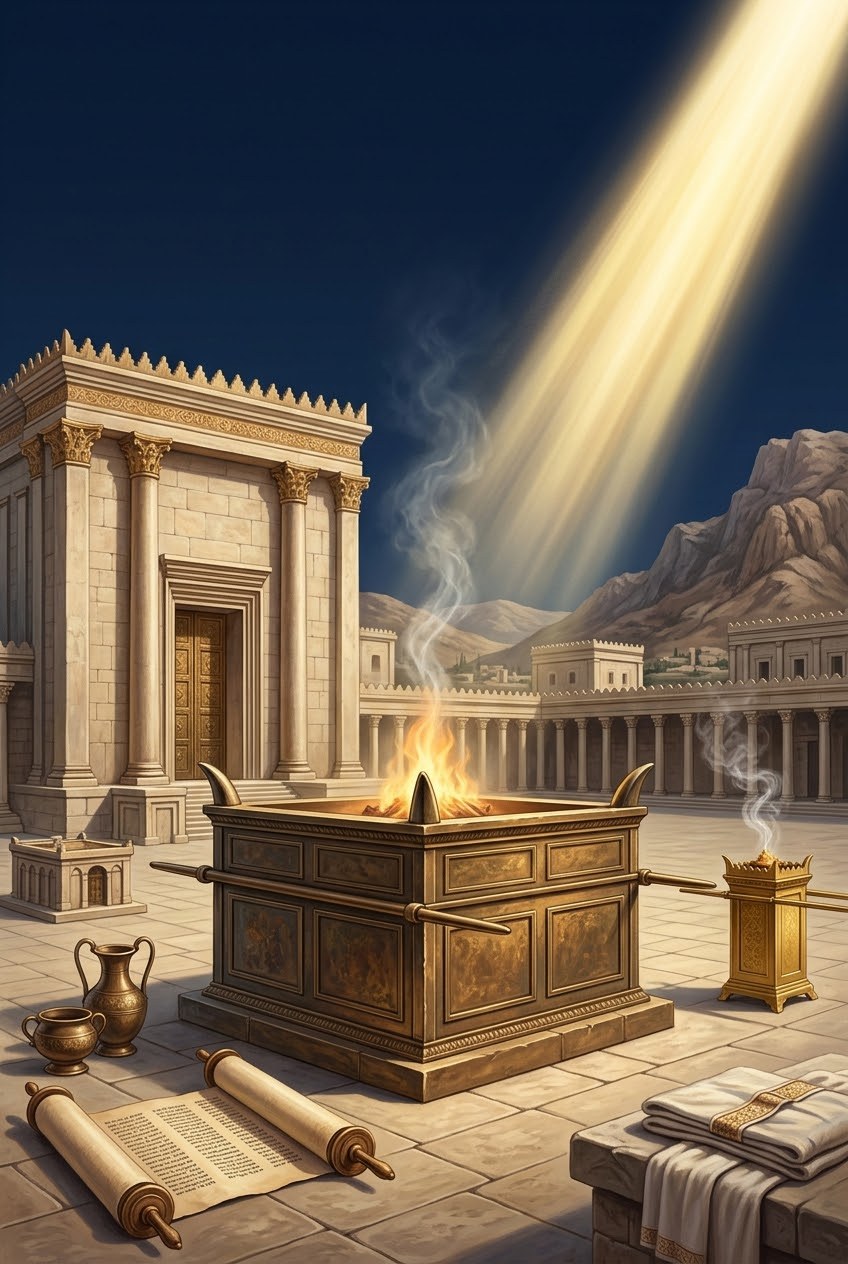
THE ALTAR OF GOD
OPENING TEXT: "An altar of earth thou shalt make unto Me, and shalt sacrifice thereon thy burnt offerings, and thy peace offerings, thy sheep, and thine oxen: in all places where I record My name I will come unto thee, and I will bless thee. And if thou wilt make Me an altar of...
Chapter 1: INTRODUCTION
OPENING TEXT: "An altar of earth thou shalt make unto Me, and shalt sacrifice thereon thy burnt offerings, and thy peace offerings, thy sheep, and thine oxen: in all places where I record My name I will come unto thee, and I will bless thee. And if thou wilt make Me an altar of stone, thou shalt not build it of hewn stone: for if thou lift up thy tool upon it, thou hast polluted it. Neither shalt thou go up by steps unto Mine altar, that thy nakedness be not discovered thereon" (Ex. 20:24).
The Almighty GOD gave this commandment immediately after the giving of the Ten commandments.
The word "Altar" is "Mizbeach" in Hebrew. It is word #4196 in Strong's Greek Concordance. It means "place of slaughter" or "sacrifice." Mizbeach is a four-letter word, MemZayinBethChet, from the three-letter root verb Zabach. Zabach means, to offer, kill, slay an animal for sacrifice, eating or divine judgment.
Zabach is made up of the three letters Zayin, Beth and Chet. It has been said that the Mem represents a broken heart, or broken relationship with GOD and the mercy and lovingkindness of GOD. The Zayin is for a remembrance of GOD, or a means of atonement and reconciliation with GOD to amend that broken relationship. The Beth speaks of a place filled with GOD's presence, representing our heart. And the Chet, whatever we do, do as unto GOD.
The Commandment to build an altar was given by the Almighty GOD to Israel by the hand of Moses, His faithful servant.
Ever before the time of Moses and the children of Israel, altar had been in use in the worship of the Almighty GOD as a place upon which burnt sacrifice was offered up to GOD.
In Bible literature, altar was first mentioned in connection with the altar built by Noah after the flood, for the text says: "And Noah builded an altar unto the LORD; and took of every clean beast, and of every clean fowl, and offered burnt offerings on the altar" (Gen. 8:20).
The Bible had recorded the offering of Abel, son of Adam, which was accepted by GOD, and without mention of the offering being brought on an altar, although an altar is implied. The text says: "And Abel, he also brought of the firstlings of his flock and of the fat thereof. And the LORD had respect unto Abel and to his offering" (Gen. 4:4).
Father Abraham built an altar at the place of Shechem, by which Abraham formally took possession, on behalf of his descendants, of the whole land of Canaan, for the text says: "And Abram passed through the land unto the place of Sichem, unto the plain of Moreh. And the Canaanite was then in the land. And the LORD appeared unto Abram, and said, Unto thy seed will I give this land: and there builded he an altar unto the LORD, who appeared unto him" (Gen. 12:6-7).
Father Abraham built a second altar between Bethel and Ai, for the text says: "And he removed from thence unto a mountain on the east of Bethel, and pitched his tent, having Bethel on the west, and Hai on the east: and there he builded an altar unto the LORD, and called upon the name of the LORD" (Gen. 12:8). Father Abraham returned to this altar on his way from Egypt. The text says: "And he went on his journeys from the south even to Bethel, unto the place where his tent had been at the beginning, between Bethel and Hai; Unto the place of the altar, which he had made there at the first: and there Abram called on the name of the LORD" (Gen. 13:3-4).
Father Abraham built another altar in Hebron, for the text says: "Then Abram removed his tent, and came and dwelt in the plain of Mamre, which is in Hebron, and built there an altar unto the LORD" (Gen. 13:18).
Father Abraham built yet another altar on the top of a mountain in the land of Moriah for the sacrifice of his son, Isaac. The text says: "And they came to the place which GOD had told him of; and Abraham built an altar there, and laid the wood in order, and bound Isaac his son, and laid him on the altar upon the wood" (Gen. 22:9). In the place of Isaac, Abraham sacrificed a ram caught in a thicket by its horns on that altar. It was GOD Himself who provided the sacrificial ram. See verses 12-13.
The Patriarch Isaac, built an altar at Beersheba, supposed to be a re-erection on the same site, of an altar built by Father Abraham, whose home for many years was at Beersheba. The text says: "And the LORD appeared unto him the same night, and said, I am the GOD of Abraham thy father: fear not, for I am with thee, and will bless thee, and multiply thy seed for My servant Abraham\'s sake. And he builded an altar there, and called upon the name of the LORD, and pitched his tent there: and there Isaac\'s servants digged a well" (Gen. 26:24-25).
The Patriarch Jacob, erected altars in Shechem and Bethel although it is believed that he merely repaired altars built by his grandfather, Abraham, at those places. The text says: "And Jacob came to Shalem, a city of Shechem, which is in the land of Canaan, when he came from Padanaram; and pitched his tent before the city. And he bought a parcel of a field, where he had spread his tent, at the hand of the children of Hamor, Shechem\'s father, for an hundred pieces of money. And he erected there an altar, and called it El elohe-Israel" (Gen. 33:18-20). The text also says: "And GOD said unto Jacob, Arise, go up to Bethel, and dwell there: and make there an altar unto GOD, that appeared unto thee when thou fleddest from the face of Esau thy brother.... And let us arise, and go up to Bethel; and I will make there an altar unto GOD, who answered me in the day of my distress, and was with me in the way which I went.... And he built there an altar, and called the place El bethel: because there GOD appeared unto him, when he fled from the face of his brother" (Gen. 35:1, 3, 7).
Jacob offered a sacrifice on one of the mountains of Gilead, on a heap of stone which served as a witness between him and his uncle, Laban, and as an altar, for the text says: "And Jacob said unto his brethren, Gather stones; and they took stones, and made an heap: and they did eat there upon the heap. Then Jacob offered sacrifice upon the mount, and called his brethren to eat bread: and they did eat bread, and tarried all night in the mount" (Gen. 31:46, 54).
Before the children of Israel arrived Mount Sinai following their departure from Egypt, and before the instruction by GOD to erect an altar as reproduced in our opening text, Moses built an altar during the war with Amalek, for the text says: "And Moses built an altar, and called the name of it Jehovah nissi" (Gen. 17:15).
Moses built an altar at the foot of Mount Sinai where, beside the altar were erected twelve pillars, emblematic of the twelve tribes of Israel. Burnt offerings and peace offerings of oxen were offered up to the LORD on the altar and some of the blood of the sacrificial animals was sprinkled on the people in order to ratify the Covenant between GOD and the people. The text says: "And Moses wrote all the words of the LORD, and rose up early in the morning, and builded an altar under the hill, and twelve pillars, according to the twelve tribes of Israel. And he sent young men of the children of Israel, which offered burnt offerings, and sacrificed peace offerings of oxen unto the LORD. And Moses took half of the blood, and put it in basons; and half of the blood he sprinkled on the altar. And he took the book of the covenant, and read in the audience of the people: and they said, All that the LORD hath said will we do, and be obedient" (Ex, 24:4-7).
Chapter 2: THE BRAZEN ALTAR
GOD Commanded that the Tabernacle be built for Him in the wilderness, that He may dwell among the children of Israel, for it is written: "And let them make Me a sanctuary; that I may dwell among them" (Ex. 25:8). He also commanded an altar to be made together with the details of its construction and utensils, for it is written: "And thou shalt make an altar of shittim wood, five cubits long, and five cubits broad; the altar shall be foursquare: and the height thereof shall be three cubits. And thou shalt make the horns of it upon the four corners thereof: his horns shall be of the same: and thou shalt overlay it with brass. And thou shalt make his pans to receive his ashes, and his shovels, and his basons, and his fleshhooks, and his firepans: all the vessels thereof thou shalt make of brass. And thou shalt make for it a grate of network of brass; and upon the net shalt thou make four brasen rings in the four corners thereof. And thou shalt put it under the compass of the altar beneath, that the net may be even to the midst of the altar. And thou shalt make staves for the altar, staves of shittim wood, and overlay them with brass. And the staves shall be put into the rings, and the staves shall be upon the two sides of the altar, to bear it. Hollow with boards shalt thou make it: as it was shewed thee in the mount, so shall they make it" (Ex. 27:1-8).
This is the altar of burnt offering (Mizbeach ha olah), otherwise called the brazen altar. The text says: "The brasen altar, and his grate of brass, his staves, and all his vessels, the laver and his foot" (Ex. 39:39). This altar is also called the Table of the LORD, for it is written: "Ye offer polluted bread upon Mine altar; and ye say, Wherein have we polluted thee? In that ye say, The table of the LORD is contemptible. ... But ye have profaned it, in that ye say, The table of the LORD is polluted; and the fruit thereof, even his meat, is contemptible" (Mal. 1:7, 12).
In the Prophet Ezekiel's vision of the Temple during the captivity of Judah in
Babylon, the altar of burnt offering was also called the Table of the LORD, for it is
written: "The altar of wood was three cubits high, and the length thereof two
cubits; and the corners thereof, and the length thereof, and the walls thereof,
were of wood: and he said unto me, This is the table that is before the LORD"
(Ezek. 41:22).
It is also written: "But the priests the Levites, the sons of Zadok, that kept the
charge of My sanctuary when the children of Israel went astray from Me, they
shall come near to Me to minister unto Me, and they shall stand before Me to
offer unto Me the fat and the blood, saith the LORD GOD: They shall enter into
My sanctuary, and they shall come near to My table, to minister unto Me, and
they shall keep My charge" (Ezek. 44:15-16).
The brazen altar is also called the altar which is before the LORD, for it is written: "And he shall put some of the blood upon the horns of the altar which is before the LORD, that is in the tabernacle of the congregation, and shall pour out all the blood at the bottom of the altar of the burnt offering, which is at the door of the tabernacle of the congregation" (Lev. 4:18).
It is upon the brazen altar that the Priests offer unto GOD burnt offerings, peace offerings, sheep and oxen as commanded by GOD in our opening text (Ex. 20:24). The place of this altar was at the door of the Tabernacle of the congregation, for it is written: "And he put the altar of burnt offering by the door of the tabernacle of the tent of the congregation, and offered upon it the burnt offering and the meat offering; as the LORD commanded Moses" (Ex. 40:29).
According to Leviticus, the fire on the brazen altar shall burn perpetually, for it is written: "The fire shall ever be burning upon the altar; it shall never go out" (Lev. 6:13).
Chapter 3: THE GOLDEN ALTAR (ALTAR OF INCENSE)
GOD also commanded Moses that an altar of incense be made for Him in the mobile Tabernacle (Mishkan) in the wilderness. He gave detailed instructions concerning the altar of incense thus: "And thou shalt make an altar to burn incense upon: of shittim wood shalt thou make it. A cubit shall be the length thereof, and a cubit the breadth thereof; foursquare shall it be: and two cubits shall be the height thereof: the horns thereof shall be of the same. And thou shalt overlay it with pure gold, the top thereof, and the sides thereof round about, and the horns thereof; and thou shalt make unto it a crown of gold round about. And two golden rings shalt thou make to it under the crown of it, by the two corners thereof, upon the two sides of it shalt thou make it; and they shall be for places for the staves to bear it withal. And thou shalt make the staves of shittim wood, and overlay them with gold" (Ex. 30:1-5). See also Ex. 37:25-26.
The altar of incense is also called the "golden altar". It is written: "And the golden altar, and the anointing oil, and the sweet incense, and the hanging for the tabernacle door" (Ex. 39:38). It also written: "And upon the golden altar they shall spread a cloth of blue, and cover it with a covering of badgers\' skins, and shall put to the staves thereof" (Num. 4:11). This altar stood in the holy place before the veil that is before the ark of the Testimony, for it is written: "And thou shalt put it before the vail that is by the ark of the testimony, before the mercy seat that is over the testimony, where I will meet with thee" (Ex. 30:6).
On the golden altar, incense of sweet spices were continually burned every morning and evening side by side the burnt offerings on the brazen altar, with coals of fire taken from off the brazen altar, for it is written: "And he shall take a censer full of burning coals of fire from off the altar before the LORD, and his hands full of sweet incense beaten small, and bring it within the vail" (Lev. 16:12).
The text says: "And Moses said unto Aaron, Take a censer, and put fire therein from off the altar, and put on incense, and go quickly unto the congregation, and make an atonement for them: for there is wrath gone out from the LORD; the plague is begun" (Num. 16:46).
Nadab and Abihu, sons of Aaron died because the coal in their censers were not taken from off the brazen altar.
At the time of Yom Kippur (Day of Atonement) offering, the horns of the incense altar are sprinkled with blood. The morning and evening services were commenced by the High Priest offering incense on the golden altar. The golden altar was a small movable table. King David, the Psalmist prayed: "Let my prayer be set forth before thee as incense; and the lifting up of my hands as the evening sacrifice" (Ps. 141:2).
In the apocalypse of the Apostle John, we have the following record: "And when he had taken the book, the four beasts and four and twenty elders fell down before the Lamb, having every one of them harps, and golden vials full of odours, which are the prayers of saints" (Rev. 5:8). And also: "And another angel came and stood at the altar, having a golden censer; and there was given unto him much incense, that he should offer it with the prayers of all saints upon the golden altar which was before the throne. And the smoke of the incense, which came with the prayers of the saints, ascended up before GOD out of the angel\'s hand. And the angel took the censer, and filled it with fire of the altar, and cast it into the earth: and there were voices, and thunderings, and lightnings, and an earthquake" (Rev. 8:3-5).
In the Gospel according to Luke it is recorded: "According to the custom of the priest\'s office, his lot was to burn incense when he went into the temple of the LORD. And the whole multitude of the people were praying without at the time of incense" (Lk. 1:9-10).
The foregoing makes clear that there is an altar of incense in the heavenly Temple and that the prayers of the saints of GOD are like sweet incense before GOD. It also shows that the prayers offered by the saints of GOD at the time of incense offerings are sweet to GOD.
According to the account of Luke, it was at the altar of incense that Zechariah ministered when the arch angel Gabriel appeared and spoke to him concerning his son (John) that would be born to him and his wife Elizabeth (Elisheba), for the text says: "And there appeared unto him an angel of the LORD standing on the right side of the altar of incense. And when Zacharias saw him, he was troubled, and fear fell upon him. But the angel said unto him, Fear not, Zacharias: for thy prayer is heard; and thy wife Elisabeth shall bear thee a son, and thou shalt call his name John. And thou shalt have joy and gladness; and many shall rejoice at his birth. For he shall be great in the sight of the LORD, and shall drink neither wine nor strong drink; and he shall be filled with the Holy Spirit, even from his mother\'s womb. And many of the children of Israel shall he turn to the LORD their GOD. And he shall go before him in the spirit and power of Elias, to turn the hearts of the fathers to the children, and the disobedient to the wisdom of the just; to make ready a people prepared for the LORD. And Zacharias said unto the angel, Whereby shall I know this? For I am an old man, and my wife well stricken in years. And the angel answering said unto him, I am Gabriel, that stand in the presence of GOD; and am sent to speak unto thee, and to shew thee these glad tidings. And, behold, thou shalt be dumb, and not able to speak, until the day that these things shall be performed, because thou believest not my words, which shall be fulfilled in their season" (Lk.1:11-20).
The ministry of the altar did not end with the wilderness experience of the children of Israel as is now clear. The altar continued to be used thereafter as a medium of service to the Almighty GOD.
Joshua built an altar to GOD on Mount Ebal, as commanded by Moses, his predecessor saying: "And it shall come to pass, when the LORD thy GOD hath brought thee in unto the land whither thou goest to possess it, that thou shalt put the blessing upon Mount Gerizim, and the curse upon Mount Ebal" (Deut. 11:29). It had been recorded: "And Moses with the elders of Israel commanded the people, saying, Keep all the commandments which I command you this day. And it shall be on the day when ye shall pass over Jordan unto the land which the LORD thy GOD giveth thee, that thou shalt set thee up great stones, and plaister them with plaister: And thou shalt write upon them all the words of this law, when thou art passed over, that thou mayest go in unto the land which the LORD thy GOD giveth thee, a land that floweth with milk and honey; as the LORD GOD of thy fathers hath promised thee. Therefore it shall be when ye be gone over Jordan, that ye shall set up these stones, which I command you this day, in Mount Ebal, and thou shalt plaister them with plaister. And there shalt thou build an altar unto the LORD thy GOD, an altar of stones: thou shalt not lift up any iron tool upon them. Thou shalt build the altar of the LORD thy GOD of whole stones: and thou shalt offer burnt offerings thereon unto the LORD thy GOD: And thou shalt offer peace offerings, and shalt eat there, and rejoice before the LORD thy GOD. And thou shalt write upon the stones all the words of this law very plainly. And Moses and the priests the Levites spake unto all Israel, saying, Take heed, and hearken, O Israel; this day thou art become the people of the LORD thy GOD. Thou shalt therefore obey the voice of the LORD thy GOD, and do His commandments and His statutes, which I command thee this day. And Moses charged the people the same day, saying, These shall stand upon Mount Gerizim to bless the people, when ye are come over Jordan; Simeon, and Levi, and Judah, and Issachar, and Joseph, and Benjamin: And these shall stand upon Mount Ebal to curse; Reuben, Gad, and Asher, and Zebulun, Dan, and Naphtali" (Deut. 27:1-14).
All the words of the law were required to be written upon the stones very plainly so that the words of the law could be easily read and understood. This gave rise to the school of the Sopherim, the Scribes, whose office it was to read the Book of the law of GOD distinctly, giving the sense, and causing the people to understand the reading, as it is said: "And Ezra opened the book in the sight of all the people; And Ezra blessed the LORD, the great GOD. And all the people answered, Amen, Amen, with lifting up their hands: and they bowed their heads, and worshipped the LORD with their faces to the ground. Also Jeshua, and Bani, and Sherebiah, Jamin, Akkub, Shabbethai, Hodijah, Maaseiah, Kelita, Azariah, Jozabad, Hanan, Pelaiah, and the Levites, caused the people to understand the law: and the people stood in their place. So they read in the book in the law of GOD distinctly, and gave the sense, and caused them to understand the reading" (Neh. 8:5-8).
The text says of Joshua: "Then Joshua built an altar unto the LORD GOD of Israel in Mount Ebal, As Moses the servant of the LORD commanded the children of Israel, as it is written in the book of the law of Moses, an altar of whole stones, over which no man hath lift up any iron: and they offered thereon burnt offerings unto the LORD, and sacrificed peace offerings. And he wrote there upon the stones a copy of the law of Moses, which he wrote in the presence of the children of Israel" (Josh. 8:30-32).
Mount Ebal is in today's Nablus in the occupied West Bank under Palestinian Authority control. Nablus used to be called Shechem where the bones of Joseph were interred, for the text says: "And the bones of Joseph, which the children of Israel brought up out of Egypt, buried they in Shechem, in a parcel of ground which Jacob bought of the sons of Hamor the father of Shechem for an hundred pieces of silver: and it became the inheritance of the children of Joseph" (Josh. 24:32).
It is instructive that the building of an altar, that is, the institution of public worship, was to be the first duty of the Israelites on their entering into Canaan
It would be recalled that the mobile Tabernacle (Mishkan) was set up in Shiloh and with it the altars, where the High Priest, Eli, ministered with his sons, Hophni and Phinehas, in the days the Prophet Samuel. The text says: "And the whole congregation of the children of Israel assembled together at Shiloh, and set up the tabernacle of the congregation there. And the land was subdued before them" (Josh. 18:1). It also says: "These are the inheritances, which Eleazar the priest, and Joshua the son of Nun, and the heads of the fathers of the tribes of the children of Israel, divided for an inheritance by lot in Shiloh before the LORD, at the door of the tabernacle of the congregation. So they made an end of dividing the country" (Josh. 19:51).
Elkanah, the husband of Hannah (parents of the Prophet Samuel) worshipped and sacrificed to GOD thereat, for the text says: "And this man went up out of his city yearly to worship and to sacrifice unto the LORD of hosts in Shiloh. And the two sons of Eli, Hophni and Phinehas, the priests of the LORD, were there.... And when she had weaned him, she took him up with her, with three bullocks, and one ephah of flour, and a bottle of wine, and brought him unto the house of the LORD in Shiloh: and the child was young" (1 Sam. 1:3, 24).
The tribe of Reuben, the tribe of Gad and the half tribe of Manasseh erected an altar on the other side of Jordan as a witness that the LORD is GOD. The altar was called Ed. The text says: "And the children of Reuben and the children of Gad called the altar Ed: for it shall be a witness between us that the LORD is GOD" (Josh. 22:34).
When Israel was governed by Judges, Gideon (Judge) built an altar unto the LORD when he had an encounter with GOD, for the text says: "And when Gideon perceived that he was an angel of the LORD, Gideon said, Alas, O LORD GOD! For because I have seen an angel of the LORD face to face. And the LORD said unto him, Peace be unto thee; fear not: thou shalt not die. Then Gideon built an altar there unto the LORD, and called it Adonai shalom: unto this day it is yet in Ophrah of the Abiezrites" (Judg. 6:22-24).
Gideon presented an offering to GOD upon another altar he built as commanded by GOD after he threw down his father's altar of Baal. The text says: "And it came to pass the same night, that the LORD said unto him, Take thy father\'s young bullock, even the second bullock of seven years old, and throw down the altar of Baal that thy father hath, and cut down the grove that is by it: And build an altar unto the LORD thy GOD upon the top of this rock, in the ordered place, and take the second bullock, and offer a burnt sacrifice with the wood of the grove which thou shalt cut down. Then Gideon took ten men of his servants, and did as the LORD had said unto him: and so it was, because he feared his father\'s household, and the men of the city, that he could not do it by day, that he did it by night. And when the men of the city arose early in the morning, behold, the altar of Baal was cast down, and the grove was cut down that was by it, and the second bullock was offered upon the altar that was built" (Judg. 6:25-28).
Manoah, the father of Samson, set up an altar of unhewn stones and offered upon it and the angel who spoke to him ascended in the flame of the altar, for the text says: "And Manoah said unto the angel of the LORD, What is thy name, that when thy sayings come to pass we may do thee honour? And the angel of the LORD said unto him, Why askest thou thus after my name, seeing it is secret? So Manoah took a kid with a meat offering, and offered it upon a rock unto the LORD: and the angel did wondrously; and Manoah and his wife looked on. For it came to pass, when the flame went up toward heaven from off the altar, that the angel of the LORD ascended in the flame of the altar. And Manoah and his wife looked on it, and fell on their faces to the ground" (Judg. 13:17-20).
The Priest/Prophet Samuel judged Israel and built an altar unto the LORD at Ramah where he dwelt, for the text says: "And his return was to Ramah; for there was his house; and there he judged Israel; and there he built an altar unto the LORD" (1 Sam. 7:17).
In 1 Sam. 7:7- 13, Samuel offered burnt offering unto the LORD in Mizpah, suggesting the presence of an altar there, for the text says: "And when the Philistines heard that the children of Israel were gathered together to Mizpeh, the lords of the Philistines went up against Israel. And when the children of Israel heard it, they were afraid of the Philistines. And the children of Israel said to Samuel, Cease not to cry unto the LORD our GOD for us, that He will save us out of the hand of the Philistines. And Samuel took a sucking lamb, and offered it for a burnt offering wholly unto the LORD: and Samuel cried unto the LORD for Israel; and the LORD heard him. And as Samuel was offering up the burnt offering, the Philistines drew near to battle against Israel: but the LORD thundered with a great thunder on that day upon the Philistines, and discomfited them; and they were smitten before Israel. And the men of Israel went out of Mizpeh, and pursued the Philistines, and smote them, until they came under Bethcar. Then Samuel took a stone, and set it between Mizpeh and Shen, and called the name of it Ebenezer, saying, Hitherto hath the LORD helped us. So the Philistines were subdued, and they came no more into the coast of Israel: and the hand of the LORD was against the Philistines all the days of Samuel."
The LORD had rejected the Tabernacle in Shiloh because of the wickedness of the people. The text says: "Is this house, which is called by My name, become a den of robbers in your eyes? Behold, even I have seen it, saith the LORD. But go ye now unto My place which was in Shiloh, where I set My name at the first, and see what I did to it for the wickedness of My people Israel. And now, because ye have done all these works, saith the LORD, and I spake unto you, rising up early and speaking, but ye heard not; and I called you, but ye answered not; Therefore will I do unto this house, which is called by My name, wherein ye trust, and unto the place which I gave to you and to your fathers, as I have done to Shiloh. And I will cast you out of My sight, as I have cast out all your brethren, even the whole seed of Ephraim" (Jer. 7:11-15). See also Ps. 78:60; Jer. 26:6, 9.
Samuel also talked about offering burnt offerings in Gilgal, although King Saul did so ahead of him foolishly. The text says: "And thou shalt go down before me to Gilgal; and, behold, I will come down unto thee, to offer burnt offerings, and to sacrifice sacrifices of peace offerings: seven days shalt thou tarry, till I come to thee, and shew thee what thou shalt do" (1 Sam. 10:8). It also says: "And Saul said, Bring hither a burnt offering to me, and peace offerings. And he offered the burnt offering. And it came to pass, that as soon as he had made an end of offering the burnt offering, behold, Samuel came; and Saul went out to meet him, that he might salute him. And Samuel said, What hast thou done? And Saul said, Because I saw that the people were scattered from me, and that thou camest not within the days appointed, and that the Philistines gathered themselves together at Michmash; Therefore said I, The Philistines will come down now upon me to Gilgal, and I have not made supplication unto the LORD: I forced myself therefore, and offered a burnt offering. And Samuel said to Saul, Thou hast done foolishly: thou hast not kept the commandment of the LORD thy GOD, which He commanded thee: for now would the LORD have established thy kingdom upon Israel forever" (1 Sam. 13:9-13).
King Saul also built an altar unto GOD, for the text says: "And Saul built an altar unto the LORD: the same was the first altar that he built unto the LORD" (1 Sam. 14:35).
King David purchased the threshing floor of Araunah, the Jebusite where Solomon's magnificent Temple later stood, for the text says: "Then Solomon began to build the house of the LORD at Jerusalem in Mount Moriah, where the LORD appeared unto David his father, in the place that David had prepared in the threshing floor of Ornan the Jebusite" (2 Chron. 3:1). King David built an altar thereat and offered burnt offerings and peace offerings unto GOD, for the text says: "And the king said unto Araunah, Nay; but I will surely buy it of thee at a price: neither will I offer burnt offerings unto the LORD my GOD of that which doth cost me nothing. So David bought the threshing floor and the oxen for fifty shekels of silver. And David built there an altar unto the LORD, and offered burnt offerings and peace offerings. So the LORD was intreated for the land, and the plague was stayed from Israel" (2 Sam. 24:24-25).
Concerning this altar built by King David, we have the following record in Chronicles: "And David built there an altar unto the LORD, and offered burnt offerings and peace offerings, and called upon the LORD; and He answered him from heaven by fire upon the altar of burnt offering. And the LORD commanded the angel; and he put up his sword again into the sheath thereof" (1 Chron. 21:26-27). This followed the plague arising from the census of Israel.
King David had raised an altar which was a duplicate of the altar in Gibeon where was the great high place. The wilderness mobile Tabernacle (Mishkan) which used to be in Shiloh, was kept at the great high place at Gibeon and was only dismantled and the Tabernacle and its holy vessels were brought to the new Temple of Solomon in Jerusalem. The text says: "And they brought up the ark of the LORD, and the Tent of Meeting, and all the holy vessels that were in the Tent, even these did the Priests and Levites bring up" (1 Kgs. 8:4).
It was at the altar at the great high place in Gibeon that King Solomon offered a thousand burnt offerings, following which the LORD spoke to him and asked him to make a request. The text says: "And the king went to Gibeon to sacrifice there; for that was the great high place: a thousand burnt offerings did Solomon offer upon that altar. In Gibeon the LORD appeared to Solomon in a dream by night: and GOD said, Ask what I shall give thee" (1 Kgs. 4-5).
The Temple of King Solomon (Beit Hamikdash) which superseded the great high place at Gibeon had two altars, the brazen altar, made entirely of brass and the altar of incense (golden altar) as the Mishkan (mobile Tabernacle). The text says: "Moreover he made an altar of brass, twenty cubits the length thereof, and twenty cubits the breadth thereof, and ten cubits the height thereof" (2 Chron. 4:1). The text also says: "And Solomon made all the vessels that pertained unto the house of the LORD: the altar of gold, and the table of gold, whereupon the shewbread was" (1 Kgs. 7:48). The altar was covered with cedar and overlaid with pure gold, for the text says: "And the oracle in the forepart was twenty cubits in length, and twenty cubits in breadth, and twenty cubits in the height thereof: and he overlaid it with pure gold; and so covered the altar which was of cedar" (1 Kgs. 6:20). And it says: "And for the altar of incense refined gold by weight; and gold for the pattern of the chariot of the cherubims, that spread out their wings, and covered the ark of the covenant of the LORD" (I Chron. 28:18). The text further says: "The same day did the king hallow the middle of the court that was before the house of the LORD: for there he offered burnt offerings, and meat offerings, and the fat of the peace offerings: because the brasen altar that was before the LORD was too little to receive the burnt offerings, and meat offerings, and the fat of the peace offerings" (1 Kgs. 8:64). See also 2 Chron. 7:7.
Still on King Solomon, the text says: "And three times in a year did Solomon offer burnt offerings and peace offerings upon the altar which he built unto the LORD, and he burnt incense upon the altar that was before the LORD. So he finished the house" (I Kgs. 9:25). The text also says: "Then Solomon offered burnt offerings unto the LORD on the altar of the LORD, which he had built before the porch, Even after a certain rate every day, offering according to the commandment of Moses, on the Sabbaths, and on the New Moons, and on the solemn Feasts, three times in the year, even in the Feast of Unleavened Bread, and in the Feast of Weeks, and in the Feast of Tabernacles" (2 Chron. 8:12-13).
King Asa renewed this altar, for the text says: "And the Spirit of GOD came upon Azariah the son of Oded: And he went out to meet Asa, and said unto him, Hear ye me, Asa, and all Judah and Benjamin; The LORD is with you, while ye be with Him; and if ye seek Him, He will be found of you; but if ye forsake Him, He will forsake you. Now for a long season Israel hath been without the true GOD, and without a teaching priest, and without law. But when they in their trouble did turn unto the LORD GOD of Israel, and sought Him, He was found of them. And in those times there was no peace to him that went out, nor to him that came in, but great vexations were upon all the inhabitants of the countries. And nation was destroyed of nation, and city of city: for GOD did vex them with all adversity. Be ye strong therefore, and let not your hands be weak: for your work shall be rewarded. And when Asa heard these words, and the prophecy of Oded the prophet, he took courage, and put away the abominable idols out of all the land of Judah and Benjamin, and out of the cities which he had taken from mount Ephraim, and renewed the altar of the LORD, that was before the porch of the LORD" (2 Chron. 15:1-8).
This altar remained the centre of Israelite worship for two and a half centuries until King Ahaz removed it from the forefront of the house of GOD and placed it on the Northern side of his Damascene altar. Ahaz replaced this altar with one modeled on an altar he had seen in Damascus when he went to meet Tiglath-Pileser King of Assyria. He moved the old Solomon's altar and used it for divination. The text says: "And king Ahaz went to Damascus to meet Tiglathpileser king of Assyria, and saw an altar that was at Damascus: and king Ahaz sent to Urijah the priest the fashion of the altar, and the pattern of it, according to all the workmanship thereof. And Urijah the priest built an altar according to all that king Ahaz had sent from Damascus: so Urijah the priest made it against king Ahaz came from Damascus. And when the king was come from Damascus, the king saw the altar: and the king approached to the altar, and offered thereon. And he burnt his burnt offering and his meat offering, and poured his drink offering, and sprinkled the blood of his peace offerings, upon the altar. And he brought also the brasen altar, which was before the LORD, from the forefront of the house, from between the altar and the house of the LORD, and put it on the north side of the altar. And king Ahaz commanded Urijah the priest, saying, Upon the great altar burn the morning burnt offering, and the evening meat offering, and the king\'s burnt sacrifice, and his meat offering, with the burnt offering of all the people of the land, and their meat offering, and their drink offerings; and sprinkle upon it all the blood of the burnt offering, and all the blood of the sacrifice: and the brasen altar shall be for me to enquire by. Thus did Urijah the priest, according to all that king Ahaz commanded" (2 Kgs. 16:10-16).
This indignity was repaired and cleansed by King Hezekiah in the latter part of his reign and the brazen altar assumed its old place in the Temple service until the Temple was destroyed by Nebuchadnezzer in 586 BC. The text says: "But if ye say unto me, We trust in the LORD our GOD: is not that He, whose high places and whose altars Hezekiah hath taken away, and hath said to Judah and Jerusalem, Ye shall worship before this altar in Jerusalem?" (2 Kgs. 18:22). See also 2 Chron. 32:12. The text also says: "Now in the fifth month, in the tenth day of the month, which was the nineteenth year of Nebuchadrezzar king of Babylon, came Nebuzaradan, captain of the guard, which served the king of Babylon, into Jerusalem, And burned the house of the LORD, and the king\'s house; and all the houses of Jerusalem, and all the houses of the great men, burned he with fire: And all the army of the Chaldeans, that were with the captain of the guard, brake down all the walls of Jerusalem round about. Then Nebuzaradan the captain of the guard carried away captive certain of the poor of the people, and the residue of the people that remained in the city, and those that fell away, that fell to the king of Babylon, and the rest of the multitude. But Nebuzaradan the captain of the guard left certain of the poor of the land for vinedressers and for husbandmen. Now in the fifth month, in the tenth day of the month, which was the nineteenth year of Nebuchadrezzar king of Babylon, came Nebuzaradan, captain of the guard, which served the king of Babylon, into Jerusalem, And burned the house of the LORD, and the king\'s house; and all the houses of Jerusalem, and all the houses of the great men, burned he with fire: And all the army of the Chaldeans, that were with the captain of the guard, brake down all the walls of Jerusalem round about. Then Nebuzaradan the captain of the guard carried away captive certain of the poor of the people, and the residue of the people that remained in the city, and those that fell away, that fell to the king of Babylon, and the rest of the multitude. But Nebuzaradan the captain of the guard left certain of the poor of the land for vinedressers and for husbandmen. Also the pillars of brass that were in the house of the LORD, and the bases, and the brasen sea that was in the house of the LORD, the Chaldeans brake, and carried all the brass of them to Babylon" (Jer. 52:12-17).
King Hezekiah offered on the altar of GOD, for the text says: "Then Hezekiah the king rose early, and gathered the rulers of the city, and went up to the house of the LORD. And they brought seven bullocks, and seven rams, and seven lambs, and seven he goats, for a sin offering for the kingdom, and for the sanctuary, and for Judah. And he commanded the priests the sons of Aaron to offer them on the altar of the LORD" (2 Chron. 29:20-21).
King Manasseh, son of Hezekiah, also built up the altar of GOD and sacrificed thereon after he repented of his many abominations against GOD. The text says: "Wherefore the LORD brought upon them the captains of the host of the king of Assyria, which took Manasseh among the thorns, and bound him with fetters, and carried him to Babylon. And when he was in affliction, he besought the LORD his GOD, and humbled himself greatly before the GOD of his fathers, And prayed unto Him: and He was intreated of him, and heard his supplication, and brought him again to Jerusalem into his kingdom. Then Manasseh knew that the LORD He was GOD. Now after this he built a wall without the city of David, on the west side of Gihon, in the valley, even to the entering in at the fish gate, and compassed about Ophel, and raised it up a very great height, and put captains of war in all the fenced cities of Judah. And he took away the strange gods, and the idol out of the house of the LORD, and all the altars that he had built in the mount of the house of the LORD, and in Jerusalem, and cast them out of the city. And he repaired the altar of the LORD, and sacrificed thereon peace offerings and thank offerings, and commanded Judah to serve the LORD GOD of Israel" (2 Chron. 33:11-16).
King Josiah also offered upon the altar of the LORD, for the text says: "So all the service of the LORD was prepared the same day, to keep the Passover, and to offer burnt offerings upon the altar of the LORD, according to the commandment of king Josiah" (2 chron. 35:16).
After the Babylonian captivity of the Northern Kingdom (Judah and Benjamin), the first thing to be rebuilt was the altar, and burnt offerings were offered thereon morning and evening, and the foundation of the Temple was laid later. The text says: "Then stood up Jeshua the son of Jozadak, and his brethren the priests, and Zerubbabel the son of Shealtiel, and his brethren, and builded the altar of the GOD of Israel, to offer burnt offerings thereon, as it is written in the law of Moses the man of GOD. And they set the altar upon his bases; for fear was upon them because of the people of those countries: and they offered burnt offerings thereon unto the LORD, even burnt offerings morning and evening ...From the first day of the seventh month began they to offer burnt offerings unto the LORD. But the foundation of the temple of the LORD was not yet laid" (Ezra 3:2-3, 6). The text also says: "And we cast the lots among the priests, the Levites, and the people, for the wood offering, to bring it into the house of our GOD, after the houses of our fathers, at times appointed year by year, to burn upon the altar of the LORD our GOD, as it is written in the law" (Neh. 10:34).
The contest between the Prophet Elijah and the prophets of Baal at which GOD answered Elijah by fire and consumed his sacrifice on the altar is a telling demonstration by GOD of the importance of the altar and the proper sacrifice offered upon it. We find the following record in the book of First Kings: "And Elijah said unto all the people, Come near unto me. And all the people came near unto him. And he repaired the altar of the LORD that was broken down. And Elijah took twelve stones, according to the number of the tribes of the sons of Jacob, unto whom the word of the LORD came, saying, Israel shall be thy name: And with the stones he built an altar in the name of the LORD: and he made a trench about the altar, as great as would contain two measures of seed. And he put the wood in order, and cut the bullock in pieces, and laid him on the wood, and said, Fill four barrels with water, and pour it on the burnt sacrifice, and on the wood. And he said, Do it the second time. And they did it the second time. And he said, Do it the third time. And they did it the third time. And the water ran round about the altar; and he filled the trench also with water. And it came to pass at the time of the offering of the evening sacrifice, that Elijah the prophet came near, and said, LORD GOD of Abraham, Isaac, and of Israel, let it be known this day that Thou art GOD in Israel, and that I am thy servant, and that I have done all these things at thy word. Hear me, O LORD, hear me, that this people may know that Thou art the LORD GOD, and that Thou hast turned their heart back again. Then the fire of the LORD fell, and consumed the burnt sacrifice, and the wood, and the stones, and the dust, and licked up the water that was in the trench. And when all the people saw it, they fell on their faces: and they said, The LORD, He is the GOD; the LORD, He is the GOD" (1 Kgs. 18:30-39).
The fire of GOD similarly fell on the altar of the first Levitical High Priest, Aaron during the wilderness sojourn of the children of Israel with GOD, for the text says: "And Aaron lifted up his hand toward the people, and blessed them, and came down from offering of the sin offering, and the burnt offering, and peace offerings. And Moses and Aaron went into the tabernacle of the congregation, and came out, and blessed the people: and the glory of the LORD appeared unto all the people. And there came a fire out from before the LORD, and consumed upon the altar the burnt offering and the fat: which when all the people saw, they shouted, and fell on their faces" (Lev. 9:22-24).
Likewise, the fire of GOD fell on the altar of King David, for the text says: "And David built there an altar unto the LORD, and offered burnt offerings and peace offerings, and called upon the LORD; and He answered him from heaven by fire upon the altar of burnt offering" (2 Chron. 21:26).
The fire of GOD also fell on the altar of King Solomon. The text says: "Now when Solomon had made an end of praying, the fire came down from heaven, and consumed the burnt offering and the sacrifices; and the glory of the LORD filled the house" (2 Chron. 7:1).
In the Temple built after the Babylonian captivity of the children of Judah (and Benjamin) by the returnees led by Zerubbabel, the altar had been restored as noted earlier. In the process of time, this altar was taken away by the Seleucid King, Antiochus Epiphanes, but was afterwards restored by Judas Maccabeus (1 Macc. 1:23-24; 4:49).
None of the restorations or extensions of the second Temple of Zerubbabel compared with the elaborate reconstruction of this Temple by king Herod the Great in the eighteenth year of his reign, at the beginning of 19 BC. Herod had complained that the Zerubbabel Temple was built like a fortress and was shorter than that of King Solomon's Temple by about 90 feet. He was minded to leave a legacy for the Jews to be remembered by.
According to the account of the first century Jewish historian, Josephus, the construction began with the holiest building in the Temple, called "The Holy Place," which contained the Holy of Holies. Then closest to the Holy Place was the portion set aside for the altar of burnt offering and the officiating Priests and so on. The main part of Herod's rebuilding was completed before his death in 4 BC, but the work, it was recorded, was continued for more than sixty years thereafter.
When Yahshua visited the Temple at the first Passover of his ministry, it was said that the work had been on for forty-six years. The work was not completed until 63 AD. On the website of the Israeli Ministry of Foreign Affairs, the following words appear: "From the times of King Solomon to the return from the Babylonian exile and the Hasmonean period (tenth to first centuries BC), the Temple mount in Jerusalem was a relatively small platform built on top of Mount Moriah and its highest point was the stone of foundation; this was the site of the Temple. King Herod's greatest building project was to double the area of the Temple Mount by incorporating part of the hill to the NorthWest (which had to be leveled and on which he built the Antonia Fortress) and by filling up parts of the surrounding valleys. Herod transformed the Second Temple into an edifice of splendor and surrounded the Temple Mount on its four sides with massive retaining walls. The walls, founded on bedrock, were built of large ashlar stones with beautifully dressed margins. Each course was set back about 2-3 cm, from the course below it; the stones weighed some five tons each, the corner blocks tens of tons ...."
Of interest to us is that it was at the altar of incense in this Temple that Zechariah ministered when the arch angel Gabriel appeared to him (Lk. 1:11-20).
Of interest also is that it is of the altar in Herod's Temple (and altars of GOD) that Yahshua spoke in the present continuous tense when he said: "Therefore if thou bring thy gift to the altar, and there rememberest that thy brother hath ought against thee; Leave there thy gift before the altar, and go thy way; first be reconciled to thy brother, and then come and offer thy gift" (Matt. 5:23-24).
And in chastising the religious establishment of his time, Yahshua, again, speaking in the present continuous tense, underlined the sacredness of the altar and stated clearly that it is the altar that makes the gift (sacrifice) sacred, for the text says: "And, Whosoever shall swear by the altar, it is nothing; but whosoever sweareth by the gift that is upon it, he is guilty. Ye fools and blind: for whether is greater, the gift, or the altar that sanctifieth the gift?" (Matt. 23:18-19). Same is written in the Law: "Seven days thou shalt make an atonement for the altar, and sanctify it; and it shall be an altar most holy: whatsoever toucheth the altar shall be holy" (Ex. 29:37).
Herod's altar was destroyed by Roman forces led by Titus in 70 AD, only seven years after its complete construction.
Among the Trophies carried away by Titus to Rome on the destruction of Jerusalem, the altar of incense is not found.
It was concerning Herod's Temple that we have the record about Yahshua thus: "And the Jews\' Passover was at hand, and Jesus went up to Jerusalem, And found in the temple those that sold oxen and sheep and doves, and the changers of money sitting: And when he had made a scourge of small cords, he drove them all out of the temple, and the sheep, and the oxen; and poured out the changers\' money, and overthrew the tables; And said unto them that sold doves, Take these things hence; make not my Father\'s house an house of merchandise" (Jn. 2:13-16). See also Matt. 21:12; Mk. 11:15; Lk. 19:45.
Yahshua attended GOD's Feast of Tabernacles (Sukkot) at this Temple, for the text says: "Now the Jews\' Feast of Tabernacles was at hand.... Now about the midst of the Feast Jesus went up into the Temple, and taught" (Jn. 7:1, 14).
Yahshua also celebrated Chanukkah (the feast of Dedication instituted by Judas Maccabeus) at this Temple and walked in Solomon's porch, for the text says: "And it was at Jerusalem the feast of the dedication, and it was winter. And Jesus walked in the temple in Solomon\'s porch" (Jn. 10:22-23).
Chapter 4: IMPORTANCE OF THE ALTAR
It would be garnered from what has been said above that altars were generally erected for the offering of sacrifices to GOD. Sacrifice is the primary medium of exchange in altar interaction. Sacrifice is the essential act of external worship of GOD.
GOD responded actively to altar activity. For instance, Noah built an altar and sacrificed to GOD. GOD smelled the aroma and found it pleasing. He responded to Noah's sacrifice by declaring that He would never again destroy all living things through a flood, for the text says: "And I will establish my covenant with you; neither shall all flesh be cut off any more by the waters of a flood; neither shall there anymore be a flood to destroy the earth" (Gen. 9:11). See Isa. 54:9.
The text also says: "And the LORD smelled a sweet savour; and the LORD said in His heart, I will not again curse the ground any more for man\'s sake; for the imagination of man\'s heart is evil from his youth; neither will I again smite any more everything living, as I have done. While the earth remaineth, seedtime and harvest, and cold and heat, and summer and winter, and day and night shall not cease" (Gen. 8:21-22).
It is therefore, a place of Covenant. An altar was built where the Covenant was made with GOD and Abraham, and the land was sealed as a timeless promise to Abraham and his offspring. The text says: "After these things the word of the LORD came unto Abram in a vision, saying, Fear not, Abram: I am thy shield, and thy exceeding great reward. And Abram said, LORD GOD, what wilt Thou give me, seeing I go childless, and the steward of my house is this Eliezer of Damascus? And Abram said, Behold, to me Thou hast given no seed: and, lo, one born in my house is mine heir. And, behold, the word of the LORD came unto him, saying, This shall not be thine heir; but he that shall come forth out of thine own bowels shall be thine heir. And He brought him forth abroad, and said, Look now toward heaven, and tell the stars, if thou be able to number them: and He said unto him, So shall thy seed be. And he believed in the LORD; and He counted it to him for righteousness. And He said unto him, I am the LORD that brought thee out of Ur of the Chaldees, to give thee this land to inherit it. And he said, LORD GOD, whereby shall I know that I shall inherit it? And He said unto him, Take me an heifer of three years old, and a she goat of three years old, and a ram of three years old, and a turtledove, and a young pigeon. And he took unto him all these, and divided them in the midst, and laid each piece one against another: but the birds divided he not. And when the fowls came down upon the carcases, Abram drove them away. And when the sun was going down, a deep sleep fell upon Abram; and, lo, an horror of great darkness fell upon him. And He said unto Abram, Know of a surety that thy seed shall be a stranger in a land that is not theirs, and shall serve them; and they shall afflict them four hundred years; And also that nation, whom they shall serve, will I judge: and afterward shall they come out with great substance. And thou shalt go to thy fathers in peace; thou shalt be buried in a good old age. But in the fourth generation they shall come hither again: for the iniquity of the Amorites is not yet full. And it came to pass, that, when the sun went down, and it was dark, behold a smoking furnace, and a burning lamp that passed between those pieces. In the same day the LORD made a covenant with Abram, saying, Unto thy seed have I given this land, from the river of Egypt unto the great river, the river Euphrates: The Kenites, and the Kenizzites, and the Kadmonites, And the Hittites, and the Perizzites, and the Rephaims, And the Amorites, and the Canaanites, and the Girgashites, and the Jebusites" (Gen. 15:1-21).
As is clear in our opening text, it was GOD Himself who Commanded that the altar be erected in order to present burnt sacrifices and offerings to Him (Ex. 20:24-26). The altar is the word of GOD. It is therefore, His Will. The pattern of worshipping GOD and using the altar as a place of communication and medium of exchange predated the time of Moses as we have seen in the example of Noah, Abraham, Isaac and Jacob, and perhaps Abel, son of Adam who brought an acceptable sacrifice to GOD, presumably on an altar.
GOD refers to the animals brought as offerings to Him as His food, for it is written: "And the LORD spake unto Moses, saying, Command the children of Israel, and say unto them, My offering, and My bread for My sacrifices made by fire, for a sweet savour unto Me, shall ye observe to offer unto Me in their due season" (Num. 28:1-2).
Properly speaking therefore, the altar is best described as GOD's dining table. It is no surprise that it is so called in the Scriptures as noted earlier, for it is written: "The altar of wood was three cubits high, and the length thereof two cubits; and the corners thereof, and the length thereof, and the walls thereof, were of wood: and he said unto me, This is the table that is before the LORD" (Ezek. 41:22). It is also written: "They shall enter into My sanctuary, and they shall come near to My table, to minister unto Me, and they shall keep My charge" (Ezek. 44:16). It further says: "Ye offer polluted bread upon Mine altar; and ye say, Wherein have we polluted Thee? In that ye say, The table of the LORD is contemptible.... But ye have profaned it, in that ye say, The table of the LORD is polluted; and the fruit thereof, even his meat, is contemptible" (Mal.1:7,12).
All through the ages, the pattern of worshipping GOD using the altar as a medium has been at the centre of true GOD worship. It is at the core of the worship of the true GOD of Abraham, Isaac and Jacob.
The altar as we have shown, were also scenes of special revelations from GOD.
We have also shown that altars were erected for memorials and markers of place commemorating an encounter with GOD. See again Gen. 12:7-8; 13:8; 26:25; 35:1; Ex. 17:5; Josh. 22:34.
Chapter 5: ALTAR AS A PLACE OF SANCTUARY
Furthermore, an altar was a place where an unintentional murderer had a right of sanctuary and could gain a haven, for it is written: "And if a man lie not in wait, but GOD deliver him into his hand; then I will appoint thee a place whither he shall flee. But if a man come presumptuously upon his neighbour, to slay him with guile; thou shalt take him from mine altar, that he may die" (Ex. 21:13-14). It is also written: "GOD is the LORD, which hath shewed us light: bind the sacrifice with cords, even unto the horns of the altar" (Ps. 118:27).
In other words, if the murder was premeditated, then the altar was clearly profaned by the murderer's presence and the individual could be taken away and killed.
The sacred altar and its horns where the atoning blood was splashed, provided a place of sanctuary. The text says: "And Adonijah feared because of Solomon, and arose, and went, and caught hold on the horns of the altar. And it was told Solomon, saying, Behold, Adonijah feareth king Solomon: for, lo, he hath caught hold on the horns of the altar, saying, Let king Solomon swear unto me today that he will not slay his servant with the sword. And Solomon said, If he will shew himself a worthy man, there shall not an hair of him fall to the earth: but if wickedness shall be found in him, he shall die. So king Solomon sent, and they brought him down from the altar. And he came and bowed himself to king Solomon: and Solomon said unto him, Go to thine house" (1 Kgs. 1:50-53).
Joab was denied the sanctuary of the horns because he had conspired to kill Amasa and Abner in time of peace. The text says: "Then tidings came to Joab: for Joab had turned after Adonijah, though he turned not after Absalom. And Joab fled unto the tabernacle of the LORD, and caught hold on the horns of the altar. And it was told king Solomon that Joab was fled unto the tabernacle of the LORD; and, behold, he is by the altar. Then Solomon sent Benaiah the son of Jehoiada, saying, Go, fall upon him.... So Benaiah the son of Jehoiada went up, and fell upon him, and slew him: and he was buried in his own house in the wilderness" (1 Kgs. 2:28-29, 34).
Fugitives caught hold of the horns of the altar. In an oracle against Israel, GOD declared that the horns of the altar will be cut off and fall to the ground, for it is written: "That in the day that I shall visit the transgressions of Israel upon him I will also visit the altars of Bethel: and the horns of the altar shall be cut off, and fall to the ground" (Amos. 3:14). The clear message is that there will be no place to intercede with GOD and no place to claim His sanctuary.
In the literature of the Bible, it would seem that sacrifices are prior to altars and altars are prior to sacred buildings (Tabernacle/Temple). It is first mentioned in case of the altar built by Noah after the flood (Gen. 8:20) although it is implicit in the sacrifice brought by Abel that it was done upon an altar since altar is a place of sacrifice.
Chapter 6: IDOLATROUS AND UNLAWFUL ALTARS
There are instances of idolatrous and unlawful altars in the Bible. As with everything that has GOD's original, there is always Satan's clever counterfeit. Reason: Satan says he wants to be like GOD.
The text says: "How art thou fallen from heaven, O Lucifer, son of the morning! How art thou cut down to the ground, which didst weaken the nations! For thou hast said in thine heart, I will ascend into heaven, I will exalt my throne above the stars of GOD: I will sit also upon the mount of the congregation, in the sides of the north: I will ascend above the heights of the clouds; I will be like the most High" (Isa. 14:12-14).
Dr. D.K. Odukoya of MFM Ministries gives a peek into the operation of an evil altar, although going as far as liberally characterizing peoples' evil activities at venues such as crossroads, trees, rocks, images, rivers, forests, family shrines as altars (although I do not agree with such perverted characterization). He said: "An altar is a place of sacrifice, a place of covenant, a place of spiritual traffic. When Jacob built an altar to GOD in Bethel, angels of GOD were going up and down the altar. If he had built a negative altar, there would have been a traffic of demons. Altars are also places of deliberation, decisions and actions whether negative or positive. Anytime evil is determined against someone, a priest will go to an altar and offer sacrifice by shedding of blood to make covenants with evil spirits to carry out some evil operations against the person. Anything belonging to the person can be used on the altar to represent him. Evil occurrences like being pursued by a serpent, restlessness in marriage, amputated breakthroughs, spiritual backwardness, constant failures, consistent errors, etc., will begin to take place in the life of such a person. In many environments, there are local altars such as crossroads, trees, rocks, images, rivers, forests, family shrines, and so on."
The horned altars of Jeroboam were works of error and Satan's counterfeit. The text says: Whereupon the king took counsel, and made two calves of gold, and said unto them, It is too much for you to go up to Jerusalem: behold thy gods, O Israel, which brought thee up out of the land of Egypt. And he set the one in Bethel, and the other put he in Dan. And this thing became a sin: for the people went to worship before the one, even unto Dan. And he made an house of high places, and made priests of the lowest of the people, which were not of the sons of Levi. And Jeroboam ordained a feast in the eighth month, on the fifteenth day of the month, like unto the Feast that is in Judah, and he offered upon the altar. So did he in Bethel, sacrificing unto the calves that he had made: and he placed in Bethel the priests of the high places which he had made. So he offered upon the altar which he had made in Bethel the fifteenth day of the eighth month, even in the month which he had devised of his own heart; and ordained a feast unto the children of Israel: and he offered upon the altar, and burnt incense" (1 Kgs. 12:28-33).
GOD did afterwards send a Prophet from Judah who prophesied against these idolatrous altars of Jeroboam, for the text says: "And, behold, there came a man of GOD out of Judah by the word of the LORD unto Bethel: and Jeroboam stood by the altar to burn incense. And he cried against the altar in the word of the LORD, and said, O altar, altar, thus saith the LORD; Behold, a child shall be born unto the house of David, Josiah by name; and upon thee shall he offer the priests of the high places that burn incense upon thee, and men\'s bones shall be burnt upon thee. And he gave a sign the same day, saying, This is the sign which the LORD hath spoken; Behold, the altar shall be rent, and the ashes that are upon it shall be poured out. And it came to pass, when king Jeroboam heard the saying of the man of GOD, which had cried against the altar in Bethel, that he put forth his hand from the altar, saying, Lay hold on him. And his hand, which he put forth against him, dried up, so that he could not pull it in again to him. The altar also was rent, and the ashes poured out from the altar, according to the sign which the man of GOD had given by the word of the LORD. And the king answered and said unto the man of GOD, Intreat now the face of the LORD thy GOD, and pray for me, that my hand may be restored me again. And the man of GOD besought the LORD, and the king\'s hand was restored him again, and became as it was before" (1 Kgs. 13:1-6).
In the book of Hosea, we find the following record: "Because Ephraim hath made many altars to sin, altars shall be unto him to sin" (Hos. 8:11). The text also says: "Israel is an empty vine, he bringeth forth fruit unto himself: according to the multitude of his fruit he hath increased the altars; according to the goodness of his land they have made goodly images. Their heart is divided; now shall they be found faulty: he shall break down their altars, he shall spoil their images.... The high places also of Aven, the sin of Israel, shall be destroyed: the thorn and the thistle shall come up on their altars; and they shall say to the mountains, Cover us; and to the hills, Fall on us" (Hos. 10:1-2, 8). The text further says: "Is there iniquity in Gilead? Surely they are vanity: they sacrifice bullocks in Gilgal; yea, their altars are as heaps in the furrows of the fields" (Hos. 12:11).
Heathens customarily erect idolatrous altars as a medium through which they worship their false gods or as a medium through which they believe they worship the true GOD. Satan necessarily ape the Almighty GOD as he desires and aspires to be like Him, for the text says: "I will ascend above the heights of the clouds; I will be like the Most High" (Isa. 14:14).
The seven altars of king Balak of Moab and Balaam, set up to curse Israel, are idolatrous altars. The text says: "And Balaam said unto Balak, Build me here seven altars, and prepare me here seven oxen and seven rams. And Balak did as Balaam had spoken; and Balak and Balaam offered on every altar a bullock and a ram. And Balaam said unto Balak, Stand by thy burnt offering, and I will go: peradventure the LORD will come to meet me: and whatsoever He sheweth me I will tell thee. And he went to an high place. And GOD met Balaam: and he said unto Him, I have prepared seven altars, and I have offered upon every altar a bullock and a ram. And the LORD put a word in Balaam\'s mouth, and said, Return unto Balak, and thus thou shalt speak. And he returned unto him, and, lo, he stood by his burnt sacrifice, he, and all the princes of Moab. And he took up his parable, and said, Balak the king of Moab hath brought me from Aram, out of the mountains of the east, saying, Come, curse me Jacob, and come, defy Israel. How shall I curse, whom GOD hath not cursed? Or how shall I defy, whom the LORD hath not defied?" (Num. 23:1-8).
The text also says: "And Balak\'s anger was kindled against Balaam, and he smote his hands together: and Balak said unto Balaam, I called thee to curse mine enemies, and, behold, thou hast altogether blessed them these three times. Therefore now flee thou to thy place: I thought to promote thee unto great honour; but, lo, the LORD hath kept thee back from honour. And Balaam said unto Balak, Spake I not also to thy messengers which thou sentest unto me, saying, If Balak would give me his house full of silver and gold, I cannot go beyond the commandment of the LORD, to do either good or bad of mine own mind; but what the LORD saith, that will I speak?" (Num. 24:10-13).
By the way, the altar in Athens on which were inscribed the words, "TO THE UNKNOWN GOD" erected by the Greeks to whatever god they might have inadvertently left out of their pantheon is an idolatrous altar. The Apostle Paul used this altar as an opportunity to share the one true GOD with the Greeks in the Areopagus or Mars Hill, where a Council of civic elders met. This Council was in charge of religious and educational matters in Athens. The text says: "Then Paul stood in the midst of Mars\' hill, and said, Ye men of Athens, I perceive that in all things ye are too superstitious. For as I passed by, and beheld your devotions, I found an altar with this inscription, TO THE UNKNOWN GOD. Whom therefore ye ignorantly worship, him declare I unto you" (Acts 17: 22-23).
While the altar of GOD represents blessings and a scene of encounter with GOD as noted earlier, it is clear from what was demonstrated with the idolatrous seven altars of Balak and Balaam, that idolatrous altars serve as a place of wickedness where the priests who minister thereat interact with powers of darkness, to afflict, curse, control and manipulate people's destinies and fortunes. It is also used to invoke blessings from their false gods as well as perpetrate and perpetuate wickedness in the world.
And I make the point that if the Priests who minister at the altar of GOD turn the altar into a scene to perpetrate wickedness against men, it becomes an idolatrous altar automatically. Some who are supposed to be Priests of the Most High GOD are driven and consumed by human ego, envy and sheer wickedness to invoke the names of their perceived enemies in GOD's congregation or otherwise, at the altar and invite the wrath of GOD on such persons. Some offer what they choose to call "Pull down offering" (Aja Nkwatu) against their perceived enemies in GOD's congregation, moved by sheer envy, in order to prevent them (if possible) from ascent to their elevated destiny or from reaping the fruits of GOD's promised blessings for their labor in GOD's vineyard.
Not only that, they also form a confederacy known as "Defenders of the Altar," or "Altar Defenders." The work of this wicked and evil contraption is akin to the work of a political strike force. Their specialty is to kill, bring down or otherwise silence real, imagined or perceived enemies of the man at the top. The man at the top, often actuated by envy and fear of rivalry, gives marching orders that must be carried out, without mercy, with no inclination to verify the truth. Members of this contraption deploy spiritism, voodooism, witchcraft, wizardry (sorcery), evil prayers, evil spiritual works, spiritual manipulations and projections using mirrors and other ritual gadgets and devices to stop, if possible, the progress and prosperity of GOD's diligent and conscientious children dead or destroy (kill) them altogether. Such people, Priests/Levites together with so called Apostles and Pastors who join their ranks are evil and shall not escape the judgment of GOD in due time. They pollute the sacred altar by their wicked practices. Such practices are antithetical to the purpose and use of the altar as a place of encounter, a place to seek forgiveness (atonement) for themselves and for the people, a place of blessing, worship and intercession. If only heaven could open their eyes to see, they would realize that they are not offering to the Holy GOD of Heaven but to the devil whose wicked ways they have unwittingly embraced.
GOD has on occasions rejected His altars and the sacrifices offered upon them. He did so, not because He annulled His commandment regarding the altar services and His food served upon it. He did so because of the sin and wickedness of the people when they are mistaken as to the meaning and purpose of the altar as a means to an end and not the end itself.
Righteousness of the Priests who minister at the altar and righteousness of the people themselves, is what gives meaning to the worship of GOD at the altar as a primary medium of exchange and interaction, as a place where the Divine and human worlds interact. The altar and the Tabernacle in Shiloh is a classic example. (Jer. 7:11-15; Ps. 78:60). As it is said: "Let thy priests be clothed with righteousness; and let thy saints shout for joy" (Ps. 132:9). And it is said: "And he shall sit as a refiner and purifier of silver: and he shall purify the sons of Levi, and purge them as gold and silver, that they may offer unto the LORD an offering in righteousness. Then shall the offering of Judah and Jerusalem be pleasant unto the LORD, as in the days of old, and as in former years" (Mal. 3:3-4). And it is further said: "For from the rising of the sun even unto the going down of the same My name shall be great among the Gentiles; and in every place incense shall be offered unto My name, and a pure offering: for My name shall be great among the heathen, saith the LORD of hosts" (Mal. 1:11).
GOD had at different times rejected His appointed Feasts, including New moons and Shabbats. He had also rejected the songs and prayers of the people, as the following texts make clear:
The text says: "To what purpose is the multitude of your sacrifices unto Me? Saith the LORD: I am full of the burnt offerings of rams, and the fat of fed beasts; and I delight not in the blood of bullocks, or of lambs, or of he goats. When ye come to appear before Me, who hath required this at your hand, to tread My courts? Bring no more vain oblations; incense is an abomination unto Me; the new moons and Sabbaths, the calling of assemblies, I cannot away with; it is iniquity, even the solemn meeting. Your New Moons and your appointed Feasts My soul hateth: they are a trouble unto Me; I am weary to bear them. And when ye spread forth your hands, I will hide Mine eyes from you: yea, when ye make many prayers, I will not hear: your hands are full of blood" (Isa. 1:11-15).
The text says: "Hear, O My people, and I will speak; O Israel, and I will testify against thee: I am GOD, even thy GOD. I will not reprove thee for thy sacrifices or thy burnt offerings, to have been continually before Me. I will take no bullock out of thy house, nor he goats out of thy folds" (Ps. 50:7-9).
The text says: "Take thou away from Me the noise of thy songs; for I will not hear the melody of thy viols" (Amos 5:23).
The text says: "To what purpose cometh there to Me incense from Sheba, and the sweet cane from a far country? Your burnt offerings are not acceptable, nor your sacrifices sweet unto Me" (Jer. 6:20).
The text says: "He that killeth an ox is as if he slew a man; he that sacrificeth a lamb, as if he cut off a dog\'s neck; he that offereth an oblation, as if he offered swine\'s blood; he that burneth incense, as if he blessed an idol. Yea, they have chosen their own ways, and their soul delighteth in their abominations" (Isa. 66:3).
The text says: "And Samuel said, Hath the LORD as great delight in burnt offerings and sacrifices, as in obeying the voice of the LORD? Behold, to obey is better than sacrifice, and to hearken than the fat of rams" (1 Sam. 15:22).
The text says: "I will not reprove thee for thy sacrifices or thy burnt offerings, to have been continually before Me. I will take no bullock out of thy house, nor he goats out of thy folds" (Ps. 50:8-9).
The text says: "For I spake not unto your fathers, nor commanded them in the day that I brought them out of the land of Egypt, concerning burnt offerings or sacrifices" (Jer. 7:22).
The text says: "When they fast, I will not hear their cry; and when they offer burnt offering and an oblation, I will not accept them: but I will consume them by the sword, and by the famine, and by the pestilence" (Jer. 14:12).
The text says: "Though ye offer Me burnt offerings and your meat offerings, I will not accept them: neither will I regard the peace offerings of your fat beasts" (Amos. 5:22).
And the the text says: "Wherewith shall I come before the LORD, and bow myself before the High GOD? Shall I come before Him with burnt offerings, with calves of a year old? Will the LORD be pleased with thousands of rams, or with ten thousands of rivers of oil? Shall I give my firstborn for my transgression, the fruit of my body for the sin of my soul?" (Mic. 6:6-7).
GOD's clear reason for such rejection was the peoples' unrighteousness, including those of the Priests as the following texts show:
The text says: "For from the least of them even unto the greatest of them every one is given to covetousness; and from the prophet even unto the priest every one dealeth falsely" (Jer. 6:13).
The text says: "The heads thereof judge for reward, and the priests thereof teach for hire, and the prophets thereof divine for money: yet will they lean upon the LORD, and say, Is not the LORD among us? None evil can come upon us" (Mic. 3:11).
The text says: "They are waxen fat, they shine: yea, they overpass the deeds of the wicked: they judge not the cause, the cause of the fatherless, yet they prosper; and the right of the needy do they not judge" (Jer. 5:28).
The text says: "For I desired mercy, and not sacrifice; and the knowledge of GOD more than burnt offerings. But they like men have transgressed the covenant: there have they dealt treacherously against Me. Gilead is a city of them that work iniquity, and is polluted with blood. And as troops of robbers wait for a man, so the company of priests murder in the way by consent: for they commit lewdness. I have seen an horrible thing in the house of Israel: there is the whoredom of Ephraim, Israel is defiled" (Hos.6:6-10). See Matt. 9:13.
The text says: "For every beast of the forest is Mine, and the cattle upon a thousand hills. I know all the fowls of the mountains: and the wild beasts of the field are Mine. If I were hungry, I would not tell thee: for the world is Mine, and the fulness thereof. Will I eat the flesh of bulls, or drink the blood of goats? Offer unto GOD thanksgiving; and pay thy vows unto the Most High: And call upon Me in the day of trouble: I will deliver thee, and thou shalt glorify Me. But unto the wicked GOD saith, What hast thou to do to declare My statutes, or that thou shouldest take My covenant in thy mouth? Seeing thou hatest instruction, and castest My words behind thee. When thou sawest a thief, then thou consentedst with him, and hast been partaker with adulterers. Thou givest thy mouth to evil, and thy tongue frameth deceit. Thou sittest and speakest against thy brother; thou slanderest thine own mother\'s son. These things hast thou done, and I kept silence; thou thoughtest that I was altogether such an one as thyself: but I will reprove thee, and set them in order before thine eyes. Now consider this, ye that forget GOD, lest I tear you in pieces, and there be none to deliver. Whoso offereth praise glorifieth Me: and to him that ordereth his conversation aright will I shew the salvation of GOD" (Ps.50:10-23).
The text says: "But thine eyes and thine heart are not but for thy covetousness, and for to shed innocent blood, and for oppression, and for violence, to do it" (Jer. 22:17).
The text says: "To do righteousness and judgment is more acceptable to the LORD than sacrifice" (Prov. 21:3).
The text says: "The sacrifice of the wicked is an abomination to the LORD: but the prayer of the upright is his delight" (Prov. 15:8).
The text says: "The sacrifice of the wicked is abomination: how much more, when he bringeth it with a wicked mind?" (Prov. 21:27).
The text says: "Wash you, make you clean; put away the evil of your doings from before Mine eyes; cease to do evil; Learn to do well; seek judgment, relieve the oppressed, judge the fatherless, plead for the widow" (Isa. 1: 16-17).
The text says: "Thus saith the LORD; Execute ye judgment and righteousness, and deliver the spoiled out of the hand of the oppressor: and do no wrong, do no violence to the stranger, the fatherless, nor the widow, neither shed innocent blood in this place....He judged the cause of the poor and needy; then it was well with him: was not this to know Me? Saith the LORD" (Jer. 22:3, 16).
The text says: "He hath shewed thee, O man, what is good; and what doth the LORD require of thee, but to do justly, and to love mercy, and to walk humbly with thy GOD?" (Mic. 6:8).
The text says: "Thus speaketh the LORD of hosts, saying, Execute true judgment, and shew mercy and compassions every man to his brother" (Zech. 7:9).
The text says: "These are the things that ye shall do; Speak ye every man the truth to his neighbour; execute the judgment of truth and peace in your gates" (Zech. 8:16).
The text says: "Is not this the fast that I have chosen? To loose the bands of wickedness, to undo the heavy burdens, and to let the oppressed go free, and that ye break every yoke? Is it not to deal thy bread to the hungry, and that thou bring the poor that are cast out to thy house? When thou seest the naked, that thou cover him; and that thou hide not thyself from thine own flesh?" (Isa. 58:6-7).
The text says: "Therefore turn thou to thy GOD: keep mercy and judgment, and wait on thy GOD continually" (Hos. 12:6).
The text says: "But this thing commanded I them, saying, Obey My voice, and I will be your GOD, and ye shall be My people: and walk ye in all the ways that I have commanded you, that it may be well unto you. But they hearkened not, nor inclined their ear, but walked in the counsels and in the imagination of their evil heart, and went backward, and not forward. Since the day that your fathers came forth out of the land of Egypt unto this day I have even sent unto you all My servants the prophets, daily rising up early and sending them: Yet they hearkened not unto Me, nor inclined their ear, but hardened their neck: they did worse than their fathers" (Jer. 7:23-26).
Rejection because of sin and wickedness is not tantamount to a rejection or annulment of His eternal Words or Laws, just as the prevalence or incidence of the counterfeit does not deny or mean the non-existence of the original.
Following his sins and wickedness in the matter of Uriah, the Hittite, King David pleaded saying: "For thou desirest not sacrifice; else would I give it: thou delightest not in burnt offering. The sacrifices of GOD are a broken spirit: a broken and a contrite heart, O GOD, thou wilt not despise. Do good in thy good pleasure unto Zion: build thou the walls of Jerusalem. Then shalt thou be pleased with the sacrifices of righteousness, with burnt offering and whole burnt offering: then shall they offer bullocks upon thine altar" (Ps. 51:16-19). GOD desires that altar sacrifices and offerings be offered up to Him in righteousness and not as a hollow ritual.
It would be noted that GOD rejected even the peoples' prayers and songs, and yet no one makes a case against prayers today. No one also makes a case against songs.
Chapter 7: ALTAR IN THE MIDST OF THE LAND OF EGYPT
As we have noted many times, the Romans destroyed the Temple of GOD with its altars in 70 AD. But to reinforce our view that Yahshua's death on the tree did not bring about a cessation of the altar and its services, it is written: "In that day shall there be an altar to the LORD in the midst of the land of Egypt, and a pillar at the border thereof to the LORD. And it shall be for a sign and for a witness unto the LORD of hosts in the land of Egypt: for they shall cry unto the LORD because of the oppressors, and He shall send them a saviour, and a great one, and he shall deliver them. And the LORD shall be known to Egypt, and the Egyptians shall know the LORD in that day, and shall do sacrifice and oblation; yea, they shall vow a vow unto the LORD, and perform it. And the LORD shall smite Egypt: He shall smite and heal it: and they shall return even to the LORD, and He shall be intreated of them, and shall heal them. In that day shall there be a highway out of Egypt to Assyria, and the Assyrian shall come into Egypt, and the Egyptian into Assyria, and the Egyptians shall serve with the Assyrians. In that day shall Israel be the third with Egypt and with Assyria, even a blessing in the midst of the land: Whom the LORD of hosts shall bless, saying, Blessed be Egypt My people, and Assyria the work of My hands, and Israel Mine inheritance" (Isa. 19:19-25).
This prophecy of Isaiah, no doubt, talked about a future time. Some so called Christian Bible Commentators and exegetes have suggested that the altar in the midst of the land of Egypt foretold in the prophecy is not a Levitical, but a spiritual and evangelical altar, while some Jewish writers suppose this altar prophecy to have been fulfilled when Onias, the son of Simeon the Just, fled into Egypt, and obtained leave of Ptolemy, King of Egypt, and Queen Cleopatra, to build a Temple and an altar there, like the Temple and altar in Jerusalem, in order to draw the Jews there, which was about six hundred years after the prophecy of Isaiah, and who did build both a Temple and an altar in the nome of Heliopolis (according to the account of Flavius Josephus, a first century Jewish historian, "Antiquities of the Jews" 13:16-68), about twenty-three miles from the city of Memphis, and that altar continued for a period of three hundred and forty-three (343) years.
According to Josephus, it was to Isaiah 19:19 that Onias appealed to Ptolemy, in support of the legitimacy of the Temple/altar project in Egypt.
In my view, an altar for sacrificial offerings is what was intended in Isaiah's prophecy and not an altar for mere memorial, as some commentators and exegetes suggest. A literal altar, a Levitical altar and not a spiritual and evangelical altar is clearly what the prophecy talks about. I do not agree that the altar of Onias fulfilled the Isaiah 19:19 prophecy. If the prophecy talked about literal Egypt, Heliopolis where the Onias Temple and altar were located was geographically not in the midst of the land of Egypt. Heliopolis was in lower Egypt, although the Talmud seems to understand the Temple to have been built in Alexandria (Menahot 109b).
There is no history of the fulfillment of the other details of the Isaiah prophecy. For instance, the prophecy talks about the LORD smiting and healing Egypt and Egypt returning unto the LORD. It talks about Egypt being oppressed by oppressors by reason of which they shall cry unto the LORD who will send them a savior, and a defender to deliver them.
On the Jewish Virtual Library Website we find the following information:
"The temple of Onias, a temple of the Hellenistic and Roman period established in Egypt for Jewish worship and sacrifice. Its location is given by Josephus as being in the district of Heliopolis, where it was built over an earlier ruined temple to Bubastis, the lioness-goddess, hence the area's name Leontopolis. It was established for the worship of "GOD the Most High," as that at Jerusalem (Ant., 13:62-68). The location is presumed to be at Tel el-Yehudiyah (mound of the Jewess), the name serving as clue to its identity. It was first investigated by E. Naville in 1887 and in more detail by Flinders Petrie in 1905. The site is part of an earlier Hyskos encampment outside the present town of Shirban el- Qanatir, 25 km North of Cairo. Petrie found a towered structure beside a small temple-like enclosure, accessed by a long staircase and surrounded by a mudbrick wall, triangular in plan. He showed a model of his finds to a meeting of the Jewish Community in London in 1906, but the model has since disappeared. The location in Egypt has been visited by a number of archeologists, including the writer, who have been unable to confirm Petrie's findings, though it is clear that the alleged site is close to a necropolis of Jewish burials in the area known as Leontopolis.
The temple is mentioned several times by Josephus and twice in some detail, but each time, differently. He described it first as being modeled on the Temple of Jerusalem (Ant. 13:72), while the second temple he says it was built like a fortress in the form of a tower 60 cubits high, unlike Jerusalem (Wars. 7:426-432). It is presumed that the second description is a correction of the first. Josephus claims that it stood for 343 years (Ibid. 436), but this is unlikely, 243 years would be nearer the mark. It was destroyed in 73 CE on the orders of Titus or Vespasian (Ibid. 421), who feared that it might become the focus of further revolt after the destruction of the Temple of Jerusalem in 70 CE. At the earliest, it could have been built in 170 BCE shortly before the Hasmonean revolt, because it is always referred to as the temple of Onias (Honia in Hebrew). There are two candidates for that honour, Onias 111 (son of Simon 11, the Just), who was High Priest sometime after 200 BCE; or his son, Onias 1V. It is generally accepted that the earlier Onias, who was ousted by his Hellenizing brother, Jason, was murdered in Antioch (2 Macc. 4:34). So Onias 1V is the more likely candidate. When he saw that his legitimate right to the High Priesthood has been usurped by the Hellenistic party, friendly to the Seleucids, Onias set up a rival sanctuary in Egypt, under the protection of their enemies, the Ptolemies.
It is unlikely that he did this to serve the Jews of Egypt as a whole, who may have had some difficulty in reaching Jerusalem under the Seleucids, as the temple is never mentioned by Philo or other Judeo-Egyptian sources, nor was it located in or near Alexandria, the chief centre of Egyptian Jewry. It is more likely that the temple served a military colony under the direction of this Onias, acting in the capacity of an officer willing to bring manpower and troops over to Ptolemy V1 Philometer and his Queen, Cleopatra 11. Josephus records that two sons of Onias acted as generals in assisting Cleopatra in her fight against her son Ptolemy Lathyrus (Ant. 13:285-287 and 348-349). In that role the temple was similar to the earlier fifth century BCE temple serving the Jewish mercenaries at Elephantine, at the southern border of Egypt.
The Talmud takes a somewhat relaxed view of this temple. It claims that it was not an 'idolatrous shrine' because Onias had based himself on Isaiah 19:19, which says that 'one day there will be an altar to the LORD in the midst of the land of Egypt,' and because he was a legitimate Zadokite Priest, a descendant of the High Priest Simon the Just (Men. 109b). The Mishnah states that some vows made in the Temple of Jerusalem could be redeemed in the temple of Onias and, while a Priest who served at Onias' temple was precluded from serving in Jerusalem, he could nevertheless eat the terumah (consecrated food) there together with his Priestly brethren" (Men. 13:10).
And again, in Wikipedia we read: "Onias 1V is the designation given to the son of Onias 111 and the lawful heir of the legitimate High Priest. He had reason to hope that the victory of the national party under Judas Maccabeus would place him in the office of his fathers, but being disappointed in his expectations by the election of Alcimus, he went to Egypt to seek aid against the tyranny of the Seleucids at the court of the Ptolemies, their political enemies.
About 154 BCE, with the permission of Ptolemy V1 Philometer, he built at Leontopolis a temple which, though comparatively small, was modeled on that of Jerusalem, and was called by the name of its founder. Onias doubtless expected that after the desecrating of the Temple at Jerusalem by the Syrians the Egyptian temple will be regarded as the only legitimate one. But the traditional teachings of Judasm, as contained in the Mishnah, conceded no legitimacy to the temple of Onias. In fact, even for the Egyptian Jews the latter did not possess the same importance as did the Temple of Jerusalem.
A large number of able-bodied Judeans had accompanied Onias to Egypt, and these strangers, who were there called 'inhabitants,' received, on condition of performing military service and preserving the internal peace of the country, tracts of land of their own, on which they lived with their families... The first born sons of the colonists inherited their father's privileges and duties, but both Cheikas ben Onias and Ananias ben Onias, the sons of Onias, performed military service and acted as generals under Cleopatra 111 (who reigned from 117 to 81 BCE). Even Ptolemy Physcon (who reigned from 146 BCE to 117 BCE) had to fight against Onias, who was faithful to his benefactor."
The accounts set out above do not seem to me to fit into the Isaiah's prophetic canvass. Other than the fact that there was an altar in Egypt, the constituent elements of the prophecy are absent. It is immaterial that Onias asked for the dispensation of Ptolemy to construct the Temple and altar citing Isaiah 19:19.
Although there is talk often by Bible glossators and exegetes of dual fulfillment of prophesies, the Onias altars must not be understood to be the essential fulfillment of the Isaiah prophecy especially when it is realized that Egypt in the Language of the Isaiah prophecy may be descriptive of the land of Africa. Literal Egypt is in any event, today, a predominantly Moslem country. It has been suggested that the phrase "in the midst of the land of Egypt" must mean Nigeria geographically, in the sense of Egypt being understood, not literally, but to mean Africa.
This writer is inclined to pitch his tent and agree with the proponents of such a proposition in light of the heightened awareness of the people, especially of the South Eastern part of Nigeria who have very much established themselves as part of the Jewish diaspora and do worship the GOD of their ancestors, Abraham, Isaac and Jacob according to the oracle of GOD handed to Moses on Mount Sinai. It is no news therefore, that there are sacrificial altars at the worship places of a number of Torah observant groups in the South Eastern part of Nigeria. The people, known as the Ibos, understand themselves as a people of the lost tribes of Israel.
Chapter 8: PURE OFFERING AMONG THE GENTILES
The Prophet Malachi chided the Priests for dishonoring GOD and for despising His name, and said: "A son honoureth his father, and a servant his master: if then I be a Father, where is Mine honour? And if I be a Master, where is My fear? Saith the LORD of hosts unto you, O priests, that despise My name. And ye say, Wherein have we despised Thy name? Ye offer polluted bread upon Mine altar; and ye say, Wherein have we polluted thee? In that ye say, The table of the LORD is contemptible. And if ye offer the blind for sacrifice, is it not evil? And if ye offer the lame and sick, is it not evil? Offer it now unto thy governor; will he be pleased with thee, or accept thy person? Saith the LORD of hosts. ... Who is there even among you that would shut the doors for nought? Neither do ye kindle fire on Mine altar for nought. I have no pleasure in you, saith the LORD of hosts, neither will I accept an offering at your hand" (Mal. 1:6-8, 10).
He then prophesied thus: "For from the rising of the sun even unto the going down of the same My name shall be great among the Gentiles; and in every place incense shall be offered unto My name, and a pure offering: for My name shall be great among the heathen, saith the LORD of hosts" (Mal. 1:11).
Not much is known or recorded about the Prophet Malachi. It is said, however, that he was part of the Anshei Knesset Hagedolah, the Great Assembly that met in the holy Temple in Jerusalem at the beginning of the second Temple era (See Talmud, Bava Batra 15a and Megillah 17b).
If anything stands out in bold relief from the above quoted prophecy of the Prophet Malachi (Mal. 1:11), it is that a time shall come when GOD's name shall be great among the Gentiles who shall present offerings and pure oblations unto Him. It speaks of a future time from the going forth of that prophecy. It follows that literal altars shall be set up among the Gentiles upon which sacrifices and offerings shall be offered unto GOD.
The clear lesson from our study of the altar of GOD is that sacrifices offered unto GOD are offered upon the altar. The premise of the prophecy of Malachi is that GOD was being dishonoured by His people who oferred polluted food upon His altar. There was then the promise that there shall come a time when pure offerings shall be offered unto GOD among the Gentiles.
Prophet Malachi's prophecy perhaps, echoes the same prophetic motif as that of Isaiah in Isaiah 19:19. There is no historical record of the fulfilment of Malachi's prophecy other than what we seem to find in this era where there is now a generous awareness by a broad swath of the Ibos of the South Eastern part of Nigeria who consider themselves a people of the Covenant which GOD made with our fathers on Mount Sinai and use the altar as a medium of interaction with the Almighty GOD of Abraham, Isaac and Jacob.
Since the fulfillment of the prophecy of Malachi looked forward a distant time in the future when its reality would be found among the Gentiles, it neutralizes the argument of Bible glossators and exegetes who hold the view that the death of Yahshua on the tree has brought an end to the use of the altar as a medium of worship of the true GOD. Conversely, it cements my position that the ministry of the altar of GOD remains and with the Levitical (Aaronic) Priests who minister at the altars.
Chapter 9: DAILY SACRIFICES
GOD commanded in the law that animal sacrifices be offered up to Him day by day on a continual basis throughout the generations of the people of GOD. Such sacrifices are to be offered up to Him upon the altar. It is written: "Now this is that which ye shall offer upon the altar: two lambs of the first year day by day continually. The one lamb thou shalt offer in the morning: and the other lamb thou shalt offer at even... This shalt be a continual burnt offering throughout your generations at the door of the tabernacle of the congregation before the LORD: where I will meet you, to speak there unto thee. And there I will meet with the children of Israel, and the tabernacle shall be sanctified by My glory. And I will sanctify the tabernacle of the congregation, and the altar: I will sanctify also both Aaron and his sons, to minister to Me in the priest's office. And I will dwell among the children of Israel, and will be their GOD. And they shall know that I am the LORD their GOD, that brought them forth out of the land of Egypt, that I may dwell among them: I am the LORD their GOD" (Ex. 29:38-39, 42-46). See also Num. 28:1-8.
The point has been made that it is on account of these daily offerings that informed the presence of the apostles of Yahshua and the early Church at the Temple daily because they were actively part of the sacrificial services at the Jerusalem Temple.
The generations of the children of Israel are not extinct. And there is no want of the Levitical priests who perform this service even among the Gentiles. Jer. 33:17-22 refers.
Chapter 10: GOD'S RELIGIOUS FESTIVALS, NEW MOONS AND WORSHIP AT THE ALTAR
On the fourth day of creation, GOD commanded as follows: "Let lights appear in the sky to separate day from night and to show the time when days, years, and religious festivals begin; they will shine in the sky to give light to the earth -- and it was done. So GOD made the two larger lights, the Sun to rule over the day and the moon to rule over the night; He also made the stars. He placed the lights in the sky to shine on the earth, to rule over the day and the night, and to separate light from darkness. And GOD was pleased with what He saw. Evening passed and morning came -- that was the fourth day" (Gen. 1:14-19, GNT).
GOD's religious Festivals which He had in contemplation at creation are set out in Chapter 23 of the book of Leviticus.
It is written: "And the LORD spake unto Moses, saying, Speak unto the children of Israel, and say unto them, Concerning the Feasts (Festivals) of the LORD, which ye shall proclaim to be holy convocations, even these are My Feasts (Festivals):
THE SHABBAT: Six days shall work be done: but the seventh day is the Sabbath of rest, an holy convocation; ye shall do no work therein: it is the Sabbath of the LORD in all your dwellings.
The Shabbat commandment demands observance throughout the generations of the people of GOD as an everlasting covenant. See Ex. 31:13, 16-17. An indispensable component of Shabbat observance is the offering of Shabbat animal sacrifice upon the altar, for it is written: "And on the Sabbath day two lambs of the first year without spot, and two tenth deals of flour for a meat offering, mingled with oil, and the drink offering thereof. This is the burnt offering of every Sabbath, beside the continual burnt offering, and his drink offering" (Num. 28:9-10).
FESTIVAL OF PASSOVER/UNLEAVENED BREAD: It is written: "In the fourteenth day of the first month at even is the LORD\'S Passover. And on the fifteenth day of the same month is the Feast of Unleavened bread unto the LORD: seven days ye must eat unleavened bread. In the first day ye shall have an holy convocation: ye shall do no servile work therein. But ye shall offer an offering made by fire unto the LORD seven days: in the seventh day is an holy convocation: ye shall do no servile work therein" (Lev. 23:5-8).
Observance of the Feast of Passover/Unleavened Bread is commanded to be an everlasting covenant, for it is written: "And this day shall be unto you for a memorial: and ye shall keep it a Feast to the LORD throughout your generations: ye shall keep it a Feast by an ordinance forever" (Ex. 12:14).
It is written: "And ye shall observe the Feast of Unleavened Bread: for in this selfsame day have I brought your armies out of the land of Egypt: therefore shall ye observe this day in your generations by an ordinance forever" (Ex. 12:17).
And it is written: "And ye shall observe this thing for an ordinance to thee and to thy sons forever" (Ex. 12:24).
The details of Passover/Unleavened Bread sacrifices to be offered upon the altar of GOD will be found in Chapter 28 Numbers. It is written: "But ye shall offer a sacrifice made by fire for a burnt offering unto the LORD: two young bullocks, and one ram, and seven lambs of the first year: they shall be unto you without blemish. And their meat offering shall be of flour mingled with oil: three tenth deals shall ye offer for a bullock, and two tenth deals for a ram. A several tenth deal shalt thou offer for every lamb, throughout the seven lambs. And one goat for a sin offering, to make an atonement for you. Ye shall offer these beside the burnt offering in the morning, which is for a continual burnt offering. After this manner ye shall offer daily, throughout the seven days, the meat of the sacrifice made by fire, of a sweet savour unto the LORD: it shall be offered beside the continual burnt offering, and his drink offering" (Num. 28:19-24).
The apostles of Yahshua and the early Church were part of this Passover/Unleavened Bread Festival celebration with all its rites at the Temple in Jerusalem and altar services, with unbelieving Jews in 44 AD when James the brother of John was killed by Herod. He proceed to have Peter arrested, and kept in prison in charge of Soldiers, intending to bring him before mainstream Jews to be killed after the Passover/Unleavened Bread Festival. The prayers of the believers delivered him miraculously. See Acts 12:1-10.
On the third day from Passover, the priest is required to wave a sheaf of first fruits before the LORD and offer a he lamb without blemish of the first year for a burnt offering unto GOD, for it is written: "And the LORD spake unto Moses, saying, Speak unto the children of Israel, and say unto them, When ye be come into the land which I give unto you, and shall reap the harvest thereof, then ye shall bring a sheaf of the firstfruits of your harvest unto the priest: And he shall wave the sheaf before the LORD, to be accepted for you: on the morrow after the Sabbath the priest shall wave it. And ye shall offer that day when ye wave the sheaf an he lamb without blemish of the first year for a burnt offering unto the LORD. And the meat offering thereof shall be two tenth deals of fine flour mingled with oil, an offering made by fire unto the LORD for a sweet savour: and the drink offering thereof shall be of wine, the fourth part of an hin. And ye shall eat neither bread, nor parched corn, nor green ears, until the selfsame day that ye have brought an offering unto your GOD: it shall be a statute forever throughout your generations in all your dwellings" (Lev. 23:9-14).
FESTIVAL OF WEEKS: "It is written: "And ye shall count unto you from the morrow after the Sabbath, from the day that ye brought the sheaf of the wave offering; seven Sabbaths shall be complete: Even unto the morrow after the seventh Sabbath shall ye number fifty days; and ye shall offer a new meat offering unto the LORD. Ye shall bring out of your habitations two wave loaves of two tenth deals: they shall be of fine flour; they shall be baken with leaven; they are the firstfruits unto the LORD. And ye shall offer with the bread seven lambs without blemish of the first year, and one young bullock, and two rams: they shall be for a burnt offering unto the LORD, with their meat offering, and their drink offerings, even an offering made by fire, of sweet savour unto the LORD. Then ye shall sacrifice one kid of the goats for a sin offering, and two lambs of the first year for a sacrifice of peace offerings. And the priest shall wave them with the bread of the firstfruits for a wave offering before the LORD, with the two lambs: they shall be holy to the LORD for the priest. And ye shall proclaim on the selfsame day, that it may be an holy convocation unto you: ye shall do no servile work therein: it shall be a statute forever in all your dwellings throughout your generations" (Lev. 23:15-21). See also Num. 28:26-31.
This Feast is commonly translated in our Bibles as the Feast of Pentecost. The word "Pentecost" is the anglicized translation of the Greek word "Pentecoste," meaning "fiftieth." The Feast falls on the fiftieth day counting from the day when the priest waved the sheaf before the LORD during the Feast of Unleavened Bread, as can the seen.
Like the Feast of Passover/Unleavened Bread and the Feast of Tabernacles (See Ex. 23:14-17; 34:18, 22-24; Deut. 16:16-17), this Feast is one of three pilgrimage Feasts that requires all males to appear before the LORD at the Temple in Jerusalem with their offerings (gifts). Like other Feasts, sacrificial offerings upon the altar of GOD are part of its observance.
Regarding this Feast, it is recorded concerning the Apostle Paul who was on missionary assignment to the Gentiles thus: "For Paul determined to sail by Ephesus, because he would not spend the time in Asia: for he hasted, if it were possible for him, to be at Jerusalem the day of Pentecost" (Acts 20:16).
Again, it is reported concerning the Apostle Paul: "And he came to Ephesus, and left them there: but he himself entered into the Synagogue, and reasoned with the Jews. When they desired him to tarry longer time with them, he consented not: But bade them farewell, saying, I must by all means keep this Feast that cometh in Jerusalem: but I will return again unto you, if GOD will. And he sailed from Ephesus" (Acts 18:19-21).
FESTIVAL OF TRUMPETS: It is written: "And the LORD spake unto Moses, saying, Speak unto the children of Israel, saying, In the seventh month, in the first day of the month, shall ye have a Sabbath, a memorial of blowing of trumpets, an holy convocation. Ye shall do no servile work therein: but ye shall offer an offering made by fire unto the LORD" (Lev. 23:23-25).
Sacrificial offerings upon the altar is a requirement for the observance of this Feast as well. It is written: "And in the seventh month, on the first day of the month, ye shall have an holy convocation: ye shall do no servile work: it is a day of blowing the trumpets unto you. And ye shall offer a burnt offering for a sweet savour unto the LORD: one young bullock, one ram, and seven lambs of the first year without blemish: And their meat offering shall be of flour mingled with oil, three tenth deals for a bullock, and two tenth deals for a ram. And one tenth deal for one lamb, throughout the seven lambs. And one kid of the goats for a sin offering, to make an atonement for you. Beside the burnt offering of the month, and his meat offering, and the daily burnt offering, and his meat offering, and their drink offerings, according unto their manner, for a sweet savour, a sacrifice made by fire unto the LORD" (Num. 29:1-6).
DAY OF ATONEMENT: It is written: "And the LORD spake unto Moses, saying, Also on the tenth day of this seventh month there shall be a Day of Atonement: it shall be an holy convocation unto you; and ye shall afflict your souls, and offer an offering made by fire unto the LORD. And ye shall do no work in that same day: for it is a Day of Atonement, to make an atonement for you before the LORD your GOD. For whatsoever soul it be that shall not be afflicted in that same day, he shall be cut off from among his people. And whatsoever soul it be that doeth any work in that same day, the same soul will I destroy from among his people. Ye shall do no manner of work: it shall be a statute forever throughout your generations in all your dwellings. It shall be unto you a Sabbath of rest, and ye shall afflict your souls: in the ninth day of the month at even, from even unto even, shall ye celebrate your Sabbath" (Lev. 23:26-32).
Regarding the Day of Atonement Fast, it is written: "And this shall be a statute forever unto you: that in the seventh month, on the tenth day of the month, ye shall afflict your souls, and do no work at all, whether it be one of your own country, or a stranger that sojourneth among you. For on that day shall the priest make an atonememt for you, to cleanse you, that ye may be clean from all your sins before the LORD. It shall be a Sabbath of rest unto you, and you shall afflict your souls, by a statute forever" (Lev. 16:29-31).
Besides other Atonement rituals and offerings which the high priest in bound to carry out on the Day of Atonememt (see Lev. 16:1-28), there are additional animal that must be offered upon GOD's altar on that day, for it is written: "And ye shall offer a burnt offering unto the LORD for a sweet savour: one young bullock, one ram, and seven lambs of the first year: they shall be unto you without blemish: And their meat offering shall be of flour mingled with oil, three tenth deals to a bullock, and two tenth deals to one ram. A several tenth deal for one lamb, throughout the seven lambs: One kid of the goats for a sin offering: beside the sin offering of atonement, and the continual burnt offering, and the meat offering of it, and their drink offerings" (Num. 29:8-11).
The Day of Atonement is not a pilgrimage Feast. It was therefore, little wonder that the Apostle Paul observed the Day of Atonement Fast while he sailed for Rome as he went to appeal to Caesar, for the text says: "We spent a long time there, until it became dangerous to continue the voyage, for by now the Day of Atonement was already past. So Paul gave them this advice" (Acts 27:9, GNT). Today's so called Christian of the Roman or American orientation would dismiss the Atonement Fast with the wave of a hand. He would say that if Atonement Fast is still necessary, it means that Christ died for nothing, thereby exposing his ignorance. It begs the question, "Between that so called Christian and the Apostle Paul, who is more Christian and who has a better understanding of the meaning of the death of Christ?"
There is no question that the Apostle Paul was more Christian and had a better understanding of the meaning of the death of Christ. The Apostle Paul thus confessed to Festus: "But this I confess unto thee, that after the way which they call heresy, so worship I the GOD of my fathers, believing all things which are written in the law and in the prophets" (Acts 24:14). The way which the unbelieving Jews call Heresy, is the way of Christ.
Today's misguided Christians make copious reference to Paul's writings with facility and reject the eternal covenant laws of GOD as unnecessary for believers in Christ, even for laws which GOD expressly commanded to be observed forever. Isn't it clear that their understanding of the meaning of the death of Christ is flawed?
FESTIVAL OF TABERNACLES: It is written: "And the LORD spake unto Moses, saying, Speak unto the children of Israel, saying, The fifteenth day of this seventh month shall be the Feast of Tabernacles for seven days unto the LORD. On the first day shall be an holy convocation: ye shall do no servile work therein. Seven days ye shall offer an offering made by fire unto the LORD: on the eighth day shall be an holy convocation unto you; and ye shall offer an offering made by fire unto the LORD: it is a solemn assembly; and ye shall do no servile work therein. These are the feasts of the LORD, which ye shall proclaim to be holy convocations, to offer an offering made by fire unto the LORD, a burnt offering, and a meat offering, a sacrifice, and drink offerings, everything upon his day: Beside the Sabbaths of the LORD, and beside your gifts, and beside all your vows, and beside all your freewill offerings, which ye give unto the LORD. Also in the fifteenth day of the seventh month, when ye have gathered in the fruit of the land, ye shall keep a feast unto the LORD seven days: on the first day shall be a Sabbath, and on the eighth day shall be a Sabbath. And ye shall take you on the first day the boughs of goodly trees, branches of palm trees, and the boughs of thick trees, and willows of the brook; and ye shall rejoice before the LORD your GOD seven days. And ye shall keep it a Feast unto the LORD seven days in the year. It shall be a statute forever in your generations: ye shall celebrate it in the seventh month. Ye shall dwell in booths seven days; all that are Israelites born shall dwell in booths: That your generations may know that I made the children of Israel to dwell in booths, when I brought them out of the land of Egypt: I am the LORD your GOD. And Moses declared unto the children of Israel the Feasts of the LORD" (Lev. 23:33-43).
Celebrating the Feast of Tabernacles involves much animal sacrifices on the altar of GOD. Beginning from the first day of the Feast until the eighth day (Last Great Day of the Feast), in a descending order, a total of seventy (70) bullocks, fifteen (15) rams, one hundred and five (105) lambs and eight (8) goats are offered up to GOD upon His altar. This is besides the rams and lambs and one kid of goat for sin offering each day and the continual daily offering of each day, and also personal freewill and burnt offerings. See Num. 29:12-39. This was the Feast that Yahshua attended during his ministry on earth (Jn. 7:2-38).
The Feast of Tabernacles shall be celebrated even in the Messianic era. See Zech. 14:16-19).
It is clear that the Feasts of GOD are ordained to last forever and their celebration involve altar sacrifices, at least until the kingdom of GOD comes to replace the present world order. This is the Will of GOD the lawgiver.
Chapter 11: IS THE SACRIFICIAL ALTAR OF GOD STILL NECESSARY TODAY?
All known sources of ecclesiastical history agree that the death of Yahshua on the tree did not put an end to the existence and ministry of the altar of GOD in its literal and true meaning. It can only be so because Yahshua's references to the altar of GOD in his teachings were always in the present continuous tense.
For the sake of emphasis, the text says: "Therefore if thou bring thy gift to the altar, and there rememberest that thy brother hath ought against thee; Leave there thy gift before the altar, and go thy way; first be reconciled to thy brother, and then come and offer thy gift" (Matt. 5:23-24). Yahshua also said: "And, Whosoever shall swear by the altar, it is nothing; but whosoever sweareth by the gift that is upon it, he is guilty. Ye fools and blind: for whether is greater, the gift, or the altar that sanctifieth the gift?" (Matt. 23:18-19). The latter reference is a clear reference to what is written in the Law thus: "Seven days thou shalt make an atonement for the altar, and sanctify it; and it shall be an altar most holy: whatsoever toucheth the altar shall be holy" (Ex. 29:37).
Yahshua had declared earlier as follows: "Think not that I am come to destroy the law, or the prophets: I am not come to destroy, but to fulfil. For verily I say unto you, Till heaven and earth pass, one jot or one tittle shall in no wise pass from the law, till all be fulfilled. Whosoever therefore shall break one of these least commandments, and shall teach men so, he shall be called the least in the kingdom of heaven: but whosoever shall do and teach them, the same shall be called great in the kingdom of heaven" (Matt. 5:17-19). And in Luke's gospel thus: And it is easier for heaven and earth to pass, than one tittle of the law to fail" (Lk. 16-17). Moreover, the text also says: "The grass withereth, the flower fadeth: but the word of our GOD shall stand for ever" (Isa. 40:8). See also 1 Pet. 1:25.
Church historians have maintained that followers of Yahshua in the First century AD and going forward, did not constitute a new Israel. These followers, otherwise called the "Nazarean Sect," consisted of the original twelve disciples of Yahshua (other than Judas who was replaced by Mathias) who walked daily with him and many others who accepted the Faith. The ethnic composition and theological orientation of the Sect was profoundly Jewish. They were a Sect within mainstream Judaism. They accepted the Jewish Scriptures as their own, but were distinguished by their belief that the expected Messiah had already appeared on earth in the person of Yahshua.
The Aaronic (Levitical) Priesthood was instituted by GOD to last forever as noted earlier and as are set out in the texts below:
It is written: "And thou shalt anoint them, as thou didst anoint their father, that they may minister unto Me in the priest\'s office: for their anointing shall surely be an everlasting priesthood throughout their generations" (Ex. 40:15). This is in reference to the Levitical high priest Aaron and his sons, ordained as priests for dwellers on earth.
It is written: "And thou shalt put the mitre upon his head, and put the holy crown upon the mitre. Then shalt thou take the anointing oil, and pour it upon his head, and anoint him. And thou shalt bring his sons, and put coats upon them. And thou shalt gird them with girdles, Aaron and his sons, and put the bonnets on them: and the priest\'s office shall be theirs for a perpetual statute: and thou shalt consecrate Aaron and his sons" (Ex. 29:6-9).
It is written: "And he shall have it, and his seed after him, even the covenant of an everlasting priesthood; because he was zealous for his GOD, and made an atonement for the children of Israel" (Ex. 25:13). This was in reference to Phinehas the son of Eleazer, Aaron's son.
Aaron had four sons namely, Nadab, Abihu, Eleazer and Ithamar. Nadab and Abihu died before their father when they kindled strange fire before GOD, for it it is written: "And Nadab and Abihu, the sons of Aaron, took either of them his censer, and put fire therein, and put incense thereon, and offered strange fire before the LORD, which He commanded them not. And there went out fire from the LORD, and devoured them, and they died before the LORD" (Lev. 10:1-2). They had no children.
Eleazer and Ithamar executed the office of the Priest. The work of the Priesthood is clearly marked out for them. It is the Aaronic Priests that minister to GOD at His altar. It is at the altar that they serve GOD His food. They do more but we are here concerned with the altar. To offer the food of GOD on the altar is the exclusive preserve of the Aaronic Priests. No one else is qualified to draw near, no, not even the Levites who are not descendants of Aaron's immediate family.
Although Aaron is of the tribe of Levi, only his own family line is chosen by GOD for the Priesthood. It is written: "And the LORD said unto Aaron, Thou and thy sons and thy father\'s house with thee shall bear the iniquity of the sanctuary: and thou and thy sons with thee shall bear the iniquity of your priesthood. And thy brethren also of the tribe of Levi, the tribe of thy father, bring thou with thee, that they may be joined unto thee, and minister unto thee: but thou and thy sons with thee shall minister before the tabernacle of witness. And they shall keep thy charge, and the charge of all the tabernacle: only they shall not come nigh the vessels of the sanctuary and the altar, that neither they, nor ye also, die" (Num. 18:1-3).
By the time David became the king of Israel, the sons of Eleazer (who succeeded Aaron, his father as High Priest) and Ithamar had become so numerous that they could not all crowd to execute the sanctuary duties of Priests at the same time as they offered GOD's food at the altar daily, on Shabbats, New Moons and at GOD's appointed Feasts. David, with Zadok of the line of Phinehas, son of Eleazer, among the many descendants of Eleazer, and Ahimelech of the line of Ithamar, among the many descendants of Ithamar, divided the Priests into courses and they performed their sanctuary duties on a shift or rotational basis. There were sixteen courses among the sons of Eleazer and eight courses among the sons of Ithamar. That order of their service continued up until the time of Yahshua. The descendants of the original courses as divided by King David, Priests Zadok and Ahimelech added to the number of the original courses as divided.
The Priest, Zechariah, the father of John the Immerser (Baptist?) was a descendant of a Priest of the Course of Abijah. Abijah was leader of the eighth Priestly course. The text says: "Now these are the divisions of the sons of Aaron. The sons of Aaron; Nadab, and Abihu, Eleazar, and Ithamar. But Nadab and Abihu died before their father, and had no children: therefore Eleazar and Ithamar executed the priest\'s office. And David distributed them, both Zadok of the sons of Eleazar, and Ahimelech of the sons of Ithamar, according to their offices in their service. And there were more chief men found of the sons of Eleazar than of the sons of Ithamar; and thus were they divided. Among the sons of Eleazar there were sixteen chief men of the house of their fathers, and eight among the sons of Ithamar according to the house of their fathers. Thus were they divided by lot, one sort with another; for the governors of the sanctuary, and governors of the house of GOD, were of the sons of Eleazar, and of the sons of Ithamar.... The seventh to Hakkoz, the eighth to Abijah" (1 Chron. 24:1-5, 10).
We read in the gospel of Luke as follows: "There was in the days of Herod, the king of Judaea, a certain priest named Zacharias, of the course of Abia \[Abijah\]: and his wife was of the daughters of Aaron, and her name was Elisabeth (Elisheba). And they were both righteous before GOD, walking in all the commandments and ordinances of the LORD blameless. And they had no child, because that Elisabeth was barren, and they both were now well stricken in years. And it came to pass, that while he executed the priest\'s office before GOD in the order of his course, According to the custom of the priest\'s office, his lot was to burn incense when he went into the Temple of the LORD. And the whole multitude of the people were praying without at the time of incense. And there appeared unto him an angel of the LORD standing on the right side of the altar of incense" (Lk. 1:5-11).
Luke's record unarguably shows that the descendant's of Aaron in the line of Eleazer and Ithamar continued to multiply and that they continued to offer up sacrifices to GOD at the altar in Herod's Temple when Yahshua walked this earth up until the Temple's destruction by Rome in 70 AD. The dispersion of the Jews began and was completed in 135 AD when the Romans quelled the second Jewish revolt led by Simon Bar kokhbar and Jews were completely expelled from their homeland by the Roman Emperor Hadrian.
Before the destruction of the Temple in 70 AD, the word of GOD had grown. Many of the Jews believed in Yahshua, including the Aaronic Priests, for the text says: "And the word of GOD increased; and the number of the disciples multiplied in Jerusalem greatly; and a great company of the priests were obedient to the faith" (Acts 6:7). The believing Priests did not renounce their priestly calling by reason of their belief in the Messiahship of Yahshua or because of the death of Yahshua on the tree of Calvary. There is no evidence that they did. They continued to execute their Priestly duties, which, in the main, consisted of altar service.
And so, when apolitical Church historians are unanimous in their finding that the first century believers in Yahshua --Jews and Gentiles alike, attended the Temple and sacrificed as other Jews, it only bears witness to the truth. As the world renowned Church historian, Hans Kuung, a former Catholic Priest said in his book, "Christianity, Essence, History and Future," p. 71, the first Christian Community visited the Temple, sacrificed, and prayed the same psalms and hymns as other Jews.
The likes of Hans Kung cannot be faulted as we find the following records concerning the early Church and the Apostles of Yahshua in the gospel according to Luke and the Acts of the Apostles:
Concerning the Apostles of Yahshua, the text says: "And were continually in the Temple, praising and blessing GOD. Amen" (Lk. 24:53).
The text says: "And they, continuing daily with one accord in the Temple, and breaking bread from house to house, did eat their meat with gladness and singleness of heart" (Acts 2:46).
The text says: "And daily in the temple, and in every house, they ceased not to teach and preach Jesus Christ" (Acts 5:42).
The text says: "Now Peter and John went up together into the Temple at the hour of prayer, being the ninth hour... Then Peter said, Silver and gold have I none; but such as I have give I thee: In the name of Jesus Christ of Nazareth rise up and walk" (Acts 3:1, 6).
Instructively, the ninth hour of the day is 3pm, and it is from that time that the evening sacrifice is offered unto GOD at the altar. It was at their arrival at the Temple golden gate that Peter healed the lame man who begged them for alms. The Apostle Peter was said to be Yahshua's chief disciple, and the Apostle John was said to be Yahshua's beloved who lay on his bosom. They and the others attended the Temple daily and were part of the altar sacrificial system.
Of the Apostle Paul, it is recorded: "And Paul after this tarried there yet a good while, and then took his leave of the brethren, and sailed thence into Syria, and with him Priscilla and Aquila; having shorn his head in Cenchrea: for he had a vow" (Acts 18:18).
The Apostle Paul had vowed the vow of a Nazarite (Nazir), to keep himself holy and consecrated unto GOD for a period. The Law of GOD makes provision for the vow of a Nazir and stipulates what is to be done at the end of the period of a vow. Other than have his hair shaven, a Nazir is required to offer altar sacrifice unto GOD.
It is written in the Law thus: "When either man or woman shall separate themselves to vow a vow of a Nazarite, to separate themselves unto the LORD:... And this is the law of the Nazarite, when the days of his separation are fulfilled: he shall be brought unto the door of the tabernacle of the congregation: And he shall offer his offering unto the LORD, one he lamb of the first year without blemish for a burnt offering, and one ewe lamb of the first year without blemish for a sin offering, and one ram without blemish for peace offerings" (Num. 6:2, 13-14).
We also find the following record regarding Paul's vow: "And the day following Paul went in with us unto James; and all the elders were present. And when he had saluted them, he declared particularly what things GOD had wrought among the Gentiles by his ministry. And when they heard it, they glorified the LORD, and said unto him, Thou seest, brother, how many thousands of Jews there are which believe; and they are all zealous of the law: And they are informed of thee, that thou teachest all the Jews which are among the Gentiles to forsake Moses, saying that they ought not to circumcise their children, neither to walk after the customs. What is it therefore? The multitude must needs come together: for they will hear that thou art come. Do therefore this that we say to thee: We have four men which have a vow on them; Them take, and purify thyself with them, and be at charges with them, that they may shave their heads: and all may know that those things, whereof they were informed concerning thee, are nothing; but that thou thyself also walkest orderly, and keepest the law. ...Then Paul took the men, and the next day purifying himself with them entered into the temple, to signify the accomplishment of the days of purification, until that an offering should be offered for every one of them" (Acts 21:18-24, 26).
Of the Apostle Paul, it is also recorded: "Now after many years I came to bring alms to my nation, and offerings. Whereupon certain Jews from Asia found me purified in the temple, neither with multitude, nor with tumult" (Acts 24:17-18).
For the avoidance of doubt, GOOD NEWS TRANSLATION (GNT) renders it thus: \"After being away from Jerusalem for several years, I went there to take some money to my own people and to offer sacrifices. It was while I was doing this that they found me in the Temple after I had completed the ceremony of purification. There was no crowd with me and no disorder" (Acts 24:17-18, GNT).
Whether as concerns the Apostles Peter, John, Paul and other disciples of Yahshua, all of these events involving the Temple and sacrifices on its altars took place many years after the death of Yahshua on the tree of Calvary. The disciples and Apostles of Yahshua walked daily with him. They had direct experience with him. They listened to him teach. They saw his works. He attended Temple services with them. He died, was resurrected and appeared unto them. Yahshua spent further time with them until he ascended into heaven. Yahshua did not tell them that his death had rendered Temple attendance unnecessary. He did not tell them that his death had replaced the sacrifices on the altar of GOD. He did not tell them that the altar and its sacrifices had become otiose and are no longer necessary. They continued to worship the GOD of Abraham, Isaac and Jacob according to the way and pattern He revealed to Israel, until the Temple was destroyed in 70 AD.
Because of the intensity of persecution which culminated in the death of the Apostle James the Just (Yahshua's uterine brother) in 54 AD, the first century believers (Nazarean Sect) removed from Jerusalem to Apella in Trans Jordan and went into oblivion thereafter.
The kingdom of heaven is not divided, for a kingdom divided against itself cannot stand, for the text says: "And Jesus knew their thoughts, and said unto them, Every kingdom divided against itself is brought to desolation; and every city or house divided against itself shall not stand" (Matt. 12:25).
Yahshua did not come to annul GOD's Laws. He came as a Son. The Father sent him to do the Father's work. As a Son, he could not have come to work at cross purposes with the Father. Yahshua and GOD are one. He made clear that the message he came with was not his own and that he only spoke what the Father put into his mouth.
The text says: "Jesus answered them, and said, My doctrine is not mine, but His that sent me. If any man will do His will, he shall know of the doctrine, whether it be of GOD, or whether I speak of myself. He that speaketh of himself seeketh his own glory: but he that seeketh his glory that sent him, the same is true, and no unrighteousness is in him. Did not Moses give you the law, and yet none of you keepeth the law? Why go ye about to kill me?" (Jn. 7:16-19).
The text also says: "For I have not spoken of myself; but the Father which sent me, he gave me a commandment, what I should say, and what I should speak. And I know that His commandment is life everlasting: whatsoever I speak therefore, even as the Father said unto me, so I speak" (Jn. 12:49:50).
The text further says: "Do not think that I will accuse you to the Father: there is one that accuseth you, even Moses, in whom ye trust. For had ye believed Moses, ye would have believed me: for he wrote of me. But if ye believe not his writings, how shall ye believe my words?" (Jn. 5:45-47).
Yahshua was therefore, deliberate when he said early: "For verily I say unto you, Till heaven and earth pass, one jot or one tittle shall in no wise pass from the law, till all be fulfilled" (Matt. 5:18).
Barnes was correct when he commented thus:
"Verily": Truly, certainly. A word of strong affirmation.
"Till heaven and earth pass": This expression denotes that the law never should be destroyed till it should be all fulfilled. It is the same as saying, everything else may change\--the very earth and heaven may pass away\--but the law of GOD shall not be destroyed, till its whole design shall be accomplished.
"One jot": The word "jot," or "yod," is the name of the Hebrew letter I, the smallest letter in the Hebrew alephbet.
"One tittle": The Hebrew letters were written with small points or apices, as in the letter "Shin" or "Sin," which serve to distinguish one letter from another. To change a small point of one letter, therefore, might vary the meaning of a word, and destroy the sense. Hence the Jews were exceedingly cautious in writing these letters, and considered the smallest change or omission a reason for destroying the whole manuscript when they were transcribing the Old Testament. The expression, \"one jot or tittle,\" became proverbial, and means that the smallest part of the law should not be destroyed." See also Lk. 16:17.
Heaven and earth have remained with us to this day, and so every detail of the Law. In the nature of GOD as a Holy Being who does not change, He will never amend nor exchange His Law, for all eternity, for any other one. GOD said: "My Covenant will I not break, nor alter the thing that is gone out of my lips" (Ps. 89:34).
Yahshua came to fortify and strengthen GOD's purpose, even GOD's kingdom. He came to magnify the Law and to make them honourable, for it is written: "The LORD is well pleased for His righteousness\' sake; he will magnify the law, and make it honourable" (Isa. 42:21).
Yahshua was called a "Messenger of the Covenant," for it is written: "Behold, I will send my messenger, and he shall prepare the way before me: and the Lord, whom ye seek, shall suddenly come to his temple, even the Messenger of the covenant, whom ye delight in: behold, he shall come, saith the LORD of hosts" (Mal. 3:1).
The Law is the Covenant of GOD. The altar is the Law of GOD (Ex. 20:24-26).
An aspect of Yahshua's mission was to make the Levitical (Aaronic) Priests to understand that sacrifices and offerings acceptable to GOD are the ones offered in righteousness. It is written: "But who may abide the day of his coming? And who shall stand when he appeareth? For he is like a refiner\'s fire, and like fullers\' soap: And he shall sit as a refiner and purifier of silver: and he shall purify the sons of Levi, and purge them as gold and silver, that they may offer unto the LORD an offering in righteousness. Then shall the offering of Judah and Jerusalem be pleasant unto the LORD, as in the days of old, and as in former years" (Mal. 3:2-4).
His mission was therefore, to support and strengthen the Priesthood and the sacrificial system. Once that was his mission, he could not be said to have brought the use of the altar of GOD upon which the Sacrifices and offerings are offered unto GOD and the very sacrifices and offerings to an end, by his death on the tree of Calvary, for that would be a contradiction.
The descendants of Aaron through Eleazer and Ithamar are not extinct, especially those of Eleazer, whose son, Phineas and his progeny, were given the Covenant of Everlasting Priesthood. Again, it is written: "And the LORD spake unto Moses, saying, Phinehas, the son of Eleazar, the son of Aaron the priest, hath turned My wrath away from the children of Israel, while he was zealous for My sake among them, that I consumed not the children of Israel in My jealousy. Wherefore say, Behold, I give unto him My covenant of peace: And he shall have it, and his seed after him, even the covenant of an everlasting priesthood; because he was zealous for his GOD, and made an atonement for the children of Israel" (Num. 25:10-13).
Their sons are very much with us in our world. They have continued to multiply, for the text says: "For thus saith the LORD; David shall never want a man to sit upon the throne of the house of Israel; Neither shall the priests the Levites want a man before Me to offer burnt offerings, and to kindle meat offerings, and to do sacrifice continually. And the word of the LORD came unto Jeremiah, saying, Thus saith the LORD; If ye can break My covenant of the day, and My covenant of the night, and that there should not be day and night in their season; Then may also My covenant be broken with David My servant, that he should not have a son to reign upon his throne; and with the Levites the priests, My ministers. As the host of heaven cannot be numbered, neither the sand of the sea measured: so will I multiply the seed of David My servant, and the Levites that minister unto Me" (Jer. 33:17-22).
GOD does not speak in vain. We still do have day and night -- night following day and day following night. So do we have the Priests, the Levites, according to the Word of the LORD.
What has been said in the preceding paragraphs puts it beyond controversy that the answer to the above question must be in the affirmative.
Some Christian writers posit that the phrase "in every place" found in the Malachi 1:11 prophecy implies the catholicity of the Christian church, citing John 4:21, 23 and 1 Timothy 2:8; and that the noun "incense" is figurative of prayers and praises, citing Psalm 141:2 and Revelation 8:3. They also hold that the word "sacrifice" as used in the prophecy, is used metaphorically, citing Psalm 51:17; Hebrews 13:10, 15-16; 1 Peter 2:5,12. I hereby reproduce the texts:
"Jesus saith unto her, Woman, believe me, the hour cometh, when ye shall neither in this mountain, nor yet at Jerusalem, worship the Father... But the hour cometh, and now is, when the true worshippers shall worship the Father in spirit and in truth: for the Father seeketh such to worship Him" (Jn. 4:21, 23):
"I will therefore that men pray everywhere, lifting up holy hands, without wrath and doubting" (1 Tim. 2:8):
There is nothing in the texts suggesting that the altar of GOD has been done away with. The destruction of the Temple of Jerusalem and its altars to which Yahshua's statements allude does not mean the end of the ministry of the altar of GOD. If it did, it would be impossible to reconcile what GOD Himself said about the Levitical Priesthood and the perpetuity of their service (Ex. 40:15; 29:9; Num. 25:13), which is designed to continue until GOD's kingdom comes to replace what is earthly. It would also question the legitimacy of the Prophets Isaiah 19:19 and Malachi 1:11 prophecies. Furthermore, it would question the Apostolic example and tradition of regularity at the Temple and their participation in the altar sacrificial system after the death of Yahshua, as we have shown.
"Let my prayer be set forth before thee as incense; and the lifting up of my hands as the evening sacrifice" (Ps. 141:2):
Spice incense produces aroma pleasing to GOD, as it is said of the Temple times: "The incense mixture was formulated of (eleven spices): (1) stacte, (2) onycha, (3) galbanum, (4) frankincense - each weighing seventy maneh; (5) myrrh, (6) cassia, (7) spikenard, (8) saffron -- each weighing sixteen maneh; (9) costus -- twelve maneh; (10) aromatic bark -- three; and (11) cinnamon -- nine. \[Additionally\] Carshinah lye, nine kav; Cyprus wine, three se'ah and three kav -- if he has no Cyprus wine, he brings old white wine; Sodom salt, a quarter- kav; and a minute amount of maaleh ashan...." (See the Orthodox Jewish Siddur).
As pleasing as the spice-incense mixture was, it was offered up to GOD together with the prayers of the saints of GOD. It also complemented the burnt offering. Only the prayers of the saints of GOD can compare to the aroma of the spice-incense mixture offered unto GOD. The saints are, as the Bible says, those who keep the Commandments of GOD and the Faith of Yahshua (Rev. 14:12). And even then, the place of prayer remains. The place of incense remains. GOD requires them for His service and worship. None displaces or replaces the other. Prayer goes with burnt offerings as well as incense offering, as we have shown. The text of the Psalm under reference speaks to nothing about doing away with the altar of GOD, neither does the text below:
"And another angel came and stood at the altar, having a golden censer; and there was given unto him much incense, that he should offer it with the prayers of all saints upon the golden altar which was before the throne. And the smoke of the incense, which came with the prayers of the saints, ascended up before GOD out of the angel\'s hand" (Rev. 8:3-4). Again, this reference does not suggest that incense and prayers have replaced altar sacrifices.
"The sacrifices of GOD are a broken spirit: a broken and a contrite heart, O GOD, thou wilt not despise" (Ps. 51:17):
In this same Psalm, King David the Psalmist prayed: "Do good in Thy good pleasure unto Zion: build Thou the walls of Jerusalem. Then shalt Thou be pleased with the sacrifices of righteousness, with burnt offering and whole burnt offering: then shall they offer bullocks upon Thine altar" (Ps. 51:18-19).
This only shows that King David understood that GOD is not interested in the bringing of sacrifices to Him just for the sake of it. David understood that the sacrifices that are pleasing to GOD are sacrifices offered up in righteousness. A man cannot affront or reproach GOD through deliberate sins and acts of wickedness and turn around to offer sacrifices unto Him.
That is the reason that GOD rejects sacrifices and one of the issues that Yahshua came to address and correct at his appearance on earth, as we have shown (Isa. 1:16-18; Mal. 3:2-4; Matt. 5: 23-24). Again, this agrees with the Law of GOD, for it is written: "But the soul that doeth ought presumptuously, whether he be born in the land, or a stranger, the same reproacheth the LORD; and that soul shall be cut off from among his people. Because he hath despised the word of the LORD, and hath broken His commandment, that soul shall utterly be cut off; his iniquity shall be upon him" (Num. 15:30-31). It also agrees with the record in Hebrews thus: "For if we sin wilfully after that we have received the knowledge of the truth, there remaineth no more sacrifice for sins" (Heb. 10:26).
"We have an altar, whereof they have no right to eat which serve the tabernacle. ...By him therefore let us offer the sacrifice of praise to GOD continually, that is, the fruit of our lips giving thanks to His name. But to do good and to communicate forget not: for with such sacrifices GOD is well pleased" (Heb. 13:10, 15-16):
The word "altar" is here applied metaphorically. The text does not speak to the abolition of the literal altar.
"Ye also, as lively stones, are built up a spiritual house, an holy priesthood, to offer up spiritual sacrifices, acceptable to GOD by Jesus Christ... Having your conversation honest among the Gentiles: that, whereas they speak against you as evildoers, they may by your good works, which they shall behold, glorify GOD in the day of visitation" (1 Pet. 2:5, 12):
The use of the phrase "spiritual sacrifices" does not mean the abolition of the altar of GOD. True worship of GOD demands spiritual living. To make the point even clearer, the Law of GOD says: "If a woman have conceived seed, and born a man child: then she shall be unclean seven days; according to the days of the separation for her infirmity shall she be unclean. And in the eighth day the flesh of his foreskin shall be circumcised" (Lev. 12:2-3). This law of GOD commands literal circumcision of the male child on the eighth day of his birth.
Then Moses talked about spiritual circumcision and said: "Circumcise therefore the foreskin of your heart, and be no more stiffnecked" (Deut. 10:16). As much as the Law of GOD commands that a male child be circumcised on the eighth day of his birth, which Law must be obeyed, he is also required to be obedient to GOD in all things, producing spiritual fruits of righteousness.
Continuing to raise false equivalents, as the argument goes, they say that spiritual worship shall be established, and a total abolition of the Mosaic sacrifices and the establishment of the spiritual worship over the whole earth is here foretold; the incense of praise and a pure offering of the Lamb without spot, and through him, a holy loving heart shall be presented everywhere among the Gentiles, and the Jews and their mock offerings shall be rejected, citing Mathew 21:41, 43; Mathew 8:1-11. They say there shall be a rejection of the Jews and an adoption of the Gentiles.
For the Christian Church in its present syncretistic form, the altar is spiritualized away in its perverted understanding of spirituality. The altar is equated to prayer and praise. I reproduce the cited texts:
"They say unto him, He will miserably destroy those wicked men, and will let out his vineyard unto other husbandmen, which shall render him the fruits in their seasons... Therefore say I unto you, The kingdom of GOD shall be taken from you, and given to a nation bringing forth the fruits thereof" (Matt. 21:41, 43):
This is replacement theology and a false doctrine. The Jews have not been rejected and replaced by the Gentiles. If any Gentile were to replace the Jew, it is not the Gentile who rejects the Laws of GOD as "Old Testament," "Mosaic" and "nailed to the cross," which is essentially the thrust of the false message of paganized Christianity, which is the form of the Christianity bequeathed by Rome and marketed by American Pentecostalism. That is Christianity in its present version.
The truth is that Israel has not been rejected by GOD. We live in times when GOD is taking out a people for His holy name among the Gentiles, the lost sheep of the house of Israel, so to speak. GOD is not taking out those who reject His eternal Laws and yet preach to people to repent. He is not taking out those who blaspheme the way of truth and deny Yahshua, and profess that they have received him as LORD and Saviour.
The place of Israel as first before GOD remains, for the text says: "For I would not, brethren, that ye should be ignorant of this mystery, lest ye should be wise in your own conceits; that blindness in part is happened to Israel, until the fulness of the Gentiles be come in. And so all Israel shall be saved: as it is written, There shall come out of Sion the Deliverer, and shall turn away ungodliness from Jacob: For this is My covenant unto them, when I shall take away their sins. As concerning the gospel, they are enemies for your sakes: but as touching the election, they are beloved for the fathers\' sakes. For the gifts and calling of GOD are without repentance" (Rom. 11:25-29).
"When he was come down from the mountain, great multitudes followed him. And, behold, there came a leper and worshipped him, saying, Lord, if thou wilt, thou canst make me clean. And Jesus put forth his hand, and touched him, saying, I will; be thou clean. And immediately his leprosy was cleansed. And Jesus saith unto him, See thou tell no man; but go thy way, shew thyself to the Priest, and offer the gift that Moses commanded, for a testimony unto them. And when Jesus was entered into Capernaum, there came unto him a centurion, beseeching him, And saying, Lord, my servant lieth at home sick of the palsy, grievously tormented. And Jesus saith unto him, I will come and heal him. The centurion answered and said, Lord, I am not worthy that thou shouldest come under my roof: but speak the word only, and my servant shall be healed. For I am a man under authority, having soldiers under me: and I say to this man, Go, and he goeth; and to another, Come, and he cometh; and to my servant, Do this, and he doeth it. When Jesus heard it, he marvelled, and said to them that followed, Verily I say unto you, I have not found so great faith, no, not in Israel. And I say unto you, That many shall come from the east and west, and shall sit down with Abraham, and Isaac, and Jacob, in the kingdom of heaven" (Matt. 8:1-11):
If anything, the above text buttresses my point, though made elsewhere that Yahshua supported the work of the Levitical Priests (which is earthly and serves the interest of the earth dweller) and that were he to be on earth, he would not function as a Priest, for his Priesthood is in heaven, for the text says: "Now of the things which we have spoken this is the sum: We have such an high priest, who is set on the right hand of the throne of the Majesty in the heavens; A minister of the sanctuary, and of the true tabernacle, which the Lord pitched, and not man. For every high priest is ordained to offer gifts and sacrifices: wherefore it is of necessity that this man have somewhat also to offer. For if he were on earth, he should not be a priest, seeing that there are priests that offer gifts according to the law: Who serve unto the example and shadow of heavenly things, as Moses was admonished of GOD when he was about to make the tabernacle: for, See, saith He, that thou make all things according to the pattern shewed to thee in the mount" (Heb. 8:1-5).
Some say that in the New Testament, the altar is that place of contact with GOD; that one is no longer commanded to build physical altar but spiritual altars of prayer, praises and worship unto GOD.
Some say that the Church is an altar and that altar is a thing of the heart. They therefore, categorize altar into personal altar, family or home altar, Church altar and corporate altar.
To call it its name and say it the way it is, the arguments are specious. It is nothing other than false doctrine, arising from a misapprehension and misapplication of Scripture. They also say that Yahshua is considered the ultimate sacrifice who puts us right with GOD and is ever making intercession for us. They cite Hebrews 10:1-14, 19-25; and Hebrews 13: 9-15, to buttress their argument. I also set out the cited texts:
"For the law having a shadow of good things to come, and not the very image of the things, can never with those sacrifices which they offered year by year continually make the comers thereunto perfect. For then would they not have ceased to be offered? Because that the worshippers once purged should have had no more conscience of sins. But in those sacrifices there is a remembrance again made of sins every year. For it is not possible that the blood of bulls and of goats should take away sins. Wherefore when he cometh into the world, he saith, Sacrifice and offering thou wouldest not, but a body hast thou prepared me: In burnt offerings and sacrifices for sin thou hast had no pleasure. Then said I, Lo, I come (in the volume of the book it is written of me,) to do thy will, O GOD. Above when he said, Sacrifice and offering and burnt offerings and offering for sin thou wouldest not, neither hadst pleasure therein; which are offered by the law; Then said he, Lo, I come to do thy will, O GOD. He taketh away the first, that He may establish the second. By the which will we are sanctified through the offering of the body of Jesus Christ once for all. And every priest standeth daily ministering and offering oftentimes the same sacrifices, which can never take away sins: But this man, after he had offered one sacrifice for sins forever, sat down on the right hand of GOD; From henceforth expecting till his enemies be made his footstool. For by one offering he hath perfected forever them that are sanctified...Having therefore, brethren, boldness to enter into the holiest by the blood of Jesus, By a new and living way, which he hath consecrated for us, through the veil, that is to say, his flesh; And having an high priest over the house of GOD; Let us draw near with a true heart in full assurance of faith, having our hearts sprinkled from an evil conscience, and our bodies washed with pure water. Let us hold fast the profession of our faith without wavering; And let us consider one another to provoke unto love and to good works: Not forsaking the assembling of ourselves together, as the manner of some is; but exhorting one another: and so much the more, as ye see the day approaching" (Heb. 10:1-14, 19-25):
The above text is only but a comparison between what obtains in the earthly sphere and what is heavenly. Everything about the Law of GOD on earth is a copy and a shadow of the perfect things in heaven. This is the reason the law of GOD delivered to Israel on Mount Sinai and commanded by GOD to be kept in the ark in the Tabernacle on earth is a copy of the law in the Temple in heaven, for the text says: "GOD's Temple in heaven was opened, and the Covenant Box was seen there. Then there were flashes of lightning, rumblings and peals of thunder, an earthquake, and heavy hail" (Rev. 11:19, GNT). It is not an empty box. It is called the covenant box because it is where GOD's law is kept. The King James Version renders it thus: "And the temple of GOD was opened in heaven, and there was seen in His temple the ark of his testament: and there were lightnings, and voices, and thunderings, and an earthquake, and great hail" (Rev. 11:19).
"Testament" here is more properly rendered "Testimonies," for the laws engraved upon stone tablets delivered upon Mount Sinai are otherwise called tablets of Testimony, for it is written: "And He gave unto Moses, when He had made an end of communing with him upon mount Sinai, two tables of testimony, tables of stone, written with the finger of GOD" (Ex. 31:18). It is also written: "And Moses turned, and went down from the mount, and the two tables of the testimony were in his hand: the tables were written on both their sides; on the one side and on the other were they written. And the tables were the work of GOD, and the writing was the writing of GOD, graven upon the tables" (Ex. 32:15-16). See also Ex. 34:29; Deut. 4:44-45.
These two tablets of stone are also called Tablets of the Covenant, for it is written: "When I was gone up into the mount to receive the tables of stone, even the tables of the covenant which the LORD made with you, then I abode in the mount forty days and forty nights, I neither did eat bread nor drink water: And the LORD delivered unto me two tables of stone written with the finger of GOD; and on them was written according to all the words, which the LORD spake with you in the mount out of the midst of the fire in the day of the assembly. And it came to pass at the end of forty days and forty nights, that the LORD gave me the two tables of stone, even the tables of the covenant ...So I turned and came down from the mount, and the mount burned with fire: and the two tables of the covenant were in my two hands" (Deut. 9:9-11, 15). It is written: "And he was there with the LORD forty days and forty nights; he did neither eat bread, nor drink water. And he wrote upon the tables the words of the covenant, the Ten commandments" (Ex. 34:18). It is also written: "And He declared unto you His covenant, which He commanded you to perform, even Ten commandments; and He wrote them upon two tables of stone" (Deut. 4:13).
Yahshua taught us to pray thus: "Thy kingdom come. Thy will be done in earth, as it is in heaven" (Matt. 6:10).
The law is the will of GOD. The angels of GOD obey them and there is perfect order and peace in heaven. Heaven is a perfect place because of the absence of sin. The earth is imperfect because of the presence of sin. When GOD's kingdom comes, perfection has come to replace the earthly which is imperfect. As long as man dwells on earth there is the presence of sin.
The king Solomon prayed on the day of dedication of the magnificent Temple of GOD: "If they sin against thee, for there is no man that sinneth not...." (1 Kgs. 8:46). He said: "For there is not a just man upon earth, that doeth good, and sinneth not" (Eccles. 7:20).
The Apostle John said: "If we say that we have no sin, we deceive ourselves, and the truth is not in us. If we say that we have not sinned, we make Him a liar, and His word is not in us" (1 Jn. 1:8, 10). See also 2 Chron. 6:36; Prov. 20:9; Rom. 3:23; Jas. 3:2.
Aware of this reality, Job felt compelled to ask: "I know it is so of a truth: but how should man be just with GOD?" (Job. 9:2). Eliphaz asked: "What is man, that he should be clean? And he which is born of a woman, that he should be righteous?" (Job. 15:14). And Bildad asked: "How then can man be justified with GOD? Or how can he be clean that is born of a woman?" (Job. 25:4).
We know that sin is sin whether willful or ignorant. It is written: "And if a soul sin, and commit any of these things which are forbidden to be done by the commandments of the LORD; though he wist it not, yet is he guilty, and shall bear his iniquity" (Lev. 5:17).
Given this reality of the presence of sin with the earth dweller, altar sacrifice is indispensable. It is GOD who made that provision for the good of man. The text says: "But in those sacrifices there is a remembrance again made of sins every year" (Heb. 10:3).
In any event, the enemies of Yahshua have not been made his footstool as yet because men continue to commit sin, willful and otherwise, since Yahshua's manifest death on the tree of calvary, from the Priest to the prophet and to the least member of the congregation of GOD's people. No one is free of sin, from the Pope, to the Bishop and to the choir boy, for as the text says: "There is none righteous, no, not one: There is none that understandeth, there is none that seeketh after GOD. They are all gone out of the way, they are together become unprofitable; there is none that doeth good, no, not one. Their throat is an open sepulchre; with their tongues they have used deceit; the poison of asps is under their lips: Whose mouth is full of cursing and bitterness: Their feet are swift to shed blood: For all have sinned, and come short of the glory of GOD" (Rom. 3:10-15, 23).
When the text says: "Sacrifice and offering and burnt offerings and offering for sin thou wouldest not, neither hadst pleasure therein; which are offered by the law; Then said he, Lo, I come to do thy will, O GOD. He taketh away the first, that He may establish the second" (Heb. 10:8-9), it refers to the kingdom age when there would be no need to offer for sins anymore, just as it is written: "In that day shall there be upon the bells of the horses, HOLINESS UNTO THE LORD; and the pots in the LORD\'S house shall be like the bowls before the altar. Yea, every pot in Jerusalem and in Judah shall be holiness unto the LORD of hosts: and all they that sacrifice shall come and take of them, and seethe therein: and in that day there shall be no more the Canaanite in the house of the LORD of hosts" (Zech. 14:20-21). That is when the present Covenant (First) will be superseded by the second Covenant when the Laws of GOD are being written in the hearts of men and no none would need be told to know the LORD.
To reproduce, It is written: "Behold, the days come, saith the LORD, that I will make a new covenant with the house of Israel, and with the house of Judah: Not according to the covenant that I made with their fathers in the day that I took them by the hand to bring them out of the land of Egypt; which My covenant they brake, although I was an Husband unto them, saith the LORD: But this shall be the covenant that I will make with the house of Israel; After those days, saith the LORD, I will put My law in their inward parts, and write it in their hearts; and will be their GOD, and they shall be My people. And they shall teach no more every man his neighbour, and every man his brother, saying, Know the LORD: for they shall all know Me, from the least of them unto the greatest of them, saith the LORD: for I will forgive their iniquity, and I will remember their sin no more" (Jer. 31:31-34).
GOD still remembers and punishes man for his iniquities, although He forgives. In the kingdom age, however, GOD will not remember man's iniquities anymore for all iniquities would have been forgiven and atoned for.
"Be not carried about with divers and strange doctrines. For it is a good thing that the heart be established with grace; not with meats, which have not profited them that have been occupied therein. We have an altar, whereof they have no right to eat which serve the tabernacle. For the bodies of those beasts, whose blood is brought into the sanctuary by the high priest for sin, are burned without the camp. Wherefore Jesus also, that he might sanctify the people with his own blood, suffered without the gate. Let us go forth therefore unto him without the camp, bearing his reproach. For here have we no continuing city, but we seek one to come. By him therefore let us offer the sacrifice of praise to GOD continually, that is, the fruit of our lips giving thanks to His name" (Heb. 13:9-15):
None of the above texts makes a successful case for the abolition or disuse of the altar of GOD in the worship of GOD today. The altar of GOD has not fallen into desuetude as erroneously taught by Christendom's too numerous quarter-baked preachers.
Indeed, Yahshua is the ultimate sacrifice, but does ultimacy mean the doing away with the literal altar and the sacrifices offered unto GOD upon it? The answer is in the negative.
The position of Christendom as it is professed and practiced today is inconsistent and at odds with the Apostolic example and tradition as shown above. GOD is spirit. His Laws are Words of a spirit being. They are spiritual, just as the text says: "For we know that the law is spiritual...." (Rom. 7:14). Everything proceeding from the mouth of GOD is spiritual.
In His spirituality, GOD is a GOD of form. He is a GOD of symbolism and as such, a GOD of ritual. In form, symbolism and rituality there is spiritual vibration and substance as far as it proceeds from Him and is deployed in obedience to His commandment. When Christians talk about being spiritual I shudder at their perverted understanding of the meaning of the word as it relates to GOD. Even the devil and his evil workers understand the mystery of GOD and ape GOD by perverting the use of His forms, symbolism and rituality for their wicked ends and it is efficacious for their perverted and evil purposes. Christendom has unwittingly tended to denude the word of GOD of its meaning by unnecessary and useless distinctions between what is moral law and what is ceremonial Law due to ignorance. It is tragic and deeply regrettable.
Chapter 12: CONCLUSION
All said, it is abundantly clear that the use of the sacrificial altar is still necessary in the worship of the GOD of Abraham, Isaac and Jacob today.
The altar has not lost its meaning. No meaning can be assigned to the word "altar" other than that assigned to it by the Creator Himself. The altar is a place of burnt offering upon which the food of the Almighty GOD is offered or presented, and no more. To use the term loosely and metaphorically in order to invoke a heightened sense of holiness as expected of an individual or assembly of GOD's people cannot change its meaning and its purpose. The Church rostrum or podium is not an altar any more than any place or corner separated in a house or office for prayers. There is no such thing as altar call. That is a coinage of perverts of the meaning of the word "altar."
That elevated platform in the Church from which the Pastor preaches, is at best referred to as "throne" if it has an elevated chair behind a table and chairs at either of the table as a picturesque representation of GOD's throne because it is assumed that that is the place of the divine presence in GOD's house. The chairs at either end of the table depict the place of the Son and the Holy Spirit.
It is a misnomer to refer to anything less as a throne, and even worse, as an altar.
Some say that the Church is the new altar of GOD under grace; that the cross is the altar metaphorically. Whatever that means!
In a sense, we are enjoined to walk holily with GOD and be likened to an altar. But that does not strip the altar of its meaning, neither does it make the place of the altar unnecessary in the worship of GOD. It is equivalent to the Apostle Paul saying as follows: "Flee fornication. Every sin that a man doeth is without the body; but he that committeth fornication sinneth against his own body. What? Know ye not that your body is the temple of the Holy Spirit which is in you, which ye have of GOD, and ye are not your own?" (1 Cor. 6:18-19). That statement cannot, by any stretch of the imagination be taken to mean that there is no need for GOD's temple, neither can it mean that worship of GOD at His Temple is not necessary. I have in this discourse shown that the Apostle Paul and the Apostles of Yahshua attended worship at GOD's Temple in Jerusalem and offered sacrifices to Him according to the Law.
The problem of Christianity is ignorance, perhaps sincere ignorance, which, according to Martin Luther King Jr., is the worst kind of ignorance. I agree. In its ignorance, it refuses the truth to inform it. Most Christian beliefs and practices are in large measure, Christianized pagan beliefs that are incongruent with what is written in the very Bible that Christianity claims to be its holy Book and article of faith. They have no basis in the Bible and yet these beliefs and practices are followed religiously with ignorant zeal and enthusiasm. Yet adherents pray with such vehemence as to pray down heaven, if only possible. They are quick to invoke GOD's promises and claim the blessings grounded on obedience to GOD's eternal Laws, which Laws they reject as Old Testament Laws, passed away, Mosaic and nailed to the cross.
Christianity is the only religion that denies its roots. It would rather kow tow to Rome, the mystery Babylon that destroyed Christianity, and to the United States of America, revealed as the beast with the face of a lamb but speaks with the voice of the dragon (the devil), than show demonstrable fidelity and support for Israel from where it took root.
The Christian Church cannot spiritualize away the meaning of the altar of GOD. The altar of GOD remains valid as a medium of worship and interaction with the Divine for all time. He that has ears, let him hear.
- By The Apostle (Justice) Paul Madubochi
Note: This message contains sacred literature. Please do not deface or discard
Comments
No comments yet.