
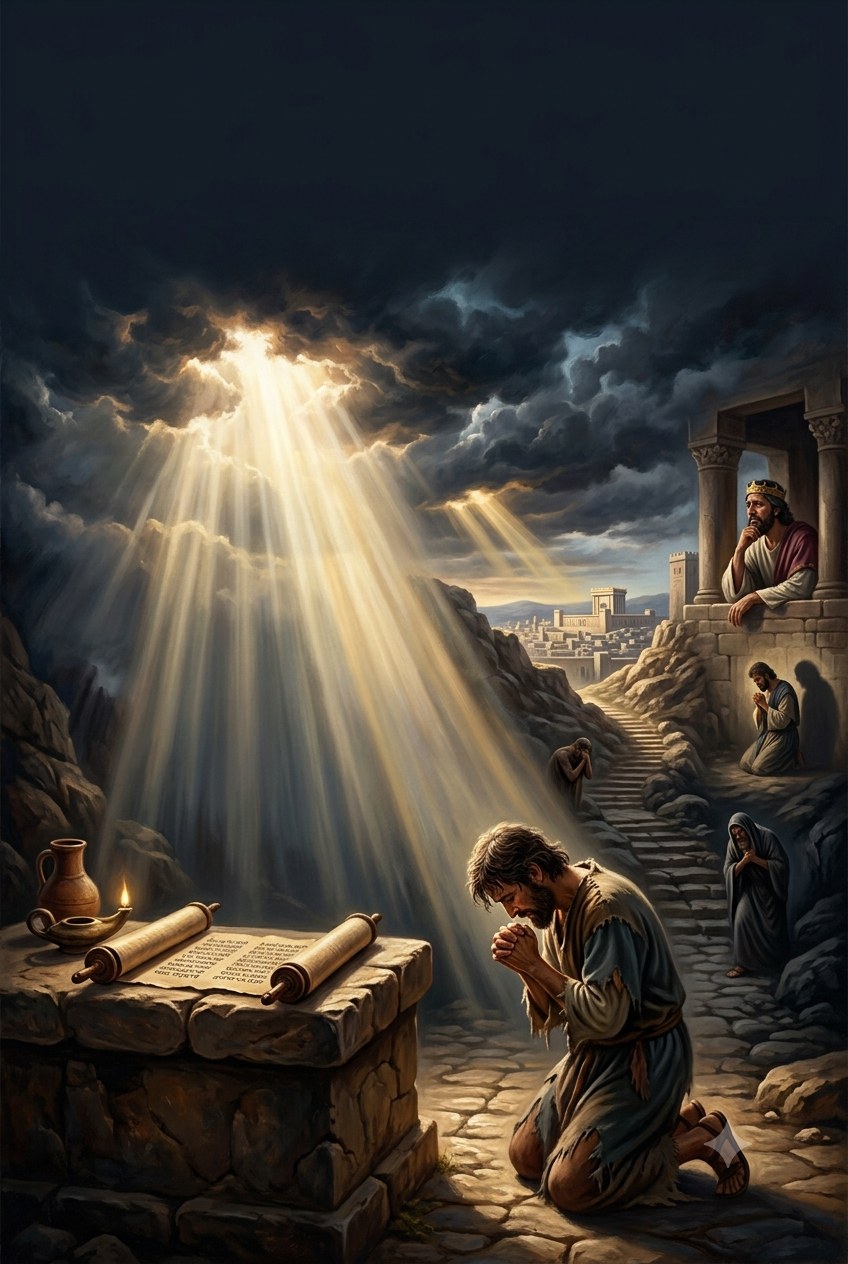
DOES THE ATONING BLOOD OF YAHSHUA CANCEL THE TEMPORAL RESULTS OF DEVIATIONS FROM RECTITUDE?
OPENING TEXT: Blessed is he whose transgression is forgiven, whose sin is covered. Blessed is the man unto whom the LORD imputeth not iniquity, and in whose spirit there is no guile" (Ps.
Chapter 1: INTRODUCTION
OPENING TEXT: Blessed is he whose transgression is forgiven, whose sin is covered. Blessed is the man unto whom the LORD imputeth not iniquity, and in whose spirit there is no guile" (Ps. 32:1-2).
It is written: "And the LORD passed by before him, and proclaimed, The LORD, The LORD GOD, merciful and gracious, longsuffering, and abundant in goodness and truth, Keeping mercy for thousands, forgiving iniquity and transgression and sin, and that will by no means clear the guilty; visiting the iniquity of the fathers upon the children, and upon the children\'s children, unto the third and to the fourth generation" (Ex. 34:6-7).
This was the Almighty GOD declaring His attributes to His servant, Moses in answer to his prayer thus: "Now therefore, I pray thee, if I have found grace in thy sight, shew me now thy way, that I may know thee, that I may find grace in thy sight: and consider that this nation is thy people" (Ex. 33:13). GOD's attributes which He declared to Moses are otherwise called the "thirteen attributes of mercy" or simply "the thirteen qualities."
From those attributes, it is plain that GOD forgives iniquity, transgression and sin. And so it is said in the eighty fifth Psalm: "LORD, thou hast been favourable unto thy land: thou hast brought back the captivity of Jacob. Thou hast forgiven the iniquity of thy people, thou hast covered all their sin. Selah. Thou hast taken away all thy wrath: thou hast turned thyself from the fierceness of thine anger" (Ps. 85:1-3). It is also said: "Moshe and Aharon among his cohanim and Sh'mu'el among those who call on His Name called on Adonai, and He answered them. He spoke to them in the column of cloud; they kept His instructions and the law that He gave them. Adonai our GOD, you answered them. To them you were a forgiving GOD, although You took vengeance on their wrongdoings" (Ps. 99:6-8, CJB).
In many other places, scriptures have not left anyone in doubt that the Creator is a forgiving GOD. Forgiveness naturally follows from man's guilt through sin and subsequent repentance therefrom through a demonstration of remorse and contrition, for the text says: "The sacrifices of GOD are a broken spirit: a broken and a contrite heart, O GOD, Thou wilt not despise" (Ps. 51:17). The text also says: "For thus saith the high and lofty One that inhabiteth eternity, whose Name is Holy; I dwell in the high and holy place, with him also that is of a contrite and humble spirit, to revive the spirit of the humble, and to revive the heart of the contrite ones" (Isa. 57:15). See also Isa. 66:2; Ps. 34:18.
Sin is nothing more than rebellion against GOD. GOD has revealed His will in the Torah and to go contrary to any of its commandments is transgression. Virtue is conformity to the Torah; sin is its disregard. The text says: "Everyone who keeps sinning is violating Torah --- indeed, sin is violation of Torah" (1 Jn. 3:4, CJB). And in the King James Version it is rendered thus: "Whosoever committeth sin transgresseth also the law: for sin is the transgression of the law." See also 1 Jn. 5:17; Rom. 4:15. It follows that every sin is an act of revolt against the divine will.
Sin is sin but it would be admitted that some sins are more serious than others, for the text says: "If any man see his brother sin a sin which is not unto death, he shall ask, and he shall give him life for them that sin not unto death. There is a sin unto death: I do not say that he shall pray for it. All unrighteousness is sin: and there is a sin not unto death" (1 Jn. 5:16-17). As a result some sins are considered as evils of exceptional gravity and cardinal, such as idolatory, unchastity, and bloodshed (Sanh. 74a). Slander is added. A very serious sin is to be the cause of others sinning. Whichever way one wishes to see it, as far as every sin, big or small, is an act of revolt or rebellion against GOD, the sinner is guilty and GOD will not acquit him.
The Prophet Ezekiel was inspired by GOD to say: "As I live, saith the LORD GOD, ye shall not have occasion any more to use this proverb in Israel. Behold, all souls are Mine; as the soul of the father, so also the soul of the son is Mine: the soul that sinneth, it shall die ... The soul that sinneth, it shall die. The son shall not bear the iniquity of the father, neither shall the father bear the iniquity of the son: the righteousness of the righteous shall be upon him, and the wickedness of the wicked shall be upon him" (Ezek. 18:3-4, 20). See also Deut. 24:16; Jer. 31:29-30.
Yahshua had this to say: "Wherefore I say unto you, All manner of sin and blasphemy shall be forgiven unto men: but the blasphemy against the Holy Spirit shall not be forgiven unto men. And whosoever speaketh a word against the Son of man, it shall be forgiven him: but whosoever speaketh against the Holy Spirit, it shall not be forgiven him, neither in this world, neither in the world to come" (Matt. 12:31-32).
And in the book of Hebrews, we read: "For it is impossible for those who were once enlightened, and have tasted of the heavenly gift, and were made partakers of the Holy Spirit, And have tasted the good word of GOD, and the powers of the world to come, If they shall fall away, to renew them again unto repentance; seeing they crucify to themselves the Son of GOD afresh, and put him to an open shame" (Heb. 6:4-6). We also find: "For if we sin wilfully after that we have received the knowledge of the truth, there remaineth no more sacrifice for sins, But a certain fearful looking for of judgment and fiery indignation, which shall devour the adversaries. He that despised Moses\' law died without mercy under two or three witnesses: Of how much sorer punishment, suppose ye, shall he be thought worthy, who hath trodden underfoot the Son of GOD, and hath counted the blood of the covenant, wherewith he was sanctified, an unholy thing, and hath done despite unto the Spirit of grace? For we know Him that hath said, Vengeance belongeth unto me, I will recompense, saith the LORD. And again, The LORD shall judge his people. It is a fearful thing to fall into the hands of the living GOD" (Heb. 10:26-31). This is just as it is written in the law of GOD: "But the soul that doeth ought presumptuously, whether he be born in the land, or a stranger, the same reproacheth the LORD; and that soul shall be cut off from among His people. Because he hath despised the word of the LORD, and hath broken His commandment, that soul shall utterly be cut off; his iniquity shall be upon him" (Num. 15:30-31). See also Prov. 13:13.
The Apostle Peter wrote: "For if after they have escaped the pollutions of the world through the knowledge of the Lord and Saviour Jesus Christ, they are again entangled therein, and overcome, the latter end is worse with them than the beginning. For it had been better for them not to have known the way of righteousness, than, after they have known it, to turn from the holy commandment delivered unto them" (2 Pet. 2:20-21).
There is, however, an insidious message currently being bandied around by Preachers of the word of GOD to the effect that there are people whose sins GOD does not take into account and does not impute iniquity to them because of the words in the opening text, "Blessed is the man unto whom the LORD imputeth not iniquity." Purveyors of such message should have a re-think because by such pernicious and insidious message they blaspheme GOD and misrepresent His character and attributes. Not only that, they cast a stumbling block before the blind and ignorant thereby.
One attribute of GOD as can be seen from His declaration to His servant Moses is that He never acquits the guilty. Anyone who breaks as much as even the least of GOD's commandments is a sinner and therefore, guilty before Him. It follows that GOD punishes man for every sin committed by him.
The implication of this pernicious and insidious message is that GOD does not punish some people for their sins. Another implication is that some people are above the laws of GOD or that GOD holds them to a different standard of righteousness or that GOD loves such people in a special way. This is a perversion of the meaning of GOD's love. No blasphemy can be more serious and nothing can be further from the truth. Contrariwise, it would be seen presently that GOD demonstrates His love for His children when He punishes them for their infractions against His law.
There are other implications. Such persons have no need of confession of sin, or to pray for forgiveness of sin nor repentance from sin, even for all the merits of repentance in the sight of GOD, for it takes only a sinner to repent from sin.
In the famous "Our Lord's Prayer" taught by Yahshua, which prayer is indexed on forgiveness, a suppliant is required to say, "And forgive us our debts, as we forgive our debtors" (Matt. 6:12). The further implication is that such persons whose sins GOD does not take into account are exempt from praying in the example of Yahshua, and if they do say "Our Lord's Prayer" at all they must necessarily skip the part on forgiveness.
Most importantly, persons whose sins are not taken into account are righteous before GOD and share the same prerogative of infallibility with Him, and have no need for atonement. The folly of this blasphemy and harmful teaching mocks the truth of GOD and the Scriptures when it says that there is none righteous before GOD, no, not one. The Scriptures say as follows:
"But we are all as an unclean thing, and all our righteousnesses are as filthy rags; and we all do fade as a leaf; and our iniquities, like the wind, have taken us away" (Isa. 64:6).
"For there is not a just man upon earth, that doeth good, and sinneth not" (Eccles. 7:20).
"If they sin against thee, (for there is no man that sinneth not,) and thou be angry with them, and deliver them to the enemy, so that they carry them away captives unto the land of the enemy, far or near" (1 Kgs. 8:46). See also 2 Chron. 6:36.
"Who can say, I have made my heart clean, I am pure from my sin?" (Prov. 20:9).
"If we say that we have no sin, we deceive ourselves, and the truth is not in us. If we confess our sins, he is faithful and just to forgive us our sins, and to cleanse us from all unrighteousness. If we say that we have not sinned, we make him a liar, and his word is not in us" (1 Jn. 1:8-10).
"I know it is so of a truth: but how should man be just with GOD?" (Job. 9:2).
"And enter not into judgment with thy servant: for in thy sight shall no man living be justified" (Ps.143:2).
"What is man, that he should be clean? And he which is born of a woman, that he should be righteous? Behold, He putteth no trust in His saints; yea, the heavens are not clean in His sight. How much more abominable and filthy is man, which drinketh iniquity like water?" (Job. 15:14-16).
"How then can man be justified with GOD? Or how can he be clean that is born of a woman? Behold even to the moon, and it shineth not; yea, the stars are not pure in his sight. How much less man, that is a worm? And the son of man, which is a worm?" (Job. 25:4-6).
"If thou, LORD, shouldest mark iniquities, O LORD, who shall stand? But there is forgiveness with thee, that thou mayest be feared" (Ps. 130:3-4).
There are also dispensational Preachers of the Pentecostal and Charismatic stock who teach that sin is no longer imputed to the people of GOD by reason of the death of Yahshua on the tree of Calvary, for according to them profession of belief in Yahshua suffices, for according to them, this is the meaning of the text which says: "Therefore by the deeds of the law there shall no flesh be justified in His sight: for by the law is the knowledge of sin. But now the righteousness of GOD without the law is manifested, being witnessed by the law and the prophets; Even the righteousness of GOD which is by faith of Jesus Christ unto all and upon all them that believe: for there is no difference: For all have sinned, and come short of the glory of GOD; Being justified freely by his grace through the redemption that is in Christ Jesus: Whom GOD hath set forth to be a propitiation through faith in his blood, to declare his righteousness for the remission of sins that are past, through the forbearance of GOD; To declare, I say, at this time his righteousness: that he might be just, and the justifier of him which believeth in Jesus" (Rom. 3:20-26).
The deeds of the law by which no man shall be justified refers simply to the letter of the law. It is the same thing as righteousness of the law. When obedience to the law of GOD falls short of the purpose for which the law was given, that is, the spirit behind the law, it affords no justification in the sight of GOD. It is called righteousness of the law. This is the case where one is said to keep the law but he is not spiritual. He does not bear or manifest the fruits of the Holy Spirit. He is a carnal man, full of evil works, unloving, wicked, proud, arrogant, unforgiving, faithless, vengeful, unmerciful, hypocritical etc. Man is required to serve the spirit behind the Law in the example of Yahshua the Messiah, who speaking about himself, said: "Come unto me, all ye that labour and are heavy laden, and I will give you rest. Take my yoke upon you, and learn of me; for I am meek and lowly in heart: and ye shall find rest unto your souls. For my yoke is easy, and my burden is light" (Matt. 11:28-30). This is called righteousness of faith.
Yahshua epitomized and exemplified love, for the text says: "As the Father hath loved me, so have I loved you: continue ye in my love. If ye keep my commandments, ye shall abide in my love; even as I have kept my Father\'s commandments, and abide in His love. These things have I spoken unto you, that my joy might remain in you, and that your joy might be full. This is my commandment, That ye love one another, as I have loved you. Greater love hath no man than this, that a man lay down his life for his friends" (Jn. 15:9-13). Yahshua obeyed all the commandments of GOD and was full of goodness. He served the spirit of the law and was meek and humble, kind, merciful, gracious, compassionate, forgiving etc. He said: "But go ye and learn what that meaneth, I will have mercy, and not sacrifice: for I am not come to call the righteous, but sinners to repentance" (Matt. 9:13).
To be like Yahshua is the very essence of the law given to man. It is not to disobey GOD's law while professing belief in Yahshua. The Apostle Paul wrote to the Romans: "But Israel, which followed after the law of righteousness, hath not attained to the law of righteousness. Wherefore? Because they sought it not by faith, but as it were by the works of the law. For they stumbled at that stumblingstone; As it is written, Behold, I lay in Sion a stumblingstone and rock of offence: and whosoever believeth on him shall not be ashamed" (Rom. 9:31-33).
Israel did not attain righteousness because they served the letter and not the spirit of the law. To serve the spirit of the law is to be spiritual and obey the law in the example of Yahshua. That is righteousness of faith. Paul also wrote: Brethren, my heart\'s desire and prayer to GOD for Israel is, that they might be saved. For I bear them record that they have a zeal of GOD, but not according to knowledge. For they being ignorant of GOD\'s righteousness, and going about to establish their own righteousness, have not submitted themselves unto the righteousness of GOD. For Christ is the end (purpose) of the law for righteousness to everyone that believeth" (Rom. 10:1-4). See also Rom. 8:28-29; Gal. 3:24.
To buttress my point further, the Apostle Paul wrote to the Galatians: "Knowing that a man is not justified by the works of the law, but by the faith of Jesus Christ, even we have believed in Jesus Christ, that we might be justified by the faith of Christ, and not by the works of the law: for by the works of the law shall no flesh be justified. But if, while we seek to be justified by Christ, we ourselves also are found sinners, is therefore Christ the minister of sin? GOD forbid!" (Gal. 2:16-17).
Works of the law is the same as deeds of the law. It is the same as letter of the law. It is said that the letter kills but the spirit gives life. See Rom. 7:6; 8:2; 2 Cor. 3:6.
GOD's laws must be kept. Yahshua was deliberate when he declared: "Do not think that I have come to do away with the Law of Moses and the teachings of the prophets. I have not come to do away with them, but to make their teachings come true. Remember that as long as heaven and earth last, not the least point nor the smallest detail of the Law will be done away with --- not until the end of all things. So then, whoever disobeys even the least important of the commandments and teaches others to do the same, will be least in the Kingdom of heaven. On the other hand, whoever obeys the Law and teaches others to do the same, will be great in the Kingdom of heaven. I tell you, then, that you will be able to enter the Kingdom of heaven only if you are more faithful than the teachers of the Law and the Pharisees in doing what God requires" (Matt. 5:17-20, GNT). Heaven and Earth are still very much with us.
Interpreting the Apostle Paul incorrectly, they also cite the following texts to buttress their confusion:
"For He hath made him to be sin for us, who knew no sin; that we might be made the righteousness of GOD in him" (2 Cor. 5:21).
"For as by one man\'s disobedience many were made sinners, so by the obedience of one shall many be made righteous" (Rom. 5:19).
"Christ hath redeemed us from the curse of the law, being made a curse for us: for it is written, Cursed is every one that hangeth on a tree" (Gal. 3:13).
"And ye know that he was manifested to take away our sins; and in him is no sin" (1 Jn. 3:5).
"For then must he often have suffered since the foundation of the world: but now once in the end of the world hath he appeared to put away sin by the sacrifice of himself ... So Christ was once offered to bear the sins of many; and unto them that look for him shall he appear the second time without sin unto salvation" (Heb. 9:26, 28).
They also cite the prophecy of Isaiah to buttress their confusion, for the text says: "But he was wounded for our transgressions, he was bruised for our iniquities: the chastisement of our peace was upon him; and with his stripes we are healed. All we like sheep have gone astray; we have turned everyone to his own way; and the LORD hath laid on him the iniquity of us all ... He shall see of the travail of his soul, and shall be satisfied: by his knowledge shall my righteous servant justify many; for he shall bear their iniquities. Therefore will I divide him a portion with the great, and he shall divide the spoil with the strong; because he hath poured out his soul unto death: and he was numbered with the transgressors; and he bare the sin of many, and made intercession for the transgressors" (Isa. 53:5-6, 11-12).
Question No. 1: "How are we made the righteousness of GOD in Yahshua?" (2 Cor. 5:21).
Answer: It simply means that if we obey GOD laws in the example of Yahshua, we have fulfilled GOD's standard of righteousness., as it is said: "For even hereunto were ye called: because Christ also suffered for us, leaving us an example, that ye should follow his steps: Who did no sin, neither was guile found in his mouth: Who, when he was reviled, reviled not again; when he suffered, he threatened not; but committed himself to him that judgeth righteously. Who his own self bare our sins in his own body on the tree, that we, being dead to sins, should live unto righteousness: by whose stripes ye were healed. For ye were as sheep going astray; but are now returned unto the Shepherd and Bishop of your souls" (1 Pet. 2:21-25).
Question NO. 2: "How are we made righteous by the obedience of one man (Yahshua)? (Rom. 5:19).
Answer: Our righteousness is not automatic because Yahshua obeyed GOD. We are made righteous if we live by his example of righteousness. And that is when we obey the laws of GOD to serve the spirit of the law. We are exhorted: "Wherefore, my beloved, as ye have always obeyed, not as in my presence only, but now much more in my absence, work out your own salvation with fear and trembling" (Phil. 2:12). We are made righteous when we obey the commandments of GOD, as it is said: "And it shall be our righteousness, if we observe to do all these commandments before the LORD our GOD, as He hath commanded us" (Deut. 6:25). Conversely, we are unrighteous when we commit sin, as it is said: "All unrighteousness is sin...." (1 Jn. 5:17).
Question No. 3: "What is the curse of the law from which we have been redeemed? (Gal. 3:13).
Answer: The curse of the law is "Sin." To believe in Yahshua means that we will not serve sin anymore. We will not disobey GOD's laws again. We are not to obey the devil anymore, for sin is obedience to the devil and disobedience to GOD. It has been said: "Whosoever committeth sin transgresseth also the law: for sin is the transgression of the law. And ye know that he was manifested to take away our sins; and in him is no sin ...He that committeth sin is of the devil; for the devil sinneth from the beginning. For this purpose the Son of GOD was manifested, that he might destroy the works of the devil. Whosoever is born of GOD doth not commit sin; for his seed remaineth in him: and he cannot sin, because he is born of God. In this the children of GOD are manifest, and the children of the devil: whosoever doeth not righteousness is not of GOD, neither he that loveth not his brother" (1 Jn. 3:4-5, 8-10).
It is also said: "Know ye not, that to whom ye yield yourselves servants to obey, his servants ye are to whom ye obey; whether of sin unto death, or of obedience unto righteousness? ...For when ye were the servants of sin, ye were free from righteousness" (Rom. 6:16, 20). See also Jn. 8:34.
Question No. 4: "He was manifested to take away our sin (1 Jn. 3:5). What sin did he take away?
Answer: He took away our past sins, as it is said: "Whom GOD hath set forth to be a propitiation through faith in his blood, to declare his righteousness for the remission of sins that are past, through the forbearance of GOD" (Rom. 3:25). The text says: "And you hath he quickened, who were dead in trespasses and sins; Wherein in time past ye walked according to the course of this world, according to the prince of the power of the air, the spirit that now worketh in the children of disobedience: Among whom also we all had our conversation in times past in the lusts of our flesh, fulfilling the desires of the flesh and of the mind; and were by nature the children of wrath, even as others. But GOD, who is rich in mercy, for His great love wherewith He loved us, Even when we were dead in sins, hath quickened us together with Christ, (by grace ye are saved;) And hath raised us up together, and made us sit together in heavenly places in Christ Jesus: That in the ages to come He might shew the exceeding riches of His grace in His kindness toward us through Christ Jesus. For by grace are ye saved through faith; and that not of yourselves: it is the gift of GOD: Not of works, lest any man should boast. For we are his workmanship, created in Christ Jesus unto good works, which GOD hath before ordained that we should walk in them" (Eph. 2:1-10).
It is recorded: "Sirs, why do ye these things? We also are men of like passions with you, and preach unto you that ye should turn from these vanities unto the living GOD, which made heaven, and earth, and the sea, and all things that are therein: Who in times past suffered all nations to walk in their own ways" (Acts 14:15-16).
It is said: "And the times of this ignorance GOD winked at; but now commandeth all men everywhere to repent" (Acts 17:30). And it is also said: "For the grace of GOD that bringeth salvation hath appeared to all men, Teaching us that, denying ungodliness and worldly lusts, we should live soberly, righteously, and godly, in this present world" (Tit. 2:11-12).
Question No. 5: How did Yahshua put away sin by the sacrifice of himself once? (Heb. 9:26, 28).
Answer: Yahshua did not put away sin by his death in the sense of abolition of sin. Since his death there is still sin. He died that he might reconcile us unto GOD so that we be dead to sin and not live in sin again. We were separated from GOD because of sin. He was the bridge that brought us back to GOD so that we live in his example of sinlessness. The text says: "For Christ also hath once suffered for sins, the just for the unjust, that he might bring us to GOD, being put to death in the flesh, but quickened by the Spirit" (1 Pet. 3:18). The text also says: "And you, that were sometime alienated and enemies in your mind by wicked works, yet now hath he reconciled in the body of his flesh through death, to present you holy and unblameable and unreproveable in his sight" (Col. 1:21-22). And the text further says: "Forasmuch then as Christ hath suffered for us in the flesh, arm yourselves likewise with the same mind: for he that hath suffered in the flesh hath ceased from sin; That he no longer should live the rest of his time in the flesh to the lusts of men, but to the will of GOD" (1 Pet. 4:1-2).
Question No. 6: Why was the iniquity of all laid upon Yahshua and why was he wounded for our transgressions and bruised for our iniquities? (Isa. 53).
Answer: It is in order that we may see the exceeding sinfulness of sin, deny sin and live for him, for it is said: "And that he died for all, that they which live should not henceforth live unto themselves, but unto him which died for them, and rose again" (2 Cor. 5:15). It is said: "I am crucified with Christ: nevertheless I live; yet not I, but Christ liveth in me: and the life which I now live in the flesh I live by the faith of the Son of GOD, who loved me, and gave himself for me" (Gal. 2:20). See also Rom. 14:7-8; 1 Thess. 5:10; 1 Pet. 4:2; Rom. 6:11-12.
From the questions and answers presented above, it is clear that there has been a misinterpretation of Prophet Isaiah and the Apostles by Christendom's too numerous false preachers.
Chapter 2: A JUST AND RIGHTEOUS GOD
It is said: "Righteousness and justice are the foundation of your throne; grace and truth attend you" (Ps. 89:14, CJB). See also 97:2. The text also says: ".... for the LORD is a GOD of judgment: blessed are all they that wait for him" (Isa. 30:18).
Justice being an attribute of GOD, it follows that He deals justly with His creatures. It would be expected in a universe governed by a just Judge, that the righteous be rewarded for their faithfulness to the divine will and the wicked punished for their rebelliousness.
This is the more so when it is said of GOD: "The Rock! His work is perfect, for all his ways are just. A trustworthy GOD who does no wrong, He is righteous and straight" (Deut. 32:4, CJB). See also Ps. 92:15; 145:17; 2 Sam. 22:31; Job. 34:10; 2 Chron. 19:7.
A just and righteous GOD He is. It is written in the law of GOD: "Ye shall do no unrighteousness in judgment: thou shalt not respect the person of the poor, nor honour the person of the mighty: but in righteousness shalt thou judge thy neighbor" (Lev. 19:15). This is what GOD said to man. It is also written:
"Ye shall not respect persons in judgment; but ye shall hear the small as well as the great; ye shall not be afraid of the face of man; for the judgment is GOD\'s ...." (Deut. 1:17).
"Thou shalt not wrest judgment; thou shalt not respect persons, neither take a gift: for a gift doth blind the eyes of the wise, and pervert the words of the righteous" (Deut. 16:19).
"Thou shalt not follow a multitude to do evil; neither shalt thou speak in a cause to decline after many to wrest judgment: Neither shalt thou countenance a poor man in his cause ... Thou shalt not wrest the judgment of thy poor in his cause ... And thou shalt take no gift: for the gift blindeth the wise, and perverteth the words of the righteous" (Ex. 23:2-3, 6, 8).
"A wicked man taketh a gift out of the bosom to pervert the ways of judgment" (Prov. 12:23).
"These things also belong to the wise. It is not good to have respect of persons in judgment" (Prov. 24:23).
"It is not good to accept the person of the wicked, to overthrow the righteous in judgment" (Prov. 18:5). See also Prov. 28:21.
Concerning GOD, it is said as follows:
"For the LORD your GOD is GOD of gods, and LORD of lords, a great GOD, a mighty, and a terrible, which regardeth not persons, nor taketh reward" (Deut. 10:17).
GOD being a just and righteous Judge, He cannot be partial in Judgment. Therefore the following texts say:
"For there is no respect of persons with GOD. For as many as have sinned without law shall also perish without law: and as many as have sinned in the law shall be judged by the law; (For not the hearers of the law are just before GOD, but the doers of the law shall be justified" (Rom. 2:11-13).
"Take heed what ye do: for ye judge not for man, but for the LORD, who is with you in the judgment. Wherefore now let the fear of the LORD be upon you; take heed and do it: for there is no iniquity with the LORD our GOD, nor respect of persons, nor taking of gifts" (2 Chron. 19:6-7).
"How much less to Him that accepteth not the persons of princes, nor regardeth the rich more than the poor? For they all are the work of His Hands" (Job. 34:19).
"And if ye call on the FATHER, who without respect of persons judgeth according to every man\'s work, pass the time of your sojourning here in fear" (1 Pet. 1:17).
"Knowing that whatsoever good thing any man doeth, the same shall he receive of the LORD, whether he be bond or free. And, ye masters, do the same things unto them, forbearing threatening: knowing that your Master also is in heaven; neither is there respect of persons with Him" (Eph. 6:8-9).
As with sin, so also with righteousness. GOD is no respecter of persons, just as the text says: "Then Peter opened his mouth, and said, Of a truth I perceive that GOD is no respecter of persons: But in every nation he that feareth Him, and worketh righteousness, is accepted with Him" (Acts 10:34-35).
What all of these mean is that with GOD all are equal before His law, high and low, rich and poor. This is notwithstanding what appears to be the suggestion in the text: "My foot hath held His steps, His way have I kept, and not declined. Neither have I gone back from the commandment of His lips; I have esteemed the words of His mouth more than my necessary food. But He is in one mind, and who can turn Him? And what His soul desireth, even that he doeth. For He performeth the thing that is appointed for me: and many such things are with Him" (Job 23:11-14).
Chapter 3: REPENTANCE
GOD delights not in the death of the wicked (a sinner) but that he turn from his evil way and live, for the text says: "Say unto them, As I live, saith the LORD GOD, I have no pleasure in the death of the wicked; but that the wicked turn from his way and live: turn ye, turn ye from your evil ways; for why will ye die, O house of Israel?" (Ezek. 33:11). The text also says: "Have I any pleasure at all that the wicked should die? Saith the LORD GOD: and not that he should return from his ways, and live? ... Therefore I will judge you, O house of Israel, every one according to his ways, saith the LORD GOD. Repent, and turn yourselves from all your transgressions; so iniquity shall not be your ruin. Cast away from you all your transgressions, whereby ye have transgressed; and make you a new heart and a new spirit: for why will ye die, O house of Israel? For I have no pleasure in the death of him that dieth, saith the LORD GOD: wherefore turn yourselves, and live ye" (Ezek. 18:23, 30-32). See also 2 Pet. 3:9; Rev. 2:5. It follows that GOD is anxious for man to repent and not delay to do so.
Repentance must be sincere and must result from heartfelt remorse. Repentance and good deeds are man's advocates (Shab. 32a). Repentance and good deeds are a shield against punishment (Aboth iv. 13). And it is said in the Talmud that three things can annul evil decrees: prayer, charity, and repentance.
Judaism teaches that repentance is one of the things which were designed by GOD even before the world was created in order for evil not to overrun the world created for the habitation of man.
Repentance therefore, has the power to stem the tide of evil and to neutralize it. It is said in the Talmud: "Great is repentance, for it reaches to the Throne of Glory. Great is repentance, for it makes the redemption (by the Messiah) to come near. Great is repentance, for it lengthens the years of a man's life" (Yoma 86a). It is said: "The place which the penitent occupy, the perfectly righteous are unable to occupy" (Ber. 34b). It is said: "There is nothing greater than repentance" (Deut. R. 11. 24). It is also said: "Better is one hour of repentance and good deeds in this world than the whole life of the world to come" (Aboth iv. 22).
Repentance is a means of expiation. The sacrifices of GOD are a broken spirit. Even with the sacrificial system in operation, contrition is essential before an offering could prove acceptable to GOD. Neither sin offering nor trespass offering nor death nor the Day of Atonement (Yom Kippur) can bring expiation without repentance (Tosifta Yoma v. 9).
The text says: "He that covereth his sins shall not prosper: but whoso confesseth and forsaketh them shall have mercy" (Prov. 28:13). It also says: "I acknowledged my sin unto thee, and mine iniquity have I not hid. I said, I will confess my transgressions unto the LORD; and thou forgavest the iniquity of my sin. Selah" (Ps. 32:5).
To underscore the importance of repentance, Yahshua taught saying: "Likewise, I say unto you, there is joy in the presence of the angels of GOD over one sinner that repenteth" (Lk. 15:10). Yahshua told the parable of the prodigal son to drive this point home. See Lk. 15:11-32.
Chapter 4: THE CONCEPT OF REWARD AND PUNISHMENT
The text says: "...and that will by no means clear the guilty; visiting the iniquity of the fathers upon the children, and upon the children\'s children, unto the third and to the fourth generation" (Ex. 34:7). See also Num. 14:18. The text also says: "GOD is jealous, and the LORD revengeth; the LORD revengeth, and is furious; the LORD will take vengeance on his adversaries, and he reserveth wrath for his enemies. The LORD is slow to anger, and great in power, and will not at all acquit the wicked: the LORD hath his way in the whirlwind and in the storm, and the clouds are the dust of his feet" (Nahum 1:2-3).
The text says: "To me belongeth vengeance, and recompence; their foot shall slide in due time: for the day of their calamity is at hand, and the things that shall come upon them make haste ... See now that I, even I, am he, and there is no god with me: I kill, and I make alive; I wound, and I heal: neither is there any that can deliver out of my hand. For I lift up my hand to heaven, and say, I live forever. If I whet my glittering sword, and mine hand take hold on judgment; I will render vengeance to mine enemies, and will reward them that hate me. I will make mine arrows drunk with blood, and my sword shall devour flesh; and that with the blood of the slain and of the captives, from the beginning of revenges upon the enemy. Rejoice, O ye nations, with his people: for he will avenge the blood of his servants, and will render vengeance to his adversaries, and will be merciful unto his land, and to his people" (Deut. 32:35, 39-43). See also Isa. 1:24; Nahum 1:2; Deut. 28:63.
The text also says: "Because I have called, and ye refused; I have stretched out my hand, and no man regarded; But ye have set at nought all my counsel, and would none of my reproof: I also will laugh at your calamity; I will mock when your fear cometh; When your fear cometh as desolation, and your destruction cometh as a whirlwind; when distress and anguish cometh upon you. Then shall they call upon me, but I will not answer; they shall seek me early, but they shall not find me: For that they hated knowledge, and did not choose the fear of the LORD: They would none of my counsel: they despised all my reproof. Therefore shall they eat of the fruit of their own way, and be filled with their own devices. For the turning away of the simple shall slay them, and the prosperity of fools shall destroy them. But whoso hearkeneth unto me shall dwell safely, and shall be quiet from fear of evil" (Prov. 1:24-33).
The text further says: "Shout against her round about: she hath given her hand: her foundations are fallen, her walls are thrown down: for it is the vengeance of the LORD: take vengeance upon her; as she hath done, do unto her ... Call together the archers against Babylon: all ye that bend the bow, camp against it round about; let none thereof escape: recompense her according to her work; according to all that she hath done, do unto her: for she hath been proud against the LORD, against the Holy One of Israel" (Jer. 50:15, 29).
"And I will render unto Babylon and to all the inhabitants of Chaldea all their evil that they have done in Zion in your sight, saith the LORD ... Because the spoiler is come upon her, even upon Babylon, and her mighty men are taken, every one of their bows is broken: for the LORD GOD of recompences shall surely requite" (Jer. 51:24, 56).
Judaism teaches that obedience to the will of GOD is rewarded, and disobedience punished. This is the doctrine of GOD's retributive righteousness. He is a GOD of retribution. He is a GOD of vengeance. He avenges His enemies, the wicked, the law breakers (sinners). The text says: "thou son of man, thus saith the LORD GOD unto the land of Israel; An end, the end is come upon the four corners of the land. Now is the end come upon thee, and I will send mine anger upon thee, and will judge thee according to thy ways, and will recompense upon thee all thine abominations. And mine eye shall not spare thee, neither will I have pity: but I will recompense thy ways upon thee, and thine abominations shall be in the midst of thee: and ye shall know that I am the LORD ... And mine eye shall not spare, neither will I have pity: I will recompense thee according to thy ways and thine abominations that are in the midst of thee; and ye shall know that I am the LORD that smiteth" (Ezek. 7:2-4, 9). It also says: "Then said he unto me, The iniquity of the house of Israel and Judah is exceeding great, and the land is full of blood, and the city full of perverseness: for they say, The LORD hath forsaken the earth, and the LORD seeth not. And as for me also, mine eye shall not spare, neither will I have pity, but I will recompense their way upon their head" (Ezek. 9:9-10). See also 11:21.
The text says: "Say ye to the righteous, that it shall be well with him: for they shall eat the fruit of their doings. Woe unto the wicked! It shall be ill with him: for the reward of his hands shall be given him" (Isa. 3:10-11). See also Ps. 11:6; 34:15-16; 147:10-11; Eccles. 8:12-13; Ps. 128:1-2; Deut. 28:1-68; Lev. 26:1-39.
One of the thirteen principles of the faith of a Jew is that GOD recompenses man with kindness according to his deed, and places evil on the wicked according to his wickedness. In other words, GOD rewards the good according to their merits and punishes the wicked according to their deserts. That is, indeed, the general doctrine found in the Talmud. "There is no suffering without iniquity" (Shab. 55a); "All the judgments of the Holy One, blessed be He, are on the basis of measure for measure" (Sanh. 90a). This is the concept of reward and punishment as the following texts make even clearer:
"Who will render to every man according to his deeds" (Rom. 2:6).
"For the work of a man shall he render unto him, and cause every man to find according to his ways" (Job. 34:11).
"Also unto thee, O LORD, belongeth mercy: for thou renderest to every man according to his work" (Ps. 62:12).
"If thou sayest, Behold, we knew it not; doth not He that pondereth the heart consider it? And He that keepeth thy soul, doth not He know it? And shall not He render to every man according to his works?" (Prov. 24:12).
"I the LORD search the heart, I try the reins, even to give every man according to his ways, and according to the fruit of his doings" (Jer. 17:10).
"Great in counsel, and mighty in work: for Thine eyes are open upon all the ways of the sons of men: to give every one according to his ways, and according to the fruit of his doings" (Jer. 32:19).
"Let us hear the conclusion of the whole matter: Fear GOD, and keep His commandments: for this is the whole duty of man. For GOD shall bring every work into judgment, with every secret thing, whether it be good, or whether it be evil" (Eccles. 12:13-14).
Concerning Yahshua it is said:
"For what is a man profited, if he shall gain the whole world, and lose his own soul? Or what shall a man give in exchange for his soul? For the Son of man shall come in the glory of his Father with his angels; and then he shall reward every man according to his works" (Matt. 16:26-27).
"For we must all appear before the judgment seat of Christ; that every one may receive the things done in his body, according to that he hath done, whether it be good or bad" (2 Cor. 5:10).
"And I saw the dead, small and great, stand before GOD; and the books were opened: and another book was opened, which is the book of life: and the dead were judged out of those things which were written in the books, according to their works. And the sea gave up the dead which were in it; and death and hell delivered up the dead which were in them: and they were judged every man according to their works. And death and hell were cast into the lake of fire. This is the second death. And whosoever was not found written in the book of life was cast into the lake of fire" (Rev. 20:12-15).
"And I gave her space to repent of her fornication; and she repented not. Behold, I will cast her into a bed, and them that commit adultery with her into great tribulation, except they repent of their deeds. And I will kill her children with death; and all the churches shall know that I am he which searcheth the reins and hearts: and I will give unto every one of you according to your works" (Rev. 2:21-23).
"He that is unjust, let him be unjust still: and he which is filthy, let him be filthy still: and he that is righteous, let him be righteous still: and he that is holy, let him be holy still. And, behold, I come quickly; and my reward is with me, to give every man according as his work shall be" (Rev. 22:11-12).
"Judge not according to the appearance, but judge righteous judgment" (Jn. 7:24).
"For in him we live, and move, and have our being; as certain also of your own poets have said, for we are also his offspring. Forasmuch then as we are the offspring of GOD, we ought not to think that the Godhead is like unto gold, or silver, or stone, graven by art and man\'s device. And the times of this ignorance God winked at; but now commandeth all men everywhere to repent: Because he hath appointed a day, in the which he will judge the world in righteousness by that man whom he hath ordained; whereof he hath given assurance unto all men, in that he hath raised him from the dead" (Acts 17:28-31).
Experiences of life might suggest that the righteous are not necessarily rewarded by happiness and prosperity. In fact, very often the righteous seem to be marked out for exceptional adversity, for the text says: "Many are the afflictions of the righteous: but the LORD delivereth him out of them all" (Ps. 34:19).
The wicked, similarly, are not seen to be conspicuously frowned upon by GOD and His displeasure with them are not necessarily proved by hardships and sufferings. On the contrary, fortune seems to smile upon them and they prosper. It is a world-riddle understood only under the influence of the belief in the immortality of the soul.
It is said that GOD brings sufferings upon the righteous in this world so that they may inherit the world to come, for the text says: "Though thy beginning was small, yet thy latter end should greatly increase" (Job 8:7). Similarly, GOD grants happiness to the wicked in this world in order to banish and drive them to the lowest degree (of Gehinnom), for the text says: "There is a way which seemeth right unto a man, but the end thereof are the ways of death" (Prov. 14:12; 16:25).
It has been said that one cannot have the best of both worlds, or as it is put, "eat at two tables."
The standpoint of Rabbinical law is: "A man is in duty bound to utter a benediction for the bad even as he utters one for the good; as it is said, 'And thou shall love the LORD thy GOD with all thy heart, and with all thy soul, and with all thy might" (Deut. 6:5) -- "With all thy heart," that is, with thy two impulses, with the good and the evil impulse; "With all thy soul," that is, even if He take thy soul; "With all thy might," that is, with all thy wealth. Another explanation of "With all thy might" is, with whatever measure he metes out to thee, do thou return Him thanks" (Ber. Ix. 5).
This agrees with what the Apostle Paul said to the Thessalonians: "In everything give thanks: for this is the will of GOD in Christ Jesus concerning you" (1 Thess. 5:18). See also Eph. 5:20; Col. 3:17.
Although the doctrine of reward and punishment features prominently in Talmudic teaching, nevertheless, it is exhorted again and again that the service of GOD must be disinterested and His commandments observed with pure motives, for "Blessed is the man that delighteth greatly in His commandments" (Ps. 112:1) -- in His commandments, not in the reward of His commandments (A.Z. 19a). "Be not like servants who minister to their master upon the condition of receiving a reward; but be like servants who minister to their master without the condition of receiving a reward; and let the fear of heaven be upon you" (Aboth 1.3). For greater is he who performs the commandments from love than he who performs them from fear (Sot. 31a).
Chapter 5: ATONEMENT
Reality transcends fiction. However much one deludes oneself, GOD is a GOD who chastises in this world for deviations from rectitude. The text says: "Because sentence against an evil work is not executed speedily, therefore the heart of the sons of men is fully set in them to do evil" (Eccles. 8:11). GOD knows when and how He punishes for sins. That punishment for sin is not immediate does not imply that GOD would not punish. He has the prerogative of timing for punishment for transgressions, though a sinner's life be prolonged or his riches increase.
Following the sin of the golden calf, Moses the servant of the Most High GOD interceded for the people and prayed: "Oh, this people have sinned a great sin, and have made them gods of gold. Yet now, if thou wilt forgive their sin\--; and if not, blot me, I pray thee, out of Thy book which Thou hast written" (Ex. 32:31-32). GOD's response to his prayer of intercession was: "Whosoever hath sinned against me, him will I blot out of my book. Therefore now go, lead the people unto the place of which I have spoken unto thee: behold, mine Angel shall go before thee: nevertheless in the day when I visit I will visit their sin upon them" (Verses 33-34). It is plain that GOD has the prerogative of timing for punishment for sins, for exaction of vengeance from His enemies.
GOD's chastisement is atonement for the sins we commit. Contrition and repentance earns the guilty GOD's forgiveness. Forgiveness does not, however, absolve one from atoning for the sin forgiven. It is atonement that washes away and clears one's guilt before GOD. When that happens, it is then said as in the opening text: "Blessed is he whose transgression is forgiven, whose sin is covered. Blessed is the man unto whom the LORD imputeth not iniquity, and in whose spirit there is no guile" (Ps. 32:1-2).
It is implicit in the words of prayer following the opening text that the suppliant atoned for his sin despite his being forgiven, for the text says: "When I kept silence, my bones waxed old through my roaring all the day long. For day and night thy hand was heavy upon me: my moisture is turned into the drought of summer" (Ps. 32:3-4). The same is implied when the suppliant prayed saying: "For thine arrows stick fast in me, and thy hand presseth me sore. There is no soundness in my flesh because of thine anger; neither is there any rest in my bones because of my sin. For mine iniquities are gone over mine head: as an heavy burden they are too heavy for me. My wounds stink and are corrupt because of my foolishness. I am troubled; I am bowed down greatly; I go mourning all the day long. For my loins are filled with a loathsome disease: and there is no soundness in my flesh. I am feeble and sore broken: I have roared by reason of the disquietness of my heart" (Ps. 38:2-8). It is the same as Job saying: "For the arrows of the Almighty are within me, the poison whereof drinketh up my spirit: the terrors of God do set themselves in array against me" (Job 6:4).
Atonement for sin often takes the form of suffering, trials and tribulations. It is baptism by fire. An example is the case of King David who sinned against GOD and was guilty in the matter of Uriah the Hittite who was killed and his wife, Bathsheba taken by him. Despite obtaining the forgiveness of GOD following his contrition and repentance, GOD's judgment against him for his sins stood and played out as pronounced by the Righteous Judge through the Prophet Nathan.
GOD's judgment against David were in the following terms: "Now therefore, the sword shall never depart from thine house; because thou hast despised Me, and hast taken the wife of Uriah the Hittite to be thy wife. Thus saith the LORD, Behold, I will raise up evil against thee out of thine own house, and I will take thy wives before thine eyes, and give them unto thy neighbour, and he shall lie with thy wives in the sight of this sun. For thou didst it secretly: but I will do this thing before all Israel, and before the sun" (2 Sam. 12:10-12).
King David atoned for the sins for which GOD pronounced judgment on him, although he was forgiven. We read about the incest committed by his son, Amnon and virgin daughter Tamar, following Jonadab's ill advice. For the text says: "And Amnon said unto Tamar, Bring the meat into the chamber, that I may eat of thine hand. And Tamar took the cakes which she had made, and brought them into the chamber to Amnon her brother. And when she had brought them unto him to eat, he took hold of her, and said unto her, Come lie with me, my sister. And she answered him, Nay, my brother, do not force me; for no such thing ought to be done in Israel: do not thou this folly. And I, whither shall I cause my shame to go? and as for thee, thou shalt be as one of the fools in Israel. Now therefore, I pray thee, speak unto the king; for he will not withhold me from thee. Howbeit he would not hearken unto her voice: but, being stronger than she, forced her, and lay with her" (2 Sam.13: 10-14).
Tamar war Absalom's uterine sister. Absalom murdered Amnon as a result, for the text says: "And Absalom her brother said unto her, Hath Amnon thy brother been with thee? But hold now thy peace, my sister: he is thy brother; regard not this thing. So Tamar remained desolate in her brother Absalom\'s house. But when king David heard of all these things, he was very wroth. And Absalom spake unto his brother Amnon neither good nor bad: for Absalom hated Amnon, because he had forced his sister Tamar. And it came to pass after two full years, that Absalom had sheepshearers in Baalhazor, which is beside Ephraim: and Absalom invited all the king\'s sons. And Absalom came to the king, and said, Behold now, thy servant hath sheepshearers; let the king, I beseech thee, and his servants go with thy servant. And the king said to Absalom, Nay, my son, let us not all now go, lest we be chargeable unto thee. And he pressed him: howbeit he would not go, but blessed him. Then said Absalom, If not, I pray thee, let my brother Amnon go with us. And the king said unto him, Why should he go with thee? But Absalom pressed him, that he let Amnon and all the king\'s sons go with him. Now Absalom had commanded his servants, saying, Mark ye now when Amnon\'s heart is merry with wine, and when I say unto you, Smite Amnon; then kill him, fear not: have not I commanded you? Be courageous, and be valiant. And the servants of Absalom did unto Amnon as Absalom had commanded. Then all the king\'s sons arose, and every man gat him up upon his mule, and fled. And it came to pass, while they were in the way, that tidings came to David, saying, Absalom hath slain all the king\'s sons, and there is not one of them left. Then the king arose, and tare his garments, and lay on the earth; and all his servants stood by with their clothes rent. And Jonadab, the son of Shimeah David\'s brother, answered and said, Let not my lord suppose that they have slain all the young men the king\'s sons; for Amnon only is dead: for by the appointment of Absalom this hath been determined from the day that he forced his sister Tamar" (Verses 20-32).
Following the counsel of Ahitophel, David's counsellor, Absalom committed treason against David, his father and attempted to oust him as king. David became a fugitive in his own kingdom (2 Sam. 15). Absalom violated David's ten concubines on a tent spread upon the top of the house in the glare of all Israel to fulfill the word of the LORD, for the text says: "So they spread Absalom a tent upon the top of the house; and Absalom went in unto his father\'s concubines in the sight of all Israel" (2 Sam. 16:22).
According to the "Wisdom" literature of the Bible, atonement is secured through "evil," by which suffering is to be understood. This idea is illustrated by such statements as: "There are chastenings which purge all the iniquities of man" (Ber. 5a); "Whoever manifests the symptoms of plague is to regard them as nothing but an altar of atonement" (Ber. 5b); Let a man rejoice in sufferings more than in happiness, for if a man has lived all his life in happiness, any sin which he may have committed has not been pardoned, but what is pardoned through suffering is forgiven him. Beloved are sufferings, because just as the sacrifices secured acceptance, so do sufferings secure acceptance. Nay, sufferings bring even greater acceptance, since sacrifices entail money only, while sufferings affect his body" (Sifre Deut. S 32; 37).
In the Talmud, the idea of suffering being a manifestation of divine love is conveyed in this manner: "Should a man see sufferings come upon him, let him scrutinize his actions; as it is said, 'Let us search and try our ways, and return unto the LORD' (Lam. 3:40). If he has scrutinized his actions without discovering the cause, let him attribute them to the neglect of the Torah, as it is said, 'Happy is the man whom thou chasteneth, and teachest out of thy Law' (Ps. 94:12). If he attributed them to neglect of Torah without finding any justification, it is certain that his chastenings are chastenings of love, as it is said, 'For whom the LORD loveth He correcteth'" (Prov. 3:12) (Ber. 5a).
To the question, why, then should sufferings be inflicted upon the righteous? The answer suggested in the Talmud is: "The potter does not test cracked vessels, for he need only knock upon them once and they break; but if he test sound vessels, he can knock upon them many times without their breaking. Similarly, the Holy One, Blessed be He, does not try the wicked but the righteous; as it is said, 'the LORD trieth the righteous' (Ps. 11:5), and it is written, 'GOD did test Abraham' (Gen. 22:1). Parable of a householder who had two cows, one strong and the other weak. Upon which of them does he place the yoke? Surely upon the strong. In the same manner, GOD tests the righteous" (Gen. R. xxxii. 3).
In the light of this higher conception of suffering, a beautiful lesson is read into the text, "Ye shall not make with me gods of silver" (Ex. 20:23). "Do not behave towards me as heathens behave towards their gods. When happiness come to them, they sing praises to their gods, but when retribution comes upon them they curse their gods. If I bring happiness upon you, give thanks, and when I bring sufferings give thanks also" (Mech. Ad loc.; 72b).
It is thus written in the Torah: "Thou shalt also consider in thine heart, that, as a man chasteneth his son, so the LORD thy GOD chasteneth thee" (Deut. 8:5).
Primarily, chastening is atonement for the sin committed by a child of GOD's covenant. The sin might be a recent sin or committed sometime long gone, just as the Apostle Paul wrote: "Some men\'s sins are open beforehand, going before to judgment; and some men they follow after" (1 Tim. 5:24). It might be for sins committed during one's present incarnation or previous incarnation.
The text says: "I have found David my servant; with my holy oil have I anointed him: With whom my hand shall be established: mine arm also shall strengthen him. The enemy shall not exact upon him; nor the son of wickedness afflict him. And I will beat down his foes before his face, and plague them that hate him. But my faithfulness and my mercy shall be with him: and in my name shall his horn be exalted. I will set his hand also in the sea, and his right hand in the rivers. He shall cry unto me, Thou art my father, my God, and the rock of my salvation. Also I will make him my firstborn, higher than the kings of the earth. My mercy will I keep for him for evermore, and my covenant shall stand fast with him. His seed also will I make to endure forever, and his throne as the days of heaven. If his children forsake My law, and walk not in My judgments; If they break My statutes, and keep not My commandments; Then will I visit their transgression with the rod, and their iniquity with stripes. Nevertheless My lovingkindness will I not utterly take from him, nor suffer My faithfulness to fail" (Ps. 89:20-33).
Concerning King Solomon, GOD spoke to King David saying: "And when thy days be fulfilled, and thou shalt sleep with thy fathers, I will set up thy seed after thee, which shall proceed out of thy bowels, and I will establish his kingdom. He shall build an house for My Name, and I will stablish the throne of his kingdom forever. I will be His father, and he shall be My son. If he commit iniquity, I will chasten him with the rod of men, and with the stripes of the children of men: But My mercy shall not depart away from him ...."(2 Sam. 7:12-15).
The text says: "Behold, happy is the man whom GOD correcteth: therefore despise not thou the chastening of the Almighty: For He maketh sore, and bindeth up: He woundeth, and His hands make whole. He shall deliver thee in six troubles: yea, in seven there shall no evil touch thee. In famine He shall redeem thee from death: and in war from the power of the sword. Thou shalt be hid from the scourge of the tongue: neither shalt thou be afraid of destruction when it cometh. At destruction and famine thou shalt laugh: neither shalt thou be afraid of the beasts of the earth. For thou shalt be in league with the stones of the field: and the beasts of the field shall be at peace with thee. And thou shalt know that thy tabernacle shall be in peace; and thou shalt visit thy habitation, and shalt not sin. Thou shalt know also that thy seed shall be great, and thine offspring as the grass of the earth. Thou shalt come to thy grave in a full age, like as a shock of corn cometh in in his season. Lo this, we have searched it, so it is; hear it, and know thou it for thy good" (Job. 5:17-27).
The text also says: "Blessed is the man whom thou chastenest, O LORD, and teachest him out of thy law; that thou mayest give him rest from the days of adversity, until the pit be digged for the wicked" (Ps. 94:12-13).
It is said: "My son, despise not the chastening of the LORD; neither be weary of his correction" (Prov. 3:11).
It is also said: "And ye have forgotten the exhortation which speaketh unto you as unto children, My son, despise not thou the chastening of the LORD, nor faint when thou art rebuked of Him" (Heb. 12:5).
We must not forget that it is written: "visiting the iniquity of the fathers upon the children unto the third and fourth generation of them that hate me" (Ex. 20:5). See also Ex. 34:7; Num. 14:18; Jer. 32:18. It is also written: "The fathers shall not be put to death for the children, neither shall the children be put to death for the fathers: every man shall be put to death for his own sin" (Deut. 24:16). See also Jer. 31:29-30; Ezek. 18:20.
It is said that Exodus 20:5 applies to those children who continue in their fathers' ways and Deuteronomy 24:16 refers to those who do not continue in their fathers' ways.
Chapter 6: WHY DOES HE CHASTISE?
As our Sages said, suffering is not an absolute evil. It educates, it purifies, it can be an instrument of divine love. Through it, Israel came into possession of the best gifts -- the Torah, the Holy Land, and Eternal life. He who suffers no affliction and persecution does not belong to Israel, that is, has not known the highest spiritual experience of GOD's chosen ones (Rab). And in the deepest sense, righteousness is its own reward.
It is said: "For whom the LORD loveth he correcteth; even as a Father the son in whom He delighteth" (Prov. 3:12). It is also said: "But He knoweth the way that I take: when He hath tried me, I shall come forth as gold" (Job. 23:10).
It is also said: ""For whom the LORD loveth He chasteneth, and scourgeth every son whom he receiveth... Furthermore we have had fathers of our flesh which corrected us, and we gave them reverence: shall we not much rather be in subjection unto the Father of spirits, and live? For they verily for a few days chastened us after their own pleasure; but he for our profit, that we might be partakers of his holiness. Now no chastening for the present seemeth to be joyous, but grievous: nevertheless afterward it yieldeth the peaceable fruit of righteousness unto them which are exercised thereby" (Heb. 12:6-11).
It is further said: "Blessed is the man that endureth temptation: for when he is tried, he shall receive the crown of life, which the LORD hath promised to them that love Him" (Jas. 1:12).
The text also says: "But when we are judged, we are chastened of the LORD, that we should not be condemned with the world" (1 Cor. 11:32).
GOD is not wicked. There is no unrighteousness in Him. Chastisement is necessary for the good of the man that loves GOD and is reciprocally loved by GOD. Even in His chastisement, GOD empathizes with the one who is being chastised, for the text says: "In all their affliction He was afflicted, and the angel of His presence saved them: in His love and in His pity He redeemed them; and He bare them, and carried them all the days of old" (Isa. 63:9).
In the words of Rabbi Akiva, "GOD is exacting with the righteous and penalizes them for the few evil actions which they committed in this world, so as to grant them tranquility with a good reward in the world to come; and He grants tranquility to the wicked and gives them the reward of the few meritorious deeds they may have performed in this world, in order to penalize them (for their wrongdoings) in the world to come."
John the immerser said: "I indeed baptize you with water unto repentance: but he that cometh after me is mightier than I, whose shoes I am not worthy to bear: he shall baptize you with the Holy Spirit, and with fire: Whose fan is in his hand, and he will throughly purge his floor, and gather his wheat into the garner; but he will burn up the chaff with unquenchable fire" (Matt. 3:11-12). In the Complete Jewish Bible (CJB), the quoted text is rendered thus: "It's true that I am immersing you in water so that you might turn from sin to GOD; but the one coming after me is more powerful than I --- I'm not worthy even to carry his sandals --- and he will immerse you in the Ruach HaKodesh and in fire. He has with him his winnowing fork; and he will clear out his threshing floor, gathering his wheat into the barn but burning up the straw with unquenchable fire!" (Matt. 3:11-12, CJB).
In the book of Revelation, Yahshua affirmed thus: "As many as I love, I rebuke and chasten: be zealous therefore, and repent" (Rev. 3:19).
GOD's covenant children are chastened in order to bring them out of foolishness and make them wise, for the text says: "He that spareth his rod hateth his son: but he that loveth him chasteneth him betimes" (Prov. 13:24). It is said: "The rod and reproof give wisdom: but a child left to himself bringeth his mother to shame... Correct thy son, and he shall give thee rest; yea, he shall give delight unto thy soultimes" (Prov. 29:15, 17). The rod is for the back of a fool. A fool being a transgressor of GOD's law.
The text says: "A wise son maketh a glad father: but a foolish son is the heaviness of his mother" (Pro. 10:1).
The text says: "He that begetteth a fool doeth it to his sorrow: and the father of a fool hath no joy... A foolish son is a grief to his father, and bitterness to her that bare him" (Prov. 17:21, 25).
The text says: "A wise son maketh a glad father: but a foolish man despiseth his mother" (Prov. 15:20).
The text says: "Chasten thy son while there is hope, and let not thy soul spare for his crying" (Prov. 19:18).
The text says: "Foolishness is bound in the heart of a child; but the rod of correction shall drive it far from him" (Prov. 22:15).
The text says: "Withhold not correction from the child: for if thou beatest him with the rod, he shall not die. Thou shalt beat him with the rod, and shalt deliver his soul from hell" (Prov. 23:13-14).
The text says: "Whoso loveth wisdom rejoiceth his father: but he that keepeth company with harlots spendeth his substance" (Prov. 29:3).
The text says: "Whoso keepeth the law is a wise son: but he that is a companion of riotous men shameth his father" (Prov. 28:7).
And the text says: "Before I was afflicted I went astray: but now have I kept thy word ... It is good for me that I have been afflicted; that I might learn thy statutes" (Ps. 119:67, 71).
It must be noted that those who love GOD are those who accept and take upon themselves the yoke of GOD's covenant Laws. Acceptance of His laws is an acknowledgement by them that He is their king. They obey the laws in order to demonstrate to Him that He is the Sovereign of the Universe, and no other, for as He said: "Now therefore, if ye will obey my voice indeed, and keep my covenant, then ye shall be a peculiar treasure unto me above all people: for all the earth is mine: And ye shall be unto me a kingdom of priests, and an holy nation" (Ex. 19:5-6). These are they who He loves and receives in turn. They are called GOD's children of mercy, for it is written: "And shewing mercy unto thousands of them that love me, and keep my commandments" (Ex. 20:6). See also Deut. 5:10.
It is also written: "Know therefore that the LORD thy GOD, He is GOD, the faithful GOD, which keepeth covenant and mercy with them that love Him and keep His commandments to a thousand generations; And repayeth them that hate him to their face, to destroy them: he will not be slack to him that hateth him, he will repay him to his face" (Deut. 7:9-10). See also Neh. 1:5; Dan. 9:4.
About GOD's children of mercy, the text says: "Ye have said, It is vain to serve GOD: and what profit is it that we have kept His ordinance, and that we have walked mournfully before the LORD of hosts? And now we call the proud happy; yea, they that work wickedness are set up; yea, they that tempt GOD are even delivered. Then they that feared the LORD spake often one to another: and the LORD hearkened, and heard it, and a book of remembrance was written before Him for them that feared the LORD, and that thought upon His Name. And they shall be Mine, saith the LORD of hosts, in that day when I make up My jewels; and I will spare them, as a man spareth his own son that serveth him. Then shall ye return, and discern between the righteous and the wicked, between him that serveth GOD and him that serveth Him not" (Mal. 3:14-18).
The text says: "Blessed are they which are persecuted for righteousness\' sake: for theirs is the kingdom of heaven. Blessed are ye, when men shall revile you, and persecute you, and shall say all manner of evil against you falsely, for my sake. Rejoice, and be exceeding glad: for great is your reward in heaven: for so persecuted they the prophets which were before you" (Matt. 5:10-12).
The text says: "For this is thankworthy, if a man for conscience toward GOD endure grief, suffering wrongfully. For what glory is it, if, when ye be buffeted for your faults, ye shall take it patiently? But if, when ye do well, and suffer for it, ye take it patiently, this is acceptable with GOD" (1 Pet. 2:19-20).
The text says: "But and if ye suffer for righteousness\' sake, happy are ye: and be not afraid of their terror, neither be troubled" (1 Pet. 3:14).
The text also says: "If ye be reproached for the name of Christ, happy are ye; for the spirit of glory and of GOD resteth upon you: on their part he is evil spoken of, but on your part he is glorified. But let none of you suffer as a murderer, or as a thief, or as an evildoer, or as a busybody in other men\'s matters" (1 Pet. 4:14-15).
Chapter 7: SUFFERING
It deducible from the above texts that not all chastisements are for one's wrongdoing. Yet they are often the lot of those that love GOD and obey His covenant laws. GOD permits such chastisements. We are said to be blessed and bidden to rejoice at such chastisements of men for to us belong the Kingdom of heaven.
We are often of the conception that every suffering is punishment for our sins and raise questions and utter words such as: "What has he done to deserve this?," "You must have done something very bad for this to happen to you," "GOD punished you with paralysis because you were disobedient and nasty to your mother and unhelpful to your siblings," and so on.
It would, however, appear that not all sufferings are punishment from GOD as is clear from the statement of Yahshua regarding the man who was born blind, for the text says: "And as Jesus passed by, he saw a man which was blind from his birth. And his disciples asked him, saying, Master, who did sin, this man, or his parents, that he was born blind? Jesus answered, Neither hath this man sinned, nor his parents: but that the works of GOD should be made manifest in him" (Jn. 9:1-3). The same may hold true of the case of Job who was said to be a perfect and upright man (Job. 1:1), about whom GOD Himself said: "... there is none like him in the earth, a perfect and an upright man, one that feareth GOD, and escheweth evil? And still he holdeth fast his integrity, although thou movedst me against him, to destroy him without cause" (Job. 2:3). See also 1:8. Yet untold suffering was brought upon him.
Chapter 8: CONCLUSION
I conclude as follows:
- No human is above even the smallest of GOD's Laws.
- All are equal before GOD and His laws, from the greatest to the least.
- GOD is a Just and Righteous GOD and does not respect the person of the high or low, rich or poor in judgment.
- GOD takes every transgression of His law into account though punishment for transgression may delay and the timing may vary from person to person.
5. All sins forgiven by GOD are atoned for. Through punishment, sin is atoned and the one punished is cleansed of guilt of the sin atoned for. Such a sin is not any more to be imputed to the sinner. He is therefore, blessed.
- Sin against the Holy Spirit is not forgiven and cannot be atoned for.
- Every atonement for sin forgiven takes place in this world.
- Through punishment (atonement) GOD corrects those who love Him and obey His laws so that they would not be condemned with the world.
- Those who love GOD by obeying His laws are reciprocally loved by GOD and accepted by Him. They are the ones that He chastises when they run foul of His law.
10. This method of dealing by GOD with His covenant children was not brought to an end by the atoning blood of Yahshua. In truth, this method of dealing was only made possible by the atoning blood of Yahshua which had been shed for man since the foundation of the world (Rev. 13:8).
11. The people who dismiss the covenant laws of GOD as Old Testament and abolished and nailed to the cross do not love GOD, however much they declare, pretend and simulate their love for Him. GOD does not love them either and are not accepted by Him because they reproach and mock Him by the vain praises and prayers they offer while rejecting His laws. As it is said: "This people draweth nigh unto me with their mouth, and honoureth me with their lips; but their heart is far from me. But in vain they do worship me, teaching for doctrines the commandments of men" (Matt. 25:8-9). See also Isa. 29:13: MK. 7:6-7. Manifestation of miraculous signs and wonders is not evidence of GOD's acceptance of those who reject His laws, neither is possession of material prosperity, for He is a perfect Father who provides for His creation, righteous and unrighteous, for the text says: "For He maketh his sun to rise on the evil and on the good, and sendeth rain on the just and on the unjust" (Matt. 5:45). The text also says: "The eyes of all wait upon Thee; and Thou givest them their meat in due season. Thou openest Thine hand, and satisfiest the desire of every living thing. The LORD is righteous in all His ways, and holy in all His works" Ps. 145:15-17). See also 136:25. He provides even for the fool (atheist) who denies that there is GOD. See Ps. 14:1; 53:1.
- Sinners who do not receive chastening from GOD are bastards and are not loved and accepted by Him.
- The atoning blood of Yahshua does not cancel the temporal results of deviations from rectitude, hence the text: ""As many as I love, I rebuke and chasten: be zealous therefore, and repent" (Rev. 3:19).
- By The Apostle (Justice) Paul Madubochi
Note: This message contains sacred literature. Please do not deface or discard
Comments
No comments yet.