
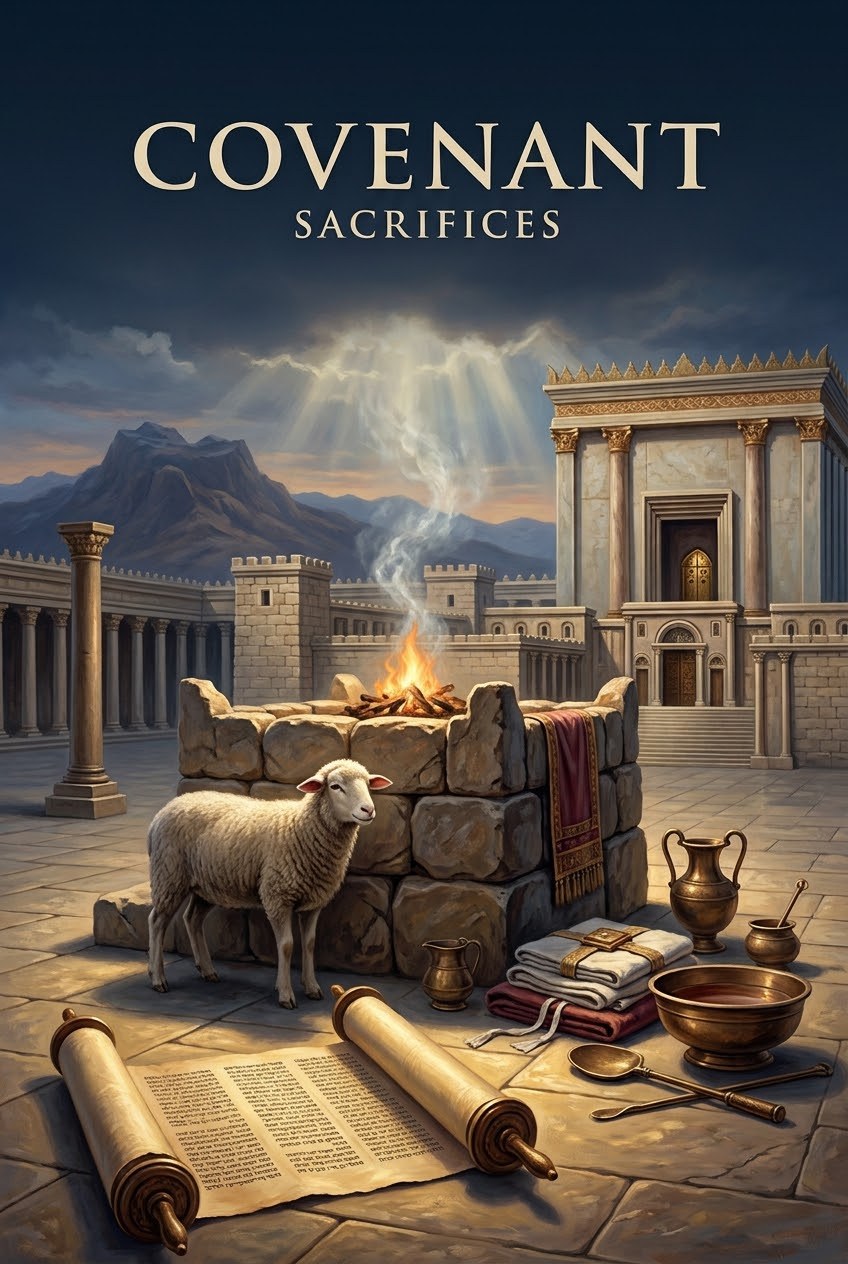
ANIMAL SACRIFICES
The Almighty GOD is the source of life and of all things. The ritual of animal sacrifice to GOD has been a major component of the worship of GOD since the beginning of time.
Chapter 1: ANIMAL SACRIFICES AS AN ESTABLISHED PATTERN OF WORSHIP FROM THE BEGINNING
The Almighty GOD is the source of life and of all things. The ritual of animal sacrifice to GOD has been a major component of the worship of GOD since the beginning of time. It was GOD Himself who showed the example for man to follow. In the first place, when Adam and Eve sinned at the Garden of Eden, animals were sacrificed by GOD and flayed to provide clothing for the two first humans, as it is written: "Unto Adam also and to his wife did the LORD GOD make coats of skins, and clothed them" (Gen. 3:21).
Scriptures record that Cain and Abel (sons of Adam and Eve) brought sacrifices to GOD. Cain's sacrifice was not accepted because he brought fruits and with an imperfect heart, while Abel's sacrifice was accepted by GOD because he sacrificed the firstborn of his flock, for the text says: "And in process of time it came to pass, that Cain brought of the fruit of the ground an offering unto the LORD. And Abel, he also brought of the firstlings of his flock and of the fat thereof. And the LORD had respect unto Abel and to his offering: But unto Cain and to his offering he had not respect. And Cain was very wroth, and his countenance fell" (Gen: 4:3-5).
After the flood receded, Noah sacrificed animals to GOD. The text says: "And Noah builded an altar unto the LORD; and took of every clean beast, and of every clean fowl, and offered burnt offerings on the altar. And the LORD smelled a sweet savour; and the LORD said in His heart, I will not again curse the ground any more for man\'s sake; for the imagination of man\'s heart is evil from his youth; neither will I again smite any more everything living, as I have done. While the earth remaineth, seedtime and harvest, and cold and heat, and summer and winter, and day and night shall not cease" (Gen. 8:20-22).
In the examples of Abel and Noah, we can see that animal sacrifice is the ritual killing and offering of an animal to appease or maintain favour with GOD. It is said that the first function of sacrifice is to heighten the consciousness of the one who brings the offering. Indeed so! It reminds the one who brings the offering about the source of all life. Sacrifice induced awe, therefore.
Contrary to popular belief, the purpose of sacrifice or offering is not simply to obtain forgiveness for sin. This is clear from the example of Abel and Noah, and would be made even clearer presently. It would not be denied, however, that sacrifice has the effect of expiating sins and even when they are brought for other purposes, the expiatory effect is incidental and circumscribed.
As would be seen, certain sacrifices or offerings are brought purely for the purpose of communing with GOD and becoming closer to Him. Some are brought for the purpose of expressing thanks to GOD, love or gratitude. Some are brought to cleanse a person of ritual impurity which does not necessarily have to do with sin. Some are brought for other diverse purposes, And unarguably, some sacrifices are brought for purposes of atonement.
Sacrifice is also called "gift." The Hebrew word for sacrifice or offering is "Korbanot". In Mark 7:11, Yahshua said: "But ye say, If a man shall say to his father or mother, It is Corban, that is to say, a gift, by whatsoever thou mightest be profited by me; he shall be free." And in Mathew 5:23-24, Yahshua said: "Therefore if thou bring thy gift to the altar, and there rememberest that thy brother hath ought against thee; Leave there thy gift before the altar, and go thy way; first be reconciled to thy brother, and then come and offer thy gift."
The term "Korban" suggests a loss of something or a giving up of something. The word comes from the root Qof-Resh-Bet, which means "to draw near," and indicates the primary purpose of offerings: to draw near to GOD. To draw near or bring a person closer to GOD is one of the basic concepts that underlie sacrifices. The other concept is the aspect of giving, which requires the renunciation of something that belongs to the person making the offering.
Another important concept is the element of substitution conveying the idea that the thing being offered is a substitute for the person making the offering, and the things that are done to the offering are things that should have been done to the person offering it. In a sense, the thing offered is "punished" in place of the offerer, whether the offerer is an individual or the community.
In the Torah, whenever the subject of Korbanot is addressed, the name of GOD used is the four letter name (YHVH) indicating GOD's mercy. In the Kabbalah, animal sacrifices provided the link between the animal world and human beings, and between the world of human beings and the higher realms of the Sefirot as the smoke on the altar ascended.
When GOD spoke to Father Abraham and told him that he would inherit the land of Canaan and Abraham asked: "LORD GOD, whereby shall I know that I shall inherit it?" GOD said to Father Abraham: "Take me an heifer of three years old, and a she goat of three years old, and a ram of three years old, and a turtledove, and a young pigeon." Abraham did as the LORD commanded him. And he took unto him all these, and divided them in the midst, and laid each piece one against another: but the birds divided he not. And when the fowls came down upon the carcases, Abram drove them away. And when the sun was going down, a deep sleep fell upon Abram; and, lo, an horror of great darkness fell upon him. And the LORD said unto Abram, Know of a surety that thy seed shall be a stranger in a land that is not theirs, and shall serve them; and they shall afflict them four hundred years; And also that nation, whom they shall serve, will I judge: and afterward shall they come out with great substance. And thou shalt go to thy fathers in peace; thou shalt be buried in a good old age. But in the fourth generation they shall come hither again: for the iniquity of the Amorites is not yet full. And it came to pass, that, when the sun went down, and it was dark, behold a smoking furnace, and a burning lamp that passed between those pieces. In the same day the LORD made a covenant with Abram, saying, Unto thy seed have I given this land, from the river of Egypt unto the great river, the river Euphrates: The Kenites, and the Kenizzites, and the Kadmonites, And the Hittites, and the Perizzites, and the Rephaims, And the Amorites, and the Canaanites, and the Girgashites, and the Jebusites" (Gen. 15:7-21).
In another place, it is recorded that Father Abraham offered up a ram provided by GOD in the place of his son, Isaac (Gen. 22:13) for a burnt offering, by reason of which GOD spoke unto him, saying: "By myself have I sworn, saith the LORD, for because thou hast done this thing, and hast not withheld thy son, thine only son: That in blessing I will bless thee, and in multiplying I will multiply thy seed as the stars of the heaven, and as the sand which is upon the sea shore; and thy seed shall possess the gate of his enemies; And in thy seed shall all the nations of the earth be blessed; because thou hast obeyed My voice" (Gen. 22:16-18).
Jacob offered a sacrifice to GOD on one of the Mountains of Gilead on an altar (a heap of stone) which served as a witness between him and his uncle, Laban, and as an altar (Gen. 31:46, 54).
While Israel encamped at Mount Sinai following the exodus from Egypt, GOD commanded, saying: "An altar of earth thou shalt make unto me, and shalt sacrifice thereon thy burnt offerings, and thy peace offerings, thy sheep, and thine oxen: in all places where I record my name I will come unto thee, and I will bless thee. And if thou wilt make me an altar of stone, thou shalt not build it of hewn stone: for if thou lift up thy tool upon it, thou hast polluted it. Neither shalt thou go up by steps unto mine altar, that thy nakedness be not discovered thereon" (Ex. 20:24-26). It is significant that GOD gave this commandment right after the giving of the Ten Commandments.
Moses offered sacrificial animals on the altar built at Mount Sinai (under the Mountain) beside which twelve pillars, emblematic of the twelve tribes of Israel, were reared. As the text says: "And Moses wrote all the words of the LORD, and rose up early in the morning, and builded an altar under the hill, and twelve pillars, according to the twelve tribes of Israel. And he sent young men of the children of Israel, which offered burnt offerings, and sacrificed peace offerings of oxen unto the LORD. And Moses took half of the blood, and put it in basons; and half of the blood he sprinkled on the altar. And he took the book of the covenant, and read in the audience of the people: and they said, All that the LORD hath said will we do, and be obedient. And Moses took the blood, and sprinkled it on the people, and said, Behold the blood of the covenant, which the LORD hath made with you concerning all these words" (Ex. 24:4-8).
When the Priesthood was formally instituted by GOD during Israel's wilderness sojourn with Him, GOD chose Aaron, the brother of Moses of the tribe of Levi, and his sons, to minister unto Him as Priests. The text says: "And take thou unto thee Aaron thy brother, and his sons with him, from among the children of Israel, that he may minister unto me in the priest\'s office, even Aaron, Nadab and Abihu, Eleazar and Ithamar, Aaron\'s sons" (Ex. 28:1). The text also says: "And thou shalt bring Aaron and his sons unto the door of the tabernacle of the congregation, and wash them with water. And thou shalt put upon Aaron the holy garments, and anoint him, and sanctify him; that he may minister unto me in the priest\'s office. And thou shalt bring his sons, and clothe them with coats: And thou shalt anoint them, as thou didst anoint their father, that they may minister unto me in the priest\'s office: for their anointing shall surely be an everlasting priesthood throughout their generations" (Ex. 40:12-15). See also Exodus Chapter 8.
The rest of the tribe of Levi was given to Aaron as a gift in the service of GOD. it is written: "And the LORD spake unto Moses, saying, Bring the tribe of Levi near, and present them before Aaron the priest, that they may minister unto him. And they shall keep his charge, and the charge of the whole congregation before the tabernacle of the congregation, to do the service of the tabernacle. And they shall keep all the instruments of the tabernacle of the congregation, and the charge of the children of Israel, to do the service of the tabernacle. And thou shalt give the Levites unto Aaron and to his sons: they are wholly given unto him out of the children of Israel. And thou shalt appoint Aaron and his sons, and they shall wait on their priest\'s office: and the stranger that cometh nigh shall be put to death. And the LORD spake unto Moses, saying, And I, behold, I have taken the Levites from among the children of Israel instead of all the firstborn that openeth the matrix among the children of Israel: therefore the Levites shall be mine; Because all the firstborn are mine; for on the day that I smote all the firstborn in the land of Egypt I hallowed unto me all the firstborn in Israel, both man and beast: mine shall they be: I am the LORD" (Num. 3:5-13).
And to Aaron, it is also written: "And thy brethren also of the tribe of Levi, the tribe of thy father, bring thou with thee, that they may be joined unto thee, and minister unto thee: but thou and thy sons with thee shall minister before the tabernacle of witness. And they shall keep thy charge, and the charge of all the tabernacle: only they shall not come nigh the vessels of the sanctuary and the altar, that neither they, nor ye also, die. And they shall be joined unto thee, and keep the charge of the tabernacle of the congregation, for all the service of the tabernacle: and a stranger shall not come nigh unto you. And ye shall keep the charge of the sanctuary, and the charge of the altar: that there be no wrath any more upon the children of Israel. And I, behold, I have taken your brethren the Levites from among the children of Israel: to you they are given as a gift for the LORD, to do the service of the tabernacle of the congregation. Therefore thou and thy sons with thee shall keep your priest\'s office for everything of the altar, and within the vail; and ye shall serve: I have given your priest\'s office unto you as a service of gift: and the stranger that cometh nigh shall be put to death" (Num. 18:2-7).
Aaron offered sacrifices and the fire of GOD fell from heaven and consumed upon the altar the burnt offering and the fat; and when all the people saw it they fell on their faces (Lev. 9:22-24).
Joshua offered burnt offerings and peace offerings to GOD, for the text says: "Then Joshua built an altar unto the LORD GOD of Israel in mount Ebal, As Moses the servant of the LORD commanded the children of Israel, as it is written in the book of the law of Moses, an altar of whole stones, over which no man hath lift up any iron: and they offered thereon burnt offerings unto the LORD, and sacrificed peace offerings" (Josh. 8:30-31).
When Israel was ruled by Judges, Gideon (a Judge), offered burnt offerings to GOD, for the text says: "And it came to pass the same night, that the LORD said unto him, Take thy father\'s young bullock, even the second bullock of seven years old, and throw down the altar of Baal that thy father hath, and cut down the grove that is by it: And build an altar unto the LORD thy GOD upon the top of this rock, in the ordered place, and take the second bullock, and offer a burnt sacrifice with the wood of the grove which thou shalt cut down. Then Gideon took ten men of his servants, and did as the LORD had said unto him: and so it was, because he feared his father\'s household, and the men of the city, that he could not do it by day, that he did it by night. And when the men of the city arose early in the morning, behold, the altar of Baal was cast down, and the grove was cut down that was by it, and the second bullock was offered upon the altar that was built" (Judg. 6:25-28).
Manoah, Samson's father, also offered unto the LORD upon an altar of unhewn stones which he set up, and the angel who spoke to him ascended in the flame of the altar, as it is recorded: "And Manoah said unto the angel of the LORD, What is thy name, that when thy sayings come to pass we may do thee honour? And the angel of the LORD said unto him, Why askest thou thus after my name, seeing it is secret? So Manoah took a kid with a meat offering, and offered it upon a rock unto the LORD: and the angel did wondrously; and Manoah and his wife looked on. For it came to pass, when the flame went up toward heaven from off the altar, that the angel of the LORD ascended in the flame of the altar. And Manoah and his wife looked on it, and fell on their faces to the ground" (Judg. 13:17-20).
The Priest/Prophet Samuel offered burnt offerings to GOD in Mitzpeh, for the text says: "And Samuel took a sucking lamb, and offered it for a burnt offering wholly unto the LORD: and Samuel cried unto the LORD for Israel; and the LORD heard him. And as Samuel was offering up the burnt offering, the Philistines drew near to battle against Israel: but the LORD thundered with a great thunder on that day upon the Philistines, and discomfited them; and they were smitten before Israel" (1 Sam. 7:9-10).
King David purchased the threshing floor of Araunah the Jebusite (where Solomon's Temple later stood, \[2 Chron. 3:1\]), built an altar and offered burnt offerings and peace offerings unto the LORD. Concerning this altar, the text says: "And David built there an altar unto the LORD, and offered burnt offerings and peace offerings, and called upon the LORD; and He answered him from heaven by fire upon the altar of burnt offering. And the LORD commanded the angel; and he put up his sword again into the sheath thereof" (1 Chron. 21:26-27). This followed the plague arising from the census of Israel. See also 2 Sam. 24:24-25).
King Solomon offered burnt offerings to GOD at the great high place at Gibeon. He offered a thousand burnt offerings, as the test says: "And the king went to Gibeon to sacrifice there; for that was the great high place: a thousand burnt offerings did Solomon offer upon that altar" (1 kgs. 3:4).
Regarding the magnificent Temple which he built unto GOD, King Solomon said: "Behold, I build an house to the name of the LORD my GOD, to dedicate to Him, and to burn before Him sweet incense, and for the continual showbread, and for the burnt offerings morning and evening, on the Sabbaths, and on the new moons, and on the solemn feasts of the LORD our GOD. This is an ordinance forever to Israel" (2 Chron. 2:4).
At the dedication of the Jerusalem Temple which replaced the great high place at Gibeon, fire came down from heaven and consumed the burnt offering and sacrifices upon the brazen altar in the magnificent Temple and the glory of the LORD filled the house. The text says: "Now when Solomon had made an end of praying, the fire came down from heaven, and consumed the burnt offering and the sacrifices; and the glory of the LORD filled the house" (2 Chron. 7:1).
Three times a year did King Solomon offer burnt sacrifices and peace offerings unto GOD upon the altar in the Temple which he built, for the text says: "And three times in a year did Solomon offer burnt offerings and peace offerings upon the altar which he built unto the LORD, and he burnt incense upon the altar that was before the LORD. So he finished the house" (1 Kgs. 9:25). See also 1 Kgs. 8:64; 2 Chron. 7:7; 2 Chron. 8:12.
King Hezekiah also sacrificed unto GOD on GOD's altar, for the text says: "Then Hezekiah the king rose early, and gathered the rulers of the city, and went up to the house of the LORD. And they brought seven bullocks, and seven rams, and seven lambs, and seven he goats, for a sin offering for the kingdom, and for the sanctuary, and for Judah. And he commanded the priests the sons of Aaron to offer them on the altar of the LORD. So they killed the bullocks, and the priests received the blood, and sprinkled it on the altar: likewise, when they had killed the rams, they sprinkled the blood upon the altar: they killed also the lambs, and they sprinkled the blood upon the altar. And they brought forth the he goats for the sin offering before the king and the congregation; and they laid their hands upon them: And the priests killed them, and they made reconciliation with their blood upon the altar, to make an atonement for all Israel: for the king commanded that the burnt offering and the sin offering should be made for all Israel" (2 Chron. 29:20-24).
King Manasseh, son of Hezekiah also sacrificed unto GOD after he repented of his many abominations, as it is recorded: "Wherefore the LORD brought upon them the captains of the host of the king of Assyria, which took Manasseh among the thorns, and bound him with fetters, and carried him to Babylon. And when he was in affliction, he besought the LORD his GOD, and humbled himself greatly before the GOD of his fathers, And prayed unto Him: and he was intreated of Him, and heard his supplication, and brought him again to Jerusalem into his kingdom. Then Manasseh knew that the LORD He was GOD. Now after this he built a wall without the city of David, on the west side of Gihon, in the valley, even to the entering in at the fish gate, and compassed about Ophel, and raised it up a very great height, and put captains of war in all the fenced cities of Judah. And he took away the strange gods, and the idol out of the house of the LORD, and all the altars that he had built in the mount of the house of the LORD, and in Jerusalem, and cast them out of the city. And he repaired the altar of the LORD, and sacrificed thereon peace offerings and thank offerings, and commanded Judah to serve the LORD GOD of Israel" (2 Chron. 33:11-16).
King Josiah of Judah sacrificed unto GOD, as it is recorded: "So all the service of the LORD was prepared the same day, to keep the Passover, and to offer burnt offerings upon the altar of the LORD, according to the commandment of king Josiah" (2 Chron. 35:16).
After the Babylonian captivity of the children of Judah and Benjamin, the returnees rebuilt the altar in the second Temple and sacrificed burnt offerings thereon morning and evening daily, for the text says: "Then stood up Jeshua the son of Jozadak, and his brethren the priests, and Zerubbabel the son of Shealtiel, and his brethren, and builded the altar of the GOD of Israel, to offer burnt offerings thereon, as it is written in the law of Moses the man of GOD. And they set the altar upon his bases; for fear was upon them because of the people of those countries: and they offered burnt offerings thereon unto the LORD, even burnt offerings morning and evening" (Ezra 3:2-3).
In the contest upon Mount Carmel between the Prophet Elijah the Prophet of GOD and the prophets of baal, GOD consumed the burnt offering of Elijah by His fire sent from heaven, for the text says: "And Elijah said unto all the people, Come near unto me. And all the people came near unto him. And he repaired the altar of the LORD that was broken down. And Elijah took twelve stones, according to the number of the tribes of the sons of Jacob, unto whom the word of the LORD came, saying, Israel shall be thy name: And with the stones he built an altar in the name of the LORD: and he made a trench about the altar, as great as would contain two measures of seed. And he put the wood in order, and cut the bullock in pieces, and laid him on the wood, and said, Fill four barrels with water, and pour it on the burnt sacrifice, and on the wood. And he said, Do it the second time. And they did it the second time. And he said, Do it the third time. And they did it the third time. And the water ran round about the altar; and he filled the trench also with water. And it came to pass at the time of the offering of the evening sacrifice, that Elijah the prophet came near, and said, LORD GOD of Abraham, Isaac, and of Israel, let it be known this day that thou art GOD in Israel, and that I am thy servant, and that I have done all these things at thy word. Hear me, O LORD, hear me, that this people may know that thou art the LORD GOD, and that thou hast turned their heart back again. Then the fire of the LORD fell, and consumed the burnt sacrifice, and the wood, and the stones, and the dust, and licked up the water that was in the trench. And when all the people saw it, they fell on their faces: and they said, The LORD, He is the GOD; the LORD, He is the GOD" (1 Kgs. 18:30-39).
Other than the Kings and individuals mentioned in the preceding paragraphs, who were mainly Jews, it is implicit in the prayer of King Solomon at the dedication of his Temple, that Gentiles offered sacrifices to GOD as well, for the text says: "Moreover concerning a stranger, that is not of thy people Israel, but cometh out of a far country for Thy name\'s sake; (For they shall hear of Thy great name, and of Thy strong hand, and of Thy stretched out arm;) when he shall come and pray toward this house; Hear Thou in heaven Thy dwelling place, and do according to all that the stranger calleth to Thee for: that all people of the earth may know Thy name, to fear Thee, as do Thy people Israel; and that they may know that this house, which I have builded, is called by Thy name" (1 Kgs. 8:41-43).
This is just as Jethro, Moses' Father-in-Law offered sacrifice to GOD in the wilderness, as it is recorded: "And Jethro, Moses\' father in law, took a burnt offering and sacrifices for GOD: and Aaron came, and all the elders of Israel, to eat bread with Moses\' father in law before GOD" (Ex. 18:12).
And as it is written in the Prophecy of the Prophet Isaiah thus: "Also the sons of the stranger, that join themselves to the LORD, to serve Him, and to love the Name of the LORD, to be His servants, every one that keepeth the Sabbath from polluting it, and taketh hold of My covenant; Even them will I bring to My holy mountain, and make them joyful in My house of prayer: their burnt offerings and their sacrifices shall be accepted upon Mine altar; for Mine house shall be called an house of prayer for all people" (Isa. 56:6-7).
It is written in the law of GOD regarding the place to present or offer burnt sacrifice to GOD: "And thou shalt say unto them, Whatsoever man there be of the house of Israel, or of the strangers \[Gentiles\] which sojourn among you, that offereth a burnt offering or sacrifice, And bringeth it not unto the door of the tabernacle of the congregation, to offer it unto the LORD; even that man shall be cut off from among his people" (Lev. 17:8-9).
On the Law of bringing animal offerings to GOD, it is written: "And if a stranger \[Gentile\] sojourn with you, or whosoever be among you in your generations, and will offer an offering made by fire, of a sweet savour unto the LORD; as ye do, so he shall do. One ordinance shall be both for you of the congregation, and also for the stranger that sojourneth with you, an ordinance forever in your generations: as ye are, so shall the stranger be before the LORD. One law and one manner shall be for you, and for the stranger that sojourneth with you" (Num. 15:14-16).
On the Law regarding animal offerings for ignorant sins, it is written: "Ye shall have one law for him that sinneth through ignorance, both for him that is born among the children of Israel, and for the stranger that sojourneth among them" (Num. 15:29).
After the Babylonian captivity of the Northern Kingdom (Judah and Benjamin), the first thing to be rebuilt was the altar, and burnt offerings were offered thereon morning and evening, and the foundation of the Temple was laid later. The text says: "Then stood up Jeshua the son of Jozadak, and his brethren the priests, and Zerubbabel the son of Shealtiel, and his brethren, and builded the altar of the GOD of Israel, to offer burnt offerings thereon, as it is written in the law of Moses the man of GOD. And they set the altar upon his bases; for fear was upon them because of the people of those countries: and they offered burnt offerings thereon unto the LORD, even burnt offerings morning and evening ...From the first day of the seventh month began they to offer burnt offerings unto the LORD. But the foundation of the temple of the LORD was not yet laid" (Ezra 3:2-3, 6).
The text also says: "And we cast the lots among the priests, the Levites, and the people, for the wood offering, to bring it into the house of our GOD, after the houses of our fathers, at times appointed year by year, to burn upon the altar of the LORD our GOD, as it is written in the law" (Neh. 10:34).
The importance of sacrifice in the Temple period in Jerusalem is expressed in the saying in "ETHICS OF THE FATHERS" (1:3) that the world stands on three things -- the Torah, The service in the Temple and benevolence.
The people of GOD continued to offer animal sacrifices to GOD after Judas Maccabeus purified and re-dedicated the Temple of GOD hitherto desecrated and plundered by the Seleucid King, Antiochus Epiphanes, for the text says: "And after that Antiochus had smitten Egypt, he returned again in the hundred forty and third year, and went up against Israel and Jerusalem with a great multitude, And entered proudly into the sanctuary, and took away the golden altar, and the candlestick of light, and all the vessels thereof, And the table of the shewbread, and the pouring vessels, and the vials. and the censers of gold, and the veil, and the crown, and the golden ornaments that were before the temple, all which he pulled off. He took also the silver and the gold, and the precious vessels: also he took the hidden treasures which he found. And when he had taken all away, he went into his own land, having made a great massacre, and spoken very proudly. Therefore there was a great mourning in Israel, in every place where they were" (1 Macc. 1:20-25).
And it is also recorded: "Then Judas appointed certain men to fight against those that were in the fortress, until he had cleansed the sanctuary. ^ ^So he chose priests of blameless conversation, such as had pleasure in the law: ^ ^Who cleansed the sanctuary, and bare out the defiled stones into an unclean place. ^ ^And when as they consulted what to do with the altar of burnt offerings, which was profaned; They thought it best to pull it down, lest it should be a reproach to them, because the heathen had defiled it: wherefore they pulled it down, And laid up the stones in the mountain of the temple in a convenient place, until there should come a prophet to shew what should be done with them. Then they took whole stones according to the law, and built a new altar according to the former;^ ^And made up the sanctuary, and the things that were within the temple, and hallowed the courts.^ ^They made also new holy vessels, and into the temple they brought the candlestick, and the altar of burnt offerings, and of incense, and the table.^ ^And upon the altar they burned incense, and the lamps that were upon the candlestick they lighted, that they might give light in the temple.^ ^Furthermore they set the loaves upon the table, and spread out the veils, and finished all the works which they had begun to make.^ ^Now on the five and twentieth day of the ninth month, which is called the month Casleu \[Kislev\], in the hundred forty and eighth year, they rose up betimes in the morning,^ ^And offered sacrifice according to the law upon the new altar of burnt offerings, which they had made.^ ^Look, at what time and what day the heathen had profaned it, even in that was it dedicated with songs, and citherns, and harps, and cymbals.^ ^Then all the people fell upon their faces, worshipping and praising the GOD of heaven, who had given them good success.^ ^And so they kept the dedication of the altar eight days and offered burnt offerings with gladness, and sacrificed the sacrifice of deliverance and praise" (1 Macc. 4:41-56).
Chapter 2: ANIMAL SACRIFICE IN THE TIME OF YAHSHUA
The second Temple in Jerusalem and its extension work by King Herod stood with its altars of incense (Golden altar) and altar of Sacrifice (Brazen altar) and activities when Yahshua was on earth.
In the first place, it was at the altar of incense in this Temple that Zechariah, the Father of John, ministered when an angel appeared to him and promised him a son, for the text says: "And it came to pass, that while he executed the priest\'s office before GOD in the order of his course, According to the custom of the Priest\'s office, his lot was to burn incense when he went into the Temple of the LORD. And the whole multitude of the people were praying without at the time of incense. And there appeared unto him an angel of the LORD standing on the right side of the altar of incense. And when Zacharias saw him, he was troubled, and fear fell upon him. But the angel said unto him, Fear not, Zacharias: for thy prayer is heard; and thy wife Elisabeth \[Elisheba\] shall bear thee a son, and thou shalt call his name John" (Lk. 1:8-13).
Consistent with prophecy about his appearance on earth, Yahshua supported and strengthened the Levitical Priesthood and the sacrificial system, and spoke in the present continuous tense. The Prophet Malachi had foretold this ministry of Yahshua when he prophesied thus: "Behold, I will send My messenger, and he shall prepare the way before me: and the Lord, whom ye seek, shall suddenly come to his Temple, even the Messenger of the covenant, whom ye delight in: behold, he shall come, saith the LORD of hosts. But who may abide the day of his coming? And who shall stand when he appeareth? For he is like a refiner\'s fire, and like fullers\' soap: And he shall sit as a refiner and purifier of silver: and he shall purify the sons of Levi, and purge them as gold and silver, that they may offer unto the LORD an offering in righteousness. Then shall the offering of Judah and Jerusalem be pleasant unto the LORD, as in the days of old, and as in former years" (Mal. 3:1-4).
In Malachi's prophecy, the "messenger" which shall "clear the way before me" is John (the immerser). In the Malachi prophecy, one must be careful to note that Yahshua is referred to as "Lord" and "Messenger of the Covenant." Indeed, he could only have come as a messenger of the covenant which GOD charged Israel and Gentiles to keep (Ex. 19:5; 12:49; Lev. 19:34; Num. 15:16) because GOD does not change, for as Yahshua said: "My doctrine is not mine, but His that sent me" (Jn. 7:16; 14:24). And as he said: "Every kingdom divided against itself is brought to desolation; and every city or house divided against itself shall not stand" (Matt. 12:25).
Yahshua spoke about this "messenger" (John, his forerunner). According to Mathew's record: "Now when John had heard in the prison the works of Christ, he sent two of his disciples, And said unto him, Art thou he that should come, or do we look for another? Jesus answered and said unto them, Go and shew John again those things which ye do hear and see: The blind receive their sight, and the lame walk, the lepers are cleansed, and the deaf hear, the dead are raised up, and the poor have the gospel preached to them. And blessed is he, whosoever shall not be offended in me. And as they departed, Jesus began to say unto the multitudes concerning John, What went ye out into the wilderness to see? A reed shaken with the wind? But what went ye out for to see? A man clothed in soft raiment? Behold, they that wear soft clothing are in kings\' houses. But what went ye out for to see? A prophet? Yea, I say unto you, and more than a prophet. For this is he, of whom it is written, Behold, I send my messenger before thy face, which shall prepare thy way before thee" (Matt. 11:2-10).
In order, if possible, to put cynicism and doubting Thomases at bay, Yahshua said early: "Think not that I am come to destroy the law, or the prophets: I am not come to destroy, but to fulfil. For verily I say unto you, Till heaven and earth pass, one jot or one tittle shall in no wise pass from the law, till all be fulfilled. Whosoever therefore shall break one of these least commandments, and shall teach men so, he shall be called the least in the kingdom of heaven: but whosoever shall do and teach them, the same shall be called great in the kingdom of heaven. For I say unto you, That except your righteousness shall exceed the righteousness of the scribes and Pharisees, ye shall in no case enter into the kingdom of heaven" (Matt. 5:17-20).
The Levitical Priests are teachers of the Law of GOD other than their sanctuary duties. It is written in the Torah concerning them: "They shall teach Jacob thy Judgments, and Israel thy law: they shall put incense before thee, and whole burnt sacrifice upon thine altar" (Deut. 33:10). It is also written: "For the priest\'s lips should keep knowledge, and they should seek the law at his mouth: for he is the messenger of the LORD of hosts" (Mal. 2:7).
The Levitical Priests of Yahshua's time on earth belonged to the party of the Sadducees, it would appear. The Scribes were the priests. As teachers of the Law, there was a mismatch in their lifestyle between Precept and example as was characteristic of the Pharisees. In fact, pharisaism denoted hypocrisy. About the Pharisees, Yahshua had this to say: "...Beware ye of the leaven of the Pharisees, which is hypocrisy" (Lk. 12:1). He had also said: "For I say unto you, That except your righteousness shall exceed the righteousness of the scribes and Pharisees, ye shall in no case enter into the kingdom of heaven" (Matt. 5:20).
Well before the manifestation of Yahshua in the flesh, the Levitical Priests had begun to fall out of favour with GOD because their ways brought about a demeaning and debasement of their high calling. Their lifestyle simply did not synchronize with the spirit of the Law that they taught the people. Of the Levitical Priests, it is written in the Scriptures: "But ye are departed out of the way; ye have caused many to stumble at the law; ye have corrupted the covenant of Levi, saith the LORD of hosts. Therefore have I also made you contemptible and base before all the people, according as ye have not kept My ways, but have been partial in the Law" (Mal. 2:8-9).
Of Priests, it is also written: "A son honoureth his father, and a servant his master: if then I be a father, where is Mine honour? And if I be a Master, where is My fear? Saith the LORD of hosts unto you, O priests, that despise My name. And ye say, Wherein have we despised Thy name? Ye offer polluted bread upon Mine altar; and ye say, Wherein have we polluted Thee? In that ye say, The table of the LORD is contemptible. And if ye offer the blind for sacrifice, is it not evil? And if ye offer the lame and sick, is it not evil? Offer it now unto thy governor; will he be pleased with thee, or accept thy person? Saith the LORD of hosts. And now, I pray you, beseech GOD that He will be gracious unto us: this hath been by your means: will He regard your persons? Saith the LORD of hosts. Who is there even among you that would shut the doors for nought? Neither do ye kindle fire on Mine altar for nought. I have no pleasure in you, saith the LORD of hosts, neither will I accept an offering at your hand" (Mal.1:6-10).
The Priests did not know GOD, as it is written: "The Priests said not, where is the LORD? And they that handle the law knew me not: the Pastors also transgressed against me, and the prophets prophesied by baal, and walked after things that do not profit" (Jer. 2:8).
It is written: "Because Ephraim hath made many altars to sin, altars shall be made unto him to sin. I have written to him the great things of My law, but they were counted as a strange thing. They sacrifice flesh for the sacrifice of My offerings, and eat it: but the LORD accepted them not ...." (Hos. 8:12-13).
It is also written : "For both Prophet and Priest are profane; yea, in My house have I found their wickedness, saith the LORD. Wherefore their way shall be unto them as slippery ways in the darkness: they shall be driven on, and fall therein: for I will bring evil upon them, even the year of their visitation, saith the LORD" (Jer. 23:11-12).
It is further written of Priests thus: "For the sins of her prophets, and the iniquities of her priests, that have shed the blood of the just in the midst of her, They have wandered as blind men in the streets, they have polluted themselves with blood, so that men could not touch their garments" (Lam. 4:13-14).
And: "Her priests have violated My law, and have profaned Mine holy things: they have put no difference between the holy and profane, neither have they shewed difference between the unclean and the clean, and have hid their eyes from My Sabbaths, and I am profaned among them" (Ezek. 22:26).
And: "The heads thereof judge for reward, and the priests thereof teach for hire, and the prophets thereof divine for money: yet will they lean upon the LORD, and say, Is not the LORD among us? None evil can come upon us" (Mic. 3:11).
Consistent with prophecy about him regarding the Levitical Priests on the text which says: "for he is like a refiner\'s fire, and like fullers\' soap: And he shall sit as a refiner and purifier of silver: and he shall purify the sons of Levi, and purge them as gold and silver, that they may offer unto the LORD an offering in righteousness. Then shall the offering of Judah and Jerusalem be pleasant unto the LORD, as in the days of old, and as in former years" (Mal. 3:2-4), Yahshua was unsparing of the Levitical Priests as he exposed them for who they really were and condemned their ways in an effort to make them effective in their Priestly duties. It was work meant to support and fortify the Priesthood, and to purge their dross and alloy. The objective was in order that they may offer an offering in righteousness, that their offering may be pleasant to the LORD as in days of old.
A few examples of Yahshua's work on the teachers of the Law would do:
Yahshua said: "The scribes and the Pharisees sit in Moses\' seat: All therefore whatsoever they bid you observe, that observe and do; but do not ye after their works: for they say, and do not. For they bind heavy burdens and grievous to be borne, and lay them on men\'s shoulders; but they themselves will not move them with one of their fingers. But all their works they do for to be seen of men: they make broad their phylacteries, and enlarge the borders of their garments, And love the uppermost rooms at feasts, and the chief seats in the Synagogues .... Neither be ye called masters: for one is your Master, even Christ. But he that is greatest among you shall be your servant. And whosoever shall exalt himself shall be abased; and he that shall humble himself shall be exalted. But woe unto you, scribes and Pharisees, hypocrites! For ye shut up the kingdom of heaven against men: for ye neither go in yourselves, neither suffer ye them that are entering to go in. Woe unto you, scribes and Pharisees, hypocrites! For ye devour widows\' houses, and for a pretence make long prayer: therefore ye shall receive the greater damnation. Woe unto you, scribes and Pharisees, hypocrites! For ye compass sea and land to make one proselyte, and when he is made, ye make him twofold more the child of hell than yourselves. Woe unto you, ye blind guides, which say, Whosoever shall swear by the temple, it is nothing; but whosoever shall swear by the gold of the temple, he is a debtor! Ye fools and blind: for whether is greater, the gold, or the temple that sanctifieth the gold? And, Whosoever shall swear by the altar, it is nothing; but whosoever sweareth by the gift that is upon it, he is guilty. Ye fools and blind: for whether is greater, the gift, or the altar that sanctifieth the gift? Whoso therefore shall swear by the altar, sweareth by it, and by all things thereon. And whoso shall swear by the temple, sweareth by it, and by him that dwelleth therein. And he that shall swear by heaven, sweareth by the throne of GOD, and by Him that sitteth thereon. Woe unto you, scribes and Pharisees, hypocrites! For ye pay tithe of mint and anise and cummin, and have omitted the weightier matters of the law, judgment, mercy, and faith: these ought ye to have done, and not to leave the other undone. Ye blind guides, which strain at a gnat, and swallow a camel. Woe unto you, scribes and Pharisees, hypocrites! For ye make clean the outside of the cup and of the platter, but within they are full of extortion and excess. Thou blind Pharisee, cleanse first that which is within the cup and platter, that the outside of them may be clean also. Woe unto you, scribes and Pharisees, hypocrites! For ye are like unto whited sepulchres, which indeed appear beautiful outward, but are within full of dead men\'s bones, and of all uncleanness. Even so ye also outwardly appear righteous unto men, but within ye are full of hypocrisy and iniquity. Woe unto you, scribes and Pharisees, hypocrites! because ye build the tombs of the prophets, and garnish the sepulchres of the righteous" (Matt. 23:2-6, 10-29).
One would notice that Yahshua talked about the altar as sanctifying the gift (sacrifice) upon it in the present continuous tense.
As a refiner's fire and fuller's soap on the Levitical Priests, Yahshua told the parable of the good Samaritan so as to expose the spiritual ingredients of love, mercy, compassion and goodness (grace) which was lacking in them. He said: "A certain man went down from Jerusalem to Jericho, and fell among thieves, which stripped him of his raiment, and wounded him, and departed, leaving him half dead. And by chance there came down a certain Priest that way: and when he saw him, he passed by on the other side. And likewise a Levite, when he was at the place, came and looked on him, and passed by on the other side. But a certain Samaritan, as he journeyed, came where he was: and when he saw him, he had compassion on him, And went to him, and bound up his wounds, pouring in oil and wine, and set him on his own beast, and brought him to an inn, and took care of him. And on the morrow when he departed, he took out two pence, and gave them to the host, and said unto him, Take care of him; and whatsoever thou spendest more, when I come again, I will repay thee. Which now of these three, thinkest thou, was neighbour unto him that fell among the thieves?" (Lk. 10:30-36).
Talking about salt, Yahshua spoke in present continuous tense regarding sacrifice in clear reference to the requirement of the Law. He said: "For every one shall be salted with fire, and every sacrifice shall be salted with salt" (Mk. 9:49). It is written in the Law thus: "And every oblation of thy meat offering shalt thou season with salt; neither shalt thou suffer the salt of the covenant of thy GOD to be lacking from thy meat offering: with all thine offerings thou shalt offer salt" (Lev. 2:13).
Speaking further in the present continuous tense in clear support of the sacrificial system, Yahshua said: "Therefore if thou bring thy gift to the altar, and there rememberest that thy brother hath ought against thee; Leave there thy gift before the altar, and go thy way; first be reconciled to thy brother, and then come and offer thy gift" (Matt. 5:23-24).
In another evidence of support for the sacrificial system, Yahshua healed a man who was leprous and charged him saying: "See thou tell no man; but go thy way, shew thyself to the priest, and offer the gift that Moses commanded, for a testimony unto them" (Matt. 8:4; Lk. 5:14).
What is Commanded in the Law for the cleansing of a leper can be found written in Lev. 14. The details of the process of cleansing are elaborate and involves offering of animal sacrifice, for it is written: "And the LORD spake unto Moses, saying, This shall be the law of the leper in the day of his cleansing: He shall be brought unto the priest: And the priest shall go forth out of the camp; and the priest shall look, and, behold, if the plague of leprosy be healed in the leper; Then shall the priest command to take for him that is to be cleansed two birds alive and clean, and cedar wood, and scarlet, and hyssop: And the priest shall command that one of the birds be killed in an earthen vessel over running water: As for the living bird, he shall take it, and the cedar wood, and the scarlet, and the hyssop, and shall dip them and the living bird in the blood of the bird that was killed over the running water: And he shall sprinkle upon him that is to be cleansed from the leprosy seven times, and shall pronounce him clean, and shall let the living bird loose into the open field. And he that is to be cleansed shall wash his clothes, and shave off all his hair, and wash himself in water, that he may be clean: and after that he shall come into the camp, and shall tarry abroad out of his tent seven days. But it shall be on the seventh day, that he shall shave all his hair off his head and his beard and his eyebrows, even all his hair he shall shave off: and he shall wash his clothes, also he shall wash his flesh in water, and he shall be clean. And on the eighth day he shall take two he lambs without blemish, and one ewe lamb of the first year without blemish, and three tenth deals of fine flour for a meat offering, mingled with oil, and one log of oil. And the priest that maketh him clean shall present the man that is to be made clean, and those things, before the LORD, at the door of the tabernacle of the congregation: And the priest shall take one he lamb, and offer him for a trespass offering, and the log of oil, and wave them for a wave offering before the LORD: And he shall slay the lamb in the place where he shall kill the sin offering and the burnt offering, in the holy place: for as the sin offering is the priest\'s, so is the trespass offering: it is most holy: And the priest shall take some of the blood of the trespass offering, and the priest shall put it upon the tip of the right ear of him that is to be cleansed, and upon the thumb of his right hand, and upon the great toe of his right foot: And the priest shall take some of the log of oil, and pour it into the palm of his own left hand: And the priest shall dip his right finger in the oil that is in his left hand, and shall sprinkle of the oil with his finger seven times before the LORD: And of the rest of the oil that is in his hand shall the priest put upon the tip of the right ear of him that is to be cleansed, and upon the thumb of his right hand, and upon the great toe of his right foot, upon the blood of the trespass offering: And the remnant of the oil that is in the priest\'s hand he shall pour upon the head of him that is to be cleansed: and the priest shall make an atonement for him before the LORD. And the priest shall offer the sin offering, and make an atonement for him that is to be cleansed from his uncleanness; and afterward he shall kill the burnt offering: And the priest shall offer the burnt offering and the meat offering upon the altar: and the priest shall make an atonement for him, and he shall be clean. And if he be poor, and cannot get so much; then he shall take one lamb for a trespass offering to be waved, to make an atonement for him, and one tenth deal of fine flour mingled with oil for a meat offering, and a log of oil; And two turtledoves, or two young pigeons, such as he is able to get; and the one shall be a sin offering, and the other a burnt offering. And he shall bring them on the eighth day for his cleansing unto the priest, unto the door of the tabernacle of the congregation, before the LORD. And the priest shall take the lamb of the trespass offering, and the log of oil, and the priest shall wave them for a wave offering before the LORD: And he shall kill the lamb of the trespass offering, and the priest shall take some of the blood of the trespass offering, and put it upon the tip of the right ear of him that is to be cleansed, and upon the thumb of his right hand, and upon the great toe of his right foot: And the priest shall pour of the oil into the palm of his own left hand: And the priest shall sprinkle with his right finger some of the oil that is in his left hand seven times before the LORD: And the priest shall put of the oil that is in his hand upon the tip of the right ear of him that is to be cleansed, and upon the thumb of his right hand, and upon the great toe of his right foot, upon the place of the blood of the trespass offering: And the rest of the oil that is in the priest\'s hand he shall put upon the head of him that is to be cleansed, to make an atonement for him before the LORD. And he shall offer the one of the turtledoves, or of the young pigeons, such as he can get; Even such as he is able to get, the one for a sin offering, and the other for a burnt offering, with the meat offering: and the priest shall make an atonement for him that is to be cleansed before the LORD. This is the law of him in whom is the plague of leprosy, whose hand is not able to get that which pertaineth to his cleansing" (Lev. 14:1-32).
Chapter 3: THE PRIESTHOOD OF YAHSHUA EXPLAINED
That Yahshua is a Priest in his own right is beyond controversy. He was a Priest before he came into the world. It then begs the question, "why would Yahshua heal a leper and refer him to another Priest for his cleansing, being a Priest himself?"
Of Yahshua, it is written in the Scriptures: "The LORD hath sworn, and will not repent, Thou art a Priest for ever after the order of Melchizedek" (Ps. 110:4; Heb. 5:6; Heb. 7:17, 21).
The first mention of the name Melchizedek in the Scriptures is in the fourteenth chapter of Genesis where it is said that Father Abraham met him on his way from slaughter of the four kings who had taken Lot, his nephew and his possessions captive, for the text says: "And Melchizedek king of Salem brought forth bread and wine: and he was the priest of the Most High GOD. And he blessed him, and said, Blessed be Abram of the Most High GOD, possessor of heaven and earth: And blessed be the Most High GOD, which hath delivered thine enemies into thy hand. And he gave him tithes of all" (Gen. 14:18-20).
Concerning Melchizedek, the text says: "For this Melchizedek, king of Salem, priest of the Most High GOD, who met Abraham returning from the slaughter of the kings, and blessed him; To whom also Abraham gave a tenth part of all; first being by interpretation King of righteousness, and after that also King of Salem, which is, King of peace; Without father, without mother, without descent, having neither beginning of days, nor end of life; but made like unto the Son of GOD; abideth a Priest continually" (Heb. 7:1-3).
The Levitical Priesthood was instituted by GOD for the earthman. It is also called Aaronic Priesthood because the Priesthood was given to Aaron and his sons as an everlasting Priesthood. Aaron is of the tribe of Levi, the third son of Jacob. They are human beings, fallible and liable to sin as are all men. They share in the fate of common humanity of a short span of life and die. So the Aaronic Priesthood is of the tribe of Levi.
Melchizedek's Priesthood is superior to that of Levitical Priesthood. Levitical Priests are mortal while Melchizedek, said to be without father, mother, genealogy, having neither beginning of days, nor end of life, but made like unto the Son of GOD, must be immortal.
It is said that Father Abraham recognized the superiority of Melchizedek's Priesthood when he paid him a tithe and received a blessing from him as his subordinate in as much as the one who blesses is greater than the one who is blessed, for the text says: "And without all contradiction the less is blessed of the better" (Heb. 7:7). Levi was Abraham's great grandson. It is therefore, said that Levi was in Abraham's loins and paid tithe to Melchizedek.
Judaism (See the ancient Targumim \[Aramaic Interpretative Translations\]) identifies Melchizedek as Shem, Noah's son, and is said to have composed psalms, taught Torah to Abraham and helped GOD to name Jerusalem. Judaism could not comprehend how the Priesthood which, according to Law, belongs perpetually to the descendants of Levi through Aaron can pass to Melchizedek. Judaism therefore, says that Melchizedek committed the error of blessing Abraham first before blessing GOD, as a result of which the Priesthood was taken from him (Shem) and given to Levi, a descendant of Abraham. The limitations of evidence on Judaism's position preclude a consensus and thus Melchizedek remains elusive.
Taking the anonymous, (though ascribed to the Apostle Paul) Epistle to the Hebrews narrative as correct and authentic, we know that Yahshua's putative father, Joseph, was from Judah. His mother, Miriam was also from Judah. Yahshua sprang out of Judah, a tribe of which the Law said nothing concerning Priesthood, for the text says: "For it is evident that our Lord sprang out of Judah; of which tribe Moses spake nothing concerning priesthood" (Heb. 7:14).
The Priesthood of Yahshua was made with an oath, for the text says: "The LORD has sworn and will not repent" (Ps. 110:4).
Yahshua's Priesthood is of a different kind. It is not Levitical, which entails offering animal sacrifices upon the altar of GOD for the earthman (because of the presence of sin in man) according to the Law. Yahshua's Priesthood is heavenly, and like that of Melchizedek, it entails the offering of bread and wine (Gen. 14:18), hence the bread and wine communion before his passion, for the text says: "And as they were eating, Jesus took bread, and blessed it, and brake it, and gave it to the disciples, and said, Take, eat; this is my body. And he took the cup, and gave thanks, and gave it to them, saying, Drink ye all of it; For this is my blood of the new testament, which is shed for many for the remission of sins" (Matt. 26:26-28). See also Lk. 22:19-20; Mk. 14:22-23.
Because of his different kind of Priesthood, Yahshua could not have usurped the office and work of the Levitical Priest while on earth, when he healed the leper, for the text says: "Now of the things which we have spoken this is the sum: We have such an high priest, who is set on the right hand of the throne of the Majesty in the heavens; A minister of the sanctuary, and of the true tabernacle, which the Lord pitched, and not man. For every high priest is ordained to offer gifts and sacrifices: wherefore it is of necessity that this man have somewhat also to offer. For if he were on earth, he should not be a priest, seeing that there are priests that offer gifts according to the law: Who serve unto the example and shadow of heavenly things, as Moses was admonished of GOD when he was about to make the tabernacle: for, See, saith He, that thou make all things according to the pattern shewed to thee in the mount" (Heb. 8:1-5).
Chapter 4: TYPES OF SACRIFICES OR OFFERINGS (KORBANOT)
There are many types and sub-types of korbanot.
- BURNT OFFERING (OLAH) --LEV. 1:3-17
The Hebrew word for "Burnt Offering" is "Olah." It is from the root Ayin -- Lamed -- Hey, which means "Ascension" (that which rises), indicating that this offering rises above and is superior to all the others. It rises to GOD in its entirety in the flames and smoke of the altar of burnt offering. An Olah is completely burnt on the altar. No part of it is eaten by anyone. Because the offering represents complete submission to GOD's will, the entire offering is given to GOD. It cannot be used after it is burnt. It expresses the desire to commune with GOD, and expiates sins incidentally in the process, because how can one commune with GOD if one is tainted with sin? An Olah could be made from cattle (bulls, cows or calves), sheep, goat, pigeon/dove, depending on the offerer's means.
- PEACE OFFERING (ZEVACH SH'LAMIM) -- LEV.3:1-17
Korban Sh'lamim (Peace Offering) is a voluntary offering expressing thanks or gratitude to GOD for His bounties and mercies. It may be brought from cattle (bulls, cows or calves) or from the flock (sheep or goats). The Hebrew word for this type of offering is Zevach Sh'lamim (or sometimes just Shelamim), which is related to the word "Shalom", meaning "Peace" or "Whole." Some parts of it are burnt on the altar, others are given to the Priests (Kohanim) to eat, and the rest is eaten by the offerer and his family: thus everyone gets part of this offering. This category of offerings include Thanksgiving offerings (in Hebrew, Todah, which is obligatory for survivors of life-threatening crisis), Freewill offerings, and offerings made after fulfillment of a vow.
- SIN OFFERING (CHATAT) - LEV. 4:1-5
A sin offering is an offering to atone for and purge a sin. It is an expression of sorrow for the error and a desire to be reconciled to GOD. The Hebrew term for this type of offering is "Chatat," from the word "Chayt," meaning "Missing the mark." A Chatat can only be offered to atone for certain classes of unintentional or inadvertent sins committed through carelessness, and not for intentional, malicious sins. The actual offerings differ according to the nature of the sin, the financial means of the sinner and who committed the sin. And so some sin offerings (Chatatot) are individual and some are communal: The Kohen Gadol (Lev. 4:3-12); the majority of the nation (communal) (Lev. 4:13-21); the king (Lev.4:22-26); or an individual (Lev. 4:27-35). There are special cases in which a sin offering is required namely, a witness who fails to give testimony, one who contracts impurity; one who omits to fulfill his vow. A person who is in possession of evidence is adjured to come forward and offer testimony. This adjuration is known as a "curse" because it is accompanied by a pronouncement of a curse upon the person should he maintain silence. Having interfered with the course of justice, he requires expiation through a sin offering. (See Lev. 5: 1-13). Confession is obligatory in the case of a sin offering. The sin offering must precede the burnt offering. There must be reconciliation between GOD and the sinner, before the sinner's gift could be acceptable. The poor is allowed to bring fine flour as a sin offering for the offences described in the beginning of Leviticus chapter 5. A few special sin offerings can be eaten, but for the most part, for the average person's personal sin, the sin offering is eaten by the Priests. It appears that the sin offering can be converted to money and given to the Priests since it is their portion to eat. For the text says: "This shall be thine of the most holy things, reserved from the fire: every oblation of theirs, every meat offering of theirs, and every sin offering of theirs, and every trespass offering of theirs, which they shall render unto Me, shall be most holy for thee and for thy sons. In the most holy place shalt thou eat it; every male shall eat it: it shall be holy unto thee" (Num. 18:9-10). And also: "The trespass money and sin money was not brought into the house of the LORD: it was the priests\'" (2 Kgs. 12:16).
- GUILT OFFERING (ASHAM) -- LEV. 5:14-26
The Hebrew word for a guilt offering is "Asham." A guilt offering is an offering to atone for unintentionally appropriating to one's own use, some "holy thing" from the altar thus causing loss to the sanctuary. He is to restore the value of the property and be fined one-fifth extra. Guilt offering is brought when you are not sure whether you have committed a sin or what sin you have committed, or for breach of trust. When there is doubt as to whether a person committed a sin, the person would bring a guilt offering (Asham) rather than a sin offering (Chatat) because bringing a sin offering would constitute an admission of the sin, and the person would have to be punished for it. If a person brought an Asham (guilt offering) and later discovers that he had, in fact, committed a sin, he would have to bring a Chatat (sin offering) at that time. A guilt offering is eaten by the Priests, and may, it seems, be converted to money just as the sin offering, as noted above.
- FOOD AND DRINK OFFERINGS -- LEV. 2:1-16
A voluntary Korban Minchah (Meal Offering) is made up of finely ground wheat flour, pure olive oil and frankincense, representing the devotion of the fruits of man's labour to GOD, because it is not a natural product, but something created through man's efforts. A representative piece of the offering is burnt on the fire of the altar, but the rest is eaten by the Priests. There are also offerings of undiluted wine, referred to as Nesekh.
It is now clear from the forgoing that the purpose of animal sacrifice is not only simply to obtain forgiveness for sin as noted earlier on.
Chapter 5: THE DEATH OF YAHSHUA AND ANIMAL SACRIFICES
The controversy surrounding the subject of animal sacrifices arises from Christendom's erroneous interpretation and understanding of the significance of the death of Yahshua on the tree of Calvary. Christian Bible exegetes and glossators are oblivious to the deep mystery of the death of Yahshua, when it took place in actuality, and when it had effect on the life of man. And to add to Christendom's confusion, it has a complete misapprehension of the meaning of the Epistle to the Hebrews, as regards the death of Yahshua, the Priesthood of Yahshua and the Aaronic Priesthood which is Levitical.
The date of the reconciling death of Yahshua and what it brought to man must not be reckoned from the date of his impalement on the tree of Calvary in the ADs or Common Era. It was an event that took place since the foundation of the world and before the creation of Adam. Its implication has worked for Man since his fall at the Garden of Eden. This is why man has been able to obtain mercy, compassion, grace, forgiveness and atonement from GOD ever since before Yahshua's manifestation and death on earth. His death beforehand is the reason Gentiles were admitted into true GOD worship with Israel before his manifestation and death on the tree, for he died for Man (Jew and Gentile) according to GOD's plan for mankind. See the title "GOD WAS IN CHRIST RECONCILING THE WORLD UNTO HIMSELF -- WHAT DOES IT MEAN?"
It is misplacement of reckoning of the effective date of Yahshua's death that has catalyzed the confusion in which Christendom finds itself today, regarding animal sacrifices.
Christendom's position was stated briefly by a commentator thus: "Christianity does not incorporate animal sacrifices. Anybody with half a brain would understand that because of the death of Jesus Christ no animal sacrifices were needed. Jesus was the ultimate sacrifice."
This statement is true only to the extent that Yahshua is the ultimate sacrifice. The question is whether the ultimacy of Yahshua's sacrifice means a cessation of the Levitical Priesthood and the annulment of the Law of GOD on animal sacrifices, even with the very clear words of the Almighty GOD regarding the Aaronic Priesthood and the sacrificial system, and the emphatic declaration of Yahshua that as long as heaven and earth last, not the least point nor the smallest detail of the Law shall be done away with. The laws of GOD on animals sacrifices are part of the body of covenant laws delivered to man by GOD on Mount Sinai.
Let it be known that the death of Yahshua was a once and for all death that reconciled man unto GOD, by which man obtained mercy, grace, forgiveness and atonement for sins. See again Col. 1:14-22. See also Eph. 1:7. And as the text says: "For scarcely for a righteous man will one die: yet peradventure for a good man some would even dare to die. But GOD commendeth his love toward us, in that, while we were yet sinners, Christ died for us. Much more then, being now justified by his blood, we shall be saved from wrath through him. For if, when we were enemies, we were reconciled to GOD by the death of his Son, much more, being reconciled, we shall be saved by his life. And not only so, but we also joy in GOD through our Lord Jesus Christ, by whom we have now received the atonement" (Rom. 5:7-11).
Let it be known that Yahshua was made sin and shed his blood before the creation of man in order to reconcile man unto GOD. This is Yahshua's ministry of reconciliation, created before man was formed and knew what is sin. Without such pre-existing reconciliation by his death, it would have been impossible for man to obtain grace, mercy, forgiveness and atonement for sin from GOD before Yahshua was manifested, for GOD is holy and His nature abhors sin, as it is said: "Thou art of purer eyes than to behold evil, and canst not look on iniquity ...." (Hab. 1:13).
His death on the tree was meant to demonstrate GOD's righteousness ab initio in creating man and to have him inhabit the earth, albeit in the realm of the spirit.
GOD is a consuming fire and a jealous GOD (Deut. 4:24; Heb. 12:29) and His nature abhors sin, for it is written: "....For I will not go up in the midst of thee; for thou art a stiffnecked people: lest I consume thee in the way... Say unto the children of Israel, Ye are a stiffnecked people: I will come up into the midst of thee in a moment, and consume thee: therefore now put off thy ornaments from thee, that I may know what to do unto thee" (Ex. 33:3, 5).
As with Israel so with humanity. It is written: "For thus saith the LORD that created the heavens; GOD Himself that formed the earth and made it; He hath established it, He created it not in vain, He formed it to be inhabited: I am the LORD; and there is none else" (Isa. 45:18). It is a deep mystery. This subject has been adequately dealt with in the chapter entitled, "GOD WAS IN CHRIST RECONCILING THE WORLD UNTO HIMSELF -- WHAT DOES IT MEAN?"
To briefly illustrate, the text says: "And there was war in heaven: Michael and his angels fought against the dragon; and the dragon fought and his angels, And prevailed not; neither was their place found any more in heaven. And the great dragon was cast out, that old serpent, called the Devil, and Satan, which deceiveth the whole world: he was cast out into the earth, and his angels were cast out with him. And I heard a loud voice saying in heaven, Now is come salvation, and strength, and the kingdom of our GOD, and the power of his Christ: for the accuser of our brethren is cast down, which accused them before our GOD day and night. And they overcame him by the blood of the Lamb, and by the word of their testimony; and they loved not their lives unto the death. Therefore rejoice, ye heavens, and ye that dwell in them. Woe to the inhabiters of the earth and of the sea! For the devil is come down unto you, having great wrath, because he knoweth that he hath but a short time" (Rev. 12:7-12). Yahshua is otherwise referred to as the Lamb of GOD. See Jn. 1:29, 36; Isa. 53:7; Acts 8:32; 1 Pet. 1:19; Rev. 5:12; 13:8 etc.
It would be conceded that the Book of Revelation reveals things that are past, present and future, and that the war talked about in the above text relates to the past. That war took place before the foundation of the world, before the creation of man. Significantly, Michael and his angels overcame the devil by the blood of Yahshua (Lamb) and by the word of their testimony. It must be conceded that if the blood had not been shed and was active, it would certainly not bring about victory over satan.
The text also says: "And it was given unto him to make war with the saints, and to overcome them: and power was given him over all kindreds, and tongues, and nations. And all that dwell upon the earth shall worship him, whose names are not written in the book of life of the Lamb slain from the foundation of the world" (Rev. 13:7-8).
The blood had been shed since the foundation of the world, and has been active in history, on account of which compassion, mercy, goodness, grace, forgiveness and atonement for sin have been available to man ever before Yahshua was manifested on earth. The manifestation of his death on earth is a demonstration of what the righteous GOD had done for man beforehand.
The text further says: "Forasmuch as ye know that ye were not redeemed with corruptible things, as silver and gold, from your vain conversation received by tradition from your fathers; But with the precious blood of Christ, as of a Lamb without blemish and without spot: Who verily was foreordained before the foundation of the world, but was manifest in these last times for you" (1 Pet. 1:18-20).
In the Chapter, "GOD WAS IN CHRIST RECONCILING THE WORLD UNTO HIMSELF -- WHAT DOES IT MEAN?,' we showed how GOD's attributes include mercy, grace, compassion, goodness, longsuffering, truth, forgiveness of sins, transgression and iniquity (Ex. 34:5-7), and how Yahshua represents those attributes of GOD. We also made references to instances of GOD's dispensation of these attributes in His relationship with man, in an effort to show that the blood of Yahshua shed since the foundation of the world was always active in history.
As regards GOD's attribute of forgiveness demonstrated before the manifestation of Yahshua's death on the tree of calvary, See examples in the following texts:
"Moses and Aaron among his priests, and Samuel among them that call upon His name; they called upon the LORD, and He answered them. He spake unto them in the cloudy pillar: they kept His testimonies, and the ordinance that he gave them. Thou answeredst them, O LORD our GOD: thou wast a GOD that forgavest them, though thou tookest vengeance of their inventions" (Ps. 99:6-8);
"And Nathan said to David, Thou art the man. Thus saith the LORD GOD of Israel, I anointed thee king over Israel, and I delivered thee out of the hand of Saul; And I gave thee thy master\'s house, and thy master\'s wives into thy bosom, and gave thee the house of Israel and of Judah; and if that had been too little, I would moreover have given unto thee such and such things. Wherefore hast thou despised the commandment of the LORD, to do evil in his sight? Thou hast killed Uriah the Hittite with the sword, and hast taken his wife to be thy wife, and hast slain him with the sword of the children of Ammon. Now therefore the sword shall never depart from thine house; because thou hast despised me, and hast taken the wife of Uriah the Hittite to be thy wife. Thus saith the LORD, Behold, I will raise up evil against thee out of thine own house, and I will take thy wives before thine eyes, and give them unto thy neighbour, and he shall lie with thy wives in the sight of this sun. For thou didst it secretly: but I will do this thing before all Israel, and before the sun. And David said unto Nathan, I have sinned against the LORD. And Nathan said unto David, The LORD also hath put away thy sin; thou shalt not die. Howbeit, because by this deed thou hast given great occasion to the enemies of the LORD to blaspheme, the child also that is born unto thee shall surely die" (2 Sam. 12:7-14). The phrase "also hath put away thy sin" simply means "has forgiven thee."
"Manasseh was twelve years old when he began to reign, and he reigned fifty and five years in Jerusalem: But did that which was evil in the sight of the LORD, like unto the abominations of the heathen, whom the LORD had cast out before the children of Israel. For he built again the high places which Hezekiah his father had broken down, and he reared up altars for Baalim, and made groves, and worshipped all the host of heaven, and served them. Also he built altars in the house of the LORD, whereof the LORD had said, In Jerusalem shall my name be forever. And he built altars for all the host of heaven in the two courts of the house of the LORD. And he caused his children to pass through the fire in the valley of the son of Hinnom: also he observed times, and used enchantments, and used witchcraft, and dealt with a familiar spirit, and with wizards: he wrought much evil in the sight of the LORD, to provoke him to anger. And he set a carved image, the idol which he had made, in the house of God, of which God had said to David and to Solomon his son, In this house, and in Jerusalem, which I have chosen before all the tribes of Israel, will I put my name for ever: Neither will I any more remove the foot of Israel from out of the land which I have appointed for your fathers; so that they will take heed to do all that I have commanded them, according to the whole law and the statutes and the ordinances by the hand of Moses. So Manasseh made Judah and the inhabitants of Jerusalem to err, and to do worse than the heathen, whom the LORD had destroyed before the children of Israel. And the LORD spake to Manasseh, and to his people: but they would not hearken. Wherefore the LORD brought upon them the captains of the host of the king of Assyria, which took Manasseh among the thorns, and bound him with fetters, and carried him to Babylon. And when he was in affliction, he besought the LORD his GOD, and humbled himself greatly before the GOD of his fathers, And prayed unto Him: and He was intreated of him, and heard his supplication, and brought him again to Jerusalem into his kingdom. Then Manasseh knew that the LORD he was GOD" (2 Chron. 33:1-13). GOD forgave Manasseh.
Said the psalmist: "If thou, LORD, shouldest mark iniquities, O LORD, who shall stand? But there is forgiveness with thee, that thou mayest be feared" (Ps. 130:3-4). See also Num. 12:13-15; Jonah 4:2-3, 1 Kgs. 8:46-50 etc.
Concerning GOD'S attribute of grace, the following texts make it clear: "Unto Adam also and to his wife did the LORD GOD make coats of skins, and clothed them" (Gen. 3:21). That was an act of grace.
It is written: "But Noah found grace in the eyes of the LORD" (Gen. 6:8).
It is written: "And he \[the prophet Jonah\] prayed unto the LORD, and said, I pray thee, O LORD, was not this my saying, when I was yet in my country? Therefore I fled before unto Tarshish: for I knew that thou art a gracious GOD, and merciful, slow to anger, and of great kindness, and repentest thee of the evil" (Jonah 4: 2);
It is written: "Therefore also now, saith the LORD, turn ye even to Me with all your heart, and with fasting, and with weeping, and with mourning: And rend your heart, and not your garments, and turn unto the LORD your GOD: for He is gracious and merciful, slow to anger, and of great kindness, and repenteth Him of the evil" (Joel 2:12-13).
Ezra prayed: "And now for a little space grace hath been shewed from the LORD our GOD, to leave us a remnant to escape, and to give us a nail in His holy place, that our GOD may lighten our eyes, and give us a little reviving in our bondage. For we were bondmen; yet our GOD hath not forsaken us in our bondage, but hath extended mercy unto us in the sight of the kings of Persia, to give us a reviving, to set up the house of our GOD, and to repair the desolations thereof, and to give us a wall in Judah and Jerusalem" (Ezra 9:8-9).
Nehemiah prayed: "... but thou art a GOD ready to pardon, gracious and merciful, slow to anger, and of great kindness, and forsookest them not... Yet thou in Thy manifold mercies forsook them not in the wilderness...." (Neh. 9:17, 19).
The Psalmist echoed GOD's attributes of grace, mercy, compassion, forgiveness love, kindness with deliberate consistency. To illustrate, it is written:
"Has GOD forgotten to be gracious? Hath He in anger shut up His tender mercies? Selah" (Ps. 77:9). He prayed: "Shall Thy lovingkindness be declared in the grave? Or Thy faithfulness in destruction?" (Ps. 88:11). His experience of GOD is that He is a GOD of grace and tender mercies. A GOD who exercises lovingkindness.
It is written: "Remember, O LORD, Thy tender mercies and Thy lovingkindness; for they have been from of old. Remember not the sins of my youth, nor my transgressions: according to Thy mercy remember Thou me for Thy goodness' sake, O LORD...All the paths of the LORD are mercy and truth unto such that keep His covenant and His Testimonies" (Ps. 25:6-7, 10).
The Psalmist prayed: "Have mercy upon me, O GOD, according to Thy lovingkindness: according unto the multitude of Thy tender mercies blot out my transgression" (Ps. 51:1).
It is written: "I will sing of the mercies of the LORD forever: with my mouth will I make known Thy faithfulness to all generations... Righteousness and Justice are the habitation of Thy throne: mercy and truth shall go before Thy face\... But My faithfulness and My mercy shall be with him... My mercy will I keep for him forevermore... Nevertheless My lovingkindness will I not utterly take from him, nor suffer My faithfulness to fail" (Ps. 89:1, 14, 24, 28, 33).
It is written: "It is a good thing to give thanks unto The LORD, and to sing praises unto Thy name, O most High: To shew forth Thy lovingkindness in the morning, and Thy faithfulness every night" (Ps. 92:1-2).
It is written: "For the LORD is a sun and shield: the LORD will give grace and glory: no good thing will He withhold from them that walk uprightly" (Ps. 84:11).
It is written: "LORD, Thou hast been favorable unto Thy land: Thou hast brought back the captivity of Jacob. Thou hast forgiven the iniquity of Thy people, Thou hast covered all their sin. Selah. Thou hast taken away all Thy wrath. Thou hast turned Thyself from the fierceness of Thine anger" (Ps. 85:1-3).
It is written: "But thou, O LORD, art a GOD full of compassion, and gracious, longsuffering, and plenteous in mercy and truth" (Ps. 86:15).
It is written: "Bless the LORD, O my soul, and forget not all His benefits: who forgiveth all thine iniquities; who healeth all thine diseases; who redeemeth thy life from destruction; who crowneth thee with lovingkindness and tender mercies ... The LORD is merciful and gracious, slow to anger, and plenteous in mercy. He will not always chide: neither will He keep His anger forever. He hath not dealt with us after our sins; nor rewarded us according to our iniquities. For as the heaven is high above the earth, so great is His mercy toward them that fear Him. As far as the east is from the west, so far hath He removed our transgressions from us. Like as a Father pitieth His children, so the LORD pitieth them that fear Him. For He knoweth our frame; He remembereth that we are dust... But the mercy of the LORD is from everlasting to everlasting upon them that fear Him, and His righteousness unto children's children to such as keep His covenant and to those that remember His commandments to do them" (Ps. 103:2-4, 8-14, 17-18).
It is written: "He hath made His wonderful works to be remembered: the LORD is gracious and full of compassion" (Ps. 111:4).
It is written: "Gracious is the LORD, and righteous; yea, our GOD is merciful" (Ps. 116:5).
It is written: "The LORD is gracious, and full of compassion; slow to anger, and of great mercy. The LORD is good to all: and His tender mercies are over all His works" (Ps. 145:8-9).
And it is written: "O give thanks unto the LORD, for He is good: for His mercy endureth forever" (Ps. 107:1). See also Ps. 115:1; 118:1-4, 29; 136:1-26.
It is written: "Surely He scorneth the scorners: but He giveth grace unto the lowly" (Prov. 3:34).
It is written: "Thus said the LORD, the people which were left of the sword found grace in the wilderness; even Israel, when I went to cause him to rest" (Jer. 31:2).
It is written: "Thus saith the LORD, Let not the wise man glory in his wisdom, neither let the mighty man glory in him might, let not the rich man glory in his riches: But let him that glorieth glory in this, that he understandeth and knoweth Me, that I am the LORD which exercise lovingkindness, judgment and righteousness, in the earth: for in these things I delight, saith the LORD" (Jer. 9:23-24).
Of Daniel it is written: "And I prayed unto the LORD my GOD, and made my confession, and said, O LORD, the great and dreadful GOD, keeping the covenant and mercy to them that love Him, and to them that keep His commandments" (Dan. 9:4).
GOD demonstrated His attributes of love, goodness, kindness, forgiveness, grace, mercy and compassion throughout Israel's wilderness sojourn with Him. This is evident from the diverse miracles performed for the people in providing them food, drink and meat. He opened His hand and satisfied the people's desires (Ps. 145:16), although often angered by the people's angst and faithlessness in not seeking counsel from Him.
These attributes can also be seen in the texts: "And the cloud departed from off the tabernacle; and, behold, Miriam became leprous, white as snow: and Aaron looked upon Miriam, and, behold, she was leprous. And Aaron said unto Moses, Alas, my lord, I beseech thee, lay not the sin upon us, wherein we have done foolishly, and wherein we have sinned. Let her not be as one dead, of whom the flesh is half consumed when he cometh out of his mother\'s womb. And Moses cried unto the LORD, saying, Heal her now, O GOD, I beseech thee. And the LORD said unto Moses, If her father had but spit in her face, should she not be ashamed seven days? Let her be shut out from the camp seven days, and after that let her be received in again. And Miriam was shut out from the camp seven days: and the people journeyed not till Miriam was brought in again" (Num. 12:10-15). GOD forgave Miriam.
It is recorded: "And Ahab said to Elijah, Hast thou found me, O mine enemy? And he answered, I have found thee: because thou hast sold thyself to work evil in the sight of the LORD. Behold, I will bring evil upon thee, and will take away thy posterity, and will cut off from Ahab him that pisseth against the wall, and him that is shut up and left in Israel, And will make thine house like the house of Jeroboam the son of Nebat, and like the house of Baasha the son of Ahijah, for the provocation wherewith thou hast provoked me to anger, and made Israel to sin. And of Jezebel also spake the LORD, saying, The dogs shall eat Jezebel by the wall of Jezreel. Him that dieth of Ahab in the city the dogs shall eat; and him that dieth in the field shall the fowls of the air eat. But there was none like unto Ahab, which did sell himself to work wickedness in the sight of the LORD, whom Jezebel his wife stirred up. And he did very abominably in following idols, according to all things as did the Amorites, whom the LORD cast out before the children of Israel. And it came to pass, when Ahab heard those words, that he rent his clothes, and put sackcloth upon his flesh, and fasted, and lay in sackcloth, and went softly. And the word of the LORD came to Elijah the Tishbite, saying, Seest thou how Ahab humbleth himself before Me? Because he humbleth himself before Me, I will not bring the evil in his days: but in his son\'s days will I bring the evil upon his house" (1 Kgs. 21:20-29). GOD forgave King Ahab.
It is recorded: "And the king commanded Hilkiah the priest, and Ahikam the son of Shaphan, and Achbor the son of Michaiah, and Shaphan the scribe, and Asahiah a servant of the king\'s, saying, Go ye, enquire of the LORD for me, and for the people, and for all Judah, concerning the words of this book that is found: for great is the wrath of the LORD that is kindled against us, because our fathers have not hearkened unto the words of this book, to do according unto all that which is written concerning us. So Hilkiah the priest, and Ahikam, and Achbor, and Shaphan, and Asahiah, went unto Huldah the prophetess, the wife of Shallum the son of Tikvah, the son of Harhas, keeper of the wardrobe; (now she dwelt in Jerusalem in the college;) and they communed with her. And she said unto them, Thus saith the LORD GOD of Israel, Tell the man that sent you to me, Thus saith the LORD, Behold, I will bring evil upon this place, and upon the inhabitants thereof, even all the words of the book which the king of Judah hath read: Because they have forsaken Me, and have burned incense unto other gods, that they might provoke Me to anger with all the works of their hands; therefore My wrath shall be kindled against this place, and shall not be quenched. But to the king of Judah which sent you to enquire of the LORD, thus shall ye say to him, Thus saith the LORD GOD of Israel, As touching the words which thou hast heard; Because thine heart was tender, and thou hast humbled thyself before the LORD, when thou heardest what I spake against this place, and against the inhabitants thereof, that they should become a desolation and a curse, and hast rent thy clothes, and wept before Me; I also have heard thee, saith the LORD. Behold therefore, I will gather thee unto thy fathers, and thou shalt be gathered into thy grave in peace; and thine eyes shall not see all the evil which I will bring upon this place. And they brought the king word again" (2 Kgs. 22:12-20). Merciful and gracious, and forgiving is He.
Ravens fed the Prophet Elijah according to the word of the LORD (1 Kgs. 17:2-6). He was also fed by an angel of the LORD (1 Kgs. 19:4-8). All the miracles of the Prophet Elijah, from that of the widow of Zarephath for whom the jar of meal was not spent, neither did the cruse of oil fail, to the raising to life of her dead son (1 Kgs. 17:8-24), to the blessing of rainfall after a period of three years and six months foretold by Elijah (1 Kgs. 17:1; James 5:17) and to the many miracles of the Prophet Elisha from the miracle of the pot of oil of the widow of one of the prophets whose creditors threatened to turn her two children into bondmen (2 Kgs. 4:1-7), the woman of Shunem who was miraculously blessed with a son who died after he was grown and was restored to life (2 Kgs. 4:8-37), healing from death of the pot of pottage for the sons of the Prophets during famine (2 Kgs. 4:38-41), feeding of one hundred people with twenty loaves of barley and fresh ears of corn and leaving a remnant (2 Kgs. 4:42-44), the healing and cleansing of the Syrian, Naaman's leprosy (2 Kgs. 5:9-15), the floating of the axe-head (2 Kgs. 6:1-7), and to the sale of a measure of fine flour for a shekel and two measures of barley for a shekel during the great famine in Samaria when women ate their sons for food for survival (2 Kgs. 6:24-29, 7:1-16), are all manifestations of GOD's attributes of love, mercy, forgiveness, compassion, kindness, grace and goodness to both Israel and non-Israel alike.
Just as Yahshua said: "That ye may be the children of your Father which is in heaven: for He maketh His sun to rise on the evil and on the good, and sendeth rain on the just and on the unjust" (Matt. 5:45). GOD is a perfect GOD and has always manifested the attributes of a perfect GOD since creation, for the text says: "Be ye therefore perfect, even as your Father which is in heaven is perfect" (Verse 48).
GOD's attributes is captured in the words of the Psalmist, "The eyes of all wait upon Thee; and Thou givest them their meat in due season. Thou openest Thine hand, and satisfiest the desire of every living thing. The LORD is righteous in all His ways, and holy in all His works" (Ps.145:15-17).
Yahshua died once and for all. What happened in the ADs or CEs when he was manifested and died on the tree was not a second death or a death in the nature of a double jeopardy or a death in superfluity. It was a demonstration, albeit, physically, made perceptible to man, of what had taken place before the creation of man.
It was GOD Himself who provided a substitute for the man who dwells on earth by reason of sin which is ever present with man, as Yahshua cannot be seen to come and die each time man commits sin, for the text says: "Nor yet that he should offer himself often, as the high priest entereth into the holy place every year with blood of others; For then must he often have suffered since the foundation of the world: but now once in the end of the world hath he appeared to put away sin by the sacrifice of himself" (Heb. 9:25-26).
The substitute for Yahshua with GOD provided for man who dwells on earth, in man's communion with GOD is animal sacrifice. The blood of the ram, goat, bull, pigeon and dove are substitutes for the blood of Yahshua and when it is dashed on the altar of GOD or as otherwise commanded by GOD it has its required efficacy. The animal's life is offered as a symbolic substitute.
As noted in our opening, when Adam and Eve sinned at the Garden of Eden, it was GOD Himself who slaughtered animals and flayed them to provide clothing for them (Gen. 3:21). The animals must certainly have come from those approved, either from sheep, goat, bull, cow or calves.
To underscore the place and importance of animal sacrifice and to show how much GOD wanted always to stay in His Covenant relationship with man, it was GOD Himself who provided the ram with which our Father, Abraham sacrificed unto Him upon the altar on Mount Moriah in the place of Isaac, his loving son. The whole narrative had begun as a trial of the faith of Abraham. GOD had required him to sacrifice his son, Isaac unto Him. The text says: "And they came to the place which GOD had told him of; and Abraham built an altar there, and laid the wood in order, and bound Isaac his son, and laid him on the altar upon the wood. And Abraham stretched forth his hand, and took the knife to slay his son. And the angel of the LORD called unto him out of heaven, and said, Abraham, Abraham: and he said, Here am I. And he said, Lay not thine hand upon the lad, neither do thou anything unto him: for now I know that thou fearest GOD, seeing thou hast not withheld thy son, thine only son from Me. And Abraham lifted up his eyes, and looked, and behold behind him a ram caught in a thicket by his horns: and Abraham went and took the ram, and offered him up for a burnt offering in the stead of his son" (Gen. 22:9-13).
And to show that the animal is Yahshua's substitute in order that its blood may be efficacious, GOD commanded that the animal has to be without blemish. Thus it was possible for the animal to bring redemption to Israel in Egypt at Passover.
It is recorded in the Scriptures: "And the LORD spake unto Moses and Aaron in the land of Egypt, saying, This month shall be unto you the beginning of months: it shall be the first month of the year to you. Speak ye unto all the congregation of Israel, saying, In the tenth day of this month they shall take to them every man a lamb, according to the house of their fathers, a lamb for an house ... Your lamb shall be without blemish, a male of the first year: ye shall take it out from the sheep, or from the goats: And ye shall keep it up until the fourteenth day of the same month: and the whole assembly of the congregation of Israel shall kill it in the evening. And they shall take of the blood, and strike it on the two side posts and on the upper door post of the houses, wherein they shall eat it.... And the blood shall be to you for a token upon the houses where ye are: and when I see the blood, I will pass over you, and the plague shall not be upon you to destroy you, when I smite the land of Egypt" (Ex. 12:1-3, 5-7, 13). One would note that Lamb includes goat, as highlighted above.
Make no mistake! That blood brought redemption to Israel because it was the blood of Yahshua in symbolism, just as it is said: "...For even Christ our Passover is sacrificed for us" (1 Cor. 5:7). In the blood of the substitute Lamb or goat, GOD was seeing the blood of Yahshua already shed and active, for the redemption of man before the foundation of the world. This holds true of the blood brought from a spotless animal (sheep, goat, bull, cow, calf, pigeon or dove) upon the altar of GOD by the Levitical Priests.
Other than offerings for sin, there are burnt offerings (Olah) and Peace Offerings (Zevach Sh'lamim). There are also food (grain) and drink offerings. It has been made categorically clear that sin offerings are offered to atone for certain classes of unintentional or inadvertent sins committed through carelessness (ignorance), and not for intentional, malicious sins. This is what it has been since before and after Yahshua manifested on earth and death on the tree.
It is written: "And if any soul sin through ignorance, then he shall bring a she goat of the first year for a sin offering. And the priest shall make an atonement for the soul that sinneth ignorantly, when he sinneth by ignorance before the LORD, to make an atonement for him; and it shall be forgiven him. Ye shall have one law for him that sinneth through ignorance, both for him that is born among the children of Israel, and for the stranger that sojourneth among them. But the soul that doeth ought presumptuously, whether he be born in the land, or a stranger, the same reproacheth the LORD; and that soul shall be cut off from among his people. Because he hath despised the word of the LORD, and hath broken His commandment, that soul shall utterly be cut off; his iniquity shall be upon him" (Num. 15:27-31).
The book of Hebrews chapter ten is saying the same thing, for the text says: "For if we sin wilfully after that we have received the knowledge of the truth, there remaineth no more sacrifice for sins, But a certain fearful looking for of judgment and fiery indignation, which shall devour the adversaries. He that despised Moses\' law died without mercy under two or three witnesses: Of how much sorer punishment, suppose ye, shall he be thought worthy, who hath trodden underfoot the Son of GOD, and hath counted the blood of the covenant, wherewith he was sanctified, an unholy thing, and hath done despite unto the Spirit of grace? For we know him that hath said, Vengeance belongeth unto me, I will recompense, saith the LORD. And again, The LORD shall judge His people. It is a fearful thing to fall into the hands of the living GOD" (Heb. 10:26-31).
And the text also says: "For it is impossible for those who were once enlightened, and have tasted of the heavenly gift, and were made partakers of the Holy Spirit, And have tasted the good word of GOD, and the powers of the world to come, If they shall fall away, to renew them again unto repentance; seeing they crucify to themselves the Son of GOD afresh, and put him to an open shame" (Heb. 6:4-6).
The word of GOD has had the same message from the beginning. The death of Yahshua before the foundation of the world brought grace, mercy, compassion, goodness, forgiveness and atonement for sin, thus reconciling man to GOD. It neither secured nor procured unto man a carte blanche to live the way he pleases under the guise of a perverted sense of grace, and to reproach and contemn GOD through the commission of deliberate sins.
GOD's altar was not and is not the place to seek atonement for deliberate sins, as King David said: "For thou desirest not sacrifice; else would I give it: thou delightest not in burnt offering. The sacrifices of GOD are a broken spirit: a broken and a contrite heart, O GOD, thou wilt not despise" (Ps. 51:16-17).
When Yahshua appeared on earth and died on the tree as a manifestation of what had taken place since the foundation of the world, he did not open the door for man to continue in deliberate sin after knowledge of the truth. The consequence that attended deliberate sins in the Law (before Yahshua appeared on earth and died on the tree) is the same consequence that follows deliberate sins since Yahshua appeared and died on the tree, as Hebrews 10:26-31 amply show.
GOD had on occasions rejected the burnt offerings of His people although He commanded offerings from them. He rejected their offerings when He saw in the people's attitude, an attempt to use sacrifices to buy Him off while practicing iniquities, as a few instances would show:
It is written: "To what purpose is the multitude of your sacrifices unto me? Saith the LORD: I am full of the burnt offerings of rams, and the fat of fed beasts; and I delight not in the blood of bullocks, or of lambs, or of he goats. When ye come to appear before Me, who hath required this at your hand, to tread my courts? Bring no more vain oblations; incense is an abomination unto Me; the new moons and Sabbaths, the calling of assemblies, I cannot away with; it is iniquity, even the solemn meeting" (Isa. 1:11-13);
It is written: "I hate, I despise your feast days, and I will not smell in your solemn assemblies. Though ye offer Me burnt offerings and your meat offerings, I will not accept them: neither will I regard the peace offerings of your fat beasts. Take thou away from Me the noise of thy songs; for I will not hear the melody of thy viols. But let judgment run down as waters, and righteousness as a mighty stream. Have ye offered unto Me sacrifices and offerings in the wilderness forty years, O house of Israel? But ye have borne the tabernacle of your Moloch and Chiun your images, the star of your god, which ye made to yourselves" (Amos 5:21-26);
It is written: "He that killeth an ox is as if he slew a man; he that sacrificeth a lamb, as if he cut off a dog\'s neck; he that offereth an oblation, as if he offered swine\'s blood; he that burneth incense, as if he blessed an idol. Yea, they have chosen their own ways, and their soul delighteth in their abominations" (Isa. 66:3). See also Isa. 61:8.
It is written: "Hear, O earth: behold, I will bring evil upon this people, even the fruit of their thoughts, because they have not hearkened unto My words, nor to My law, but rejected it. To what purpose cometh there to Me incense from Sheba, and the sweet cane from a far country? Your burnt offerings are not acceptable, nor your sacrifices sweet unto Me" (Jer. 6:19-20).
Because of the evil of the peoples' ways, it is written: "Thus saith the LORD of hosts, the GOD of Israel; Put your burnt offerings unto your sacrifices, and eat flesh. For I spake not unto your fathers, nor commanded them in the day that I brought them out of the land of Egypt, concerning burnt offerings or sacrifices: But this thing commanded I them, saying, Obey My voice, and I will be your GOD, and ye shall be My people: and walk ye in all the ways that I have commanded you, that it may be well unto you. But they hearkened not, nor inclined their ear, but walked in the counsels and in the imagination of their evil heart, and went backward, and not forward" (Jer. 7:22-24).
It is also written: "Gather My saints together unto me; those that have made a covenant with Me by sacrifice. And the heavens shall declare His righteousness: for GOD is judge himself. Selah. Hear, O My people, and I will speak; O Israel, and I will testify against thee: I am GOD, even thy GOD. I will not reprove thee for thy sacrifices or thy burnt offerings, to have been continually before Me. I will take no bullock out of thy house, nor he goats out of thy folds. For every beast of the forest is Mine, and the cattle upon a thousand hills. I know all the fowls of the mountains: and the wild beasts of the field are Mine. If I were hungry, I would not tell thee: for the world is Mine, and the fulness thereof. Will I eat the flesh of bulls, or drink the blood of goats? Offer unto GOD thanksgiving; and pay thy vows unto the Most High: And call upon Me in the day of trouble: I will deliver thee, and thou shalt glorify Me" (Ps. 50:5-15).
Yet we know that it is GOD who commanded that the altar be set up for Him and that sacrifices and offerings be brought to Him on the altar, as noted earlier on, for He was the one who commanded: "An altar of earth thou shalt make unto me, and shalt sacrifice thereon thy burnt offerings, and thy peace offerings, thy sheep, and thine oxen: in all places where I record my name I will come unto thee, and I will bless thee. And if thou wilt make me an altar of stone, thou shalt not build it of hewn stone: for if thou lift up thy tool upon it, thou hast polluted it. Neither shalt thou go up by steps unto mine altar, that thy nakedness be not discovered thereon" (Ex. 20:24-26).
Not only did the Infinite One reject the peoples' sacrifices and offerings, He also rejected their Shabbat observances, New moon celebrations and convocations, their appointed times (solemn feasts), as has been shown above. He also rejected their prayers and songs, for He said: "And when ye spread forth your hands, I will hide mine eyes from you: yea, when ye make many prayers, I will not hear: your hands are full of blood" (Isa. 1:15).
He said: "Take thou away from me the noise of thy songs; for I will not hear the melody of thy viols" (Amos 5:23).
The people had a wrong and perverted understanding of the command of GOD that sacrifices and offerings be brought to Him. They saw the ritual as an end itself rather than a means to an end.
Righteousness exalteth a nation: but sin is a reproach to any people (Prov. 14:34). It is the sins of the people that is troubling to GOD. GOD desires that sacrifices and offerings be offered unto Him in righteousness. That is when it is acceptable to Him.
The Holy One (Blessed be He) said: "From the sole of the foot even unto the head there is no soundness in it; but wounds, and bruises, and putrifying sores: they have not been closed, neither bound up, neither mollified with ointment" (Isa. 1:6). It is also said: "Is there no balm in Gilead; is there no physician there? why then is not the health of the daughter of My people recovered?" (Jer. 8:22). That is what sin does to man. That is the effect of sin on man. GOD said: "...your hands are full of blood" (Isa. 1:15).
King David said: "Do good in thy good pleasure unto Zion: build thou the walls of Jerusalem. Then shalt thou be pleased with the sacrifices of righteousness, with burnt offering and whole burnt offering: then shall they offer bullocks upon thine altar" (Ps. 51:18-19). See also Mal. 3:3.
The Holy One (Blessed be He) said: "But let judgment run down as waters, and righteousness as a mighty stream" (Amos 5:24). He said: "For I desired mercy, and not sacrifice; and the knowledge of GOD more than burnt offerings" (Hos. 6:6). It is said: "He hath shewed thee, O man, what is good; and what doth the LORD require of thee, but to do justly, and to love mercy, and to walk humbly with thy GOD?" (Mic. 6:8).
The prophet Samuel said to King Saul: "Hath the LORD as great delight in burnt offerings and sacrifices, as in obeying the voice of the LORD? Behold, to obey is better than sacrifice, and to hearken than the fat of rams" (1 Sam. 15:22). And it is said: "To do righteousness and justice is more acceptable to the LORD than sacrifice" (Prov. 21:3). It is also said: "The sacrifice of the wicked is an abomination to the LORD: but the prayer of the upright is His delight" (Prov. 15:8). It is said: "Will the LORD be pleased with thousands of rams, or with ten thousands of rivers of oil? Shall I give my firstborn for my transgression, the fruit of my body for the sin of my soul?" (Micah 6:7). It is said: "He judged the cause of the poor and needy; then it was well with him: was not this to know Me? Saith the LORD" (Jer. 22:16). It is said: "Therefore turn thou to thy GOD: keep mercy and judgment, and wait on thy GOD continually" (Hos. 12:6). It is said: "The sacrifice of the wicked is abomination: how much more, when he bringeth it with a wicked mind?" (Prov. 21:27).
The Holy One (Blessed be He) said: "O house of David, thus saith the LORD; Execute judgment in the morning, and deliver him that is spoiled out of the hand of the oppressor, lest My fury go out like fire, and burn that none can quench it, because of the evil of your doings" (Jer. 21:12). He also said: "Execute ye judgment and righteousness, and deliver the spoiled out of the hand of the oppressor: and do no wrong, do no violence to the stranger, the fatherless, nor the widow, neither shed innocent blood in this place" (Jer. 22:3). He said: "Execute true judgment, and shew mercy and compassions every man to his brother" (Zech. 7:9). He said: "These are the things that ye shall do; Speak ye every man the truth to his neighbour; execute the judgment of truth and peace in your gates" (Zech. 8:16).
He said: "Is not this the fast that I have chosen? To loose the bands of wickedness, to undo the heavy burdens, and to let the oppressed go free, and that ye break every yoke? Is it not to deal thy bread to the hungry, and that thou bring the poor that are cast out to thy house? When thou seest the naked, that thou cover him; and that thou hide not thyself from thine own flesh?" (Isa. 58:6-7).
He said: "But if a man be just, and do that which is lawful and right, And hath not eaten upon the mountains, neither hath lifted up his eyes to the idols of the house of Israel, neither hath defiled his neighbour\'s wife, neither hath come near to a menstruous woman, And hath not oppressed any, but hath restored to the debtor his pledge, hath spoiled none by violence, hath given his bread to the hungry, and hath covered the naked with a garment; He that hath not given forth upon usury, neither hath taken any increase, that hath withdrawn his hand from iniquity, hath executed true judgment between man and man, Hath walked in My statutes, and hath kept My judgments, to deal truly; he is just, he shall surely live, saith the LORD GOD" (Ezek. 18:5-9).
He said further: "Wash you, make you clean; put away the evil of your doings from before Mine eyes; cease to do evil; Learn to do well; seek judgment, relieve the oppressed, judge the fatherless, plead for the widow. Come now, and let us reason together, saith the LORD: though your sins be as scarlet, they shall be as white as snow; though they be red like crimson, they shall be as wool. If ye be willing and obedient, ye shall eat the good of the land" (Isa. 1:16-19).
The Jewish People had corrupted the purpose of the Temple. Their offerings lacked sincerity and there was no point in bringing them. Why bring burnt offerings upon the altar if the people who brought them were not dedicating themselves to the personal altar of righteous living and Divine service? They may as well eat that flesh together with the flesh of the peace offerings that are eaten at GOD's joyous Feasts. The Prophet Jeremiah had warned the people that their sinful behavior would lead to the destruction of the Temple and exile.
I reiterate that righteous living is the debt that man owes GOD. Righteousness is GOD's standard in man's relationship with Him. That is the primary reason that Yahshua was manifested -- to teach us what it means to know GOD (Jn. 17:3), showing us, by his own example, how to live righteously; to make us know that to commit sin is to obey the devil because sin is of the devil (1 Jn. 3:8-9). See also Jn. 8:34. Having shown us his own example (1 Pet. 2:21-24), we are to live like him, to walk as he walked (1 Jn.2:3-6). His precious blood being shed for us in the beginning in order that we may be reconciled to GOD, we are to live for him (2 Cor. 5:15).
Righteousness is obedience to the Laws of GOD in the example of Yahshua. It is written: "And it shall be our righteousness, if we observe to do all these commandments before the LORD our GOD, as He hath commanded us" (Deut. 6:25). And the text says: "For they being ignorant of GOD\'s righteousness, and going about to establish their own righteousness, have not submitted themselves unto the righteousness of GOD. For Christ is the end of the law for righteousness to everyone that believeth" (Rom. 10:3-4). See also Phil. 3:9.
"End" here means "purpose" or "object," or "aim," and not a cessation of the immutable Laws of GOD as widely preached by monstrous antinomianism that Christendom's many false teachers and preachers feed the people with, thereby making the blind to wander out of the way, for it is written: "Thou shalt not curse the deaf, nor put a stumbling block before the blind, but shall fear thy GOD: I am the LORD" (Lev. 19:14). It is also written: "Cursed be he that maketh the blind to wander out of the way. And all the people shall say, Amen" (Deut. 27:18).
For Yahshua had said: "Think not that I am come to destroy the law, or the prophets: I am not come to destroy, but to fulfil. For verily I say unto you, Till heaven and earth pass, one jot or one tittle shall in no wise pass from the law, till all be fulfilled. Whosoever therefore shall break one of these least commandments, and shall teach men so, he shall be called the least in the kingdom of heaven: but whosoever shall do and teach them, the same shall be called great in the kingdom of heaven" (Matt. 5:17-19).
He also said: "And it is easier for heaven and earth to pass, than one tittle of the law to fail" (Lk. 16:17).
And the Apostle Paul, the servant of Yahshua had said: "Do we then make void the law through faith? GOD forbid: yea, we establish the law" (Rom. 3:31).
The Apostle Paul also said: "But if, while we seek to be justified by Christ, we ourselves also are found sinners, is therefore Christ the minister of sin? GOD forbid" (Gal. 2:17).
And "sin" is defined in the following terms: "Whosoever committeth sin transgresseth also the law: for sin is the transgression of the law" (1 Jn. 3:4). To be a sinner therefore, is to break the law of GOD.
Yahshua's death on the tree did not bring about a cessation of the sacrificial system which he had come to strengthen, as we have shown earlier.
For the sake of emphasis, it is written: "But who may abide the day of his coming? And who shall stand when he appeareth? For he is like a refiner\'s fire, and like fullers\' soap: And he shall sit as a refiner and purifier of silver: and he shall purify the sons of Levi, and purge them as gold and silver, that they may offer unto the LORD an offering in righteousness. Then shall the offering of Judah and Jerusalem be pleasant unto the LORD, as in the days of old, and as in former years" (Mal. 3:2-4). Had his death on the tree brought animal sacrifices to GOD to an end, after having strengthened the system of bringing sacrifices to GOD, then that would be a contradiction. Far be it!
The Infinite One expects righteous living, of the people, and the more so, of the Priests who minister unto Him, for it is written: "Let thy priests be clothed with righteousness...." (Ps. 132:9).
Again, against the Priests, GOD remonstrated thus: "But ye are departed out of the way; ye have caused many to stumble at the law; ye have corrupted the covenant of Levi, saith the LORD of hosts. Therefore have I also made you contemptible and base before all the people, according as ye have not kept My ways, but have been partial in the law" (Mal. 2:8-9). The text says: "Remember them, O my GOD, because they have defiled the priesthood, and the covenant of the priesthood, and of the Levites" (Neh. 13:29).
The text says: "For both prophet and priest are profane; yea, in My house have I found their wickedness, saith the LORD. Wherefore their way shall be unto them as slippery ways in the darkness: they shall be driven on, and fall therein: for I will bring evil upon them, even the year of their visitation, saith the LORD" (Jer. 23:11-12).
The text says: "For from the least of them even unto the greatest of them every one is given to covetousness; and from the prophet even unto the priest every one dealeth falsely" (Jer. 6:13; 8:10).
The text says: "Her prophets are light and treacherous persons: her priests have polluted the sanctuary, they have done violence to the law" (Zeph. 3:4).
The text says: "For the sins of her prophets, and the iniquities of her priests, that have shed the blood of the just in the midst of her, They have wandered as blind men in the streets, they have polluted themselves with blood, so that men could not touch their garments" (Lam. 4:13-14).
The text says: "The prophets prophesy falsely, and the priests bear rule by their means; and My people love to have it so: and what will ye do in the end thereof?" (Jer. 5:31).
The text says: "Her priests have violated My law, and have profaned Mine holy things: they have put no difference between the holy and profane, neither have they shewed difference between the unclean and the clean, and have hid their eyes from My Sabbaths, and I am profaned among them" (Ezek. 22:26).
It is written: "The priests said not, Where is the LORD? And they that handle the law know Me not...." (Jer. 2:8).
The text says: "The heads thereof judge for reward, and the priests thereof teach for hire, and the prophets thereof divine for money: yet will they lean upon the LORD, and say, Is not the LORD among us? None evil can come upon us" (Mic. 3:11).
And the text says: "A son honoureth his father, and a servant his master: if then I be a Father, where is Mine honour? And if I be a Master, where is My fear? Saith the LORD of hosts unto you, O priests, that despise My name. And ye say, Wherein have we despised thy name? Ye offer polluted bread upon Mine altar; and ye say, Wherein have we polluted thee? In that ye say, The table of the LORD is contemptible. And if ye offer the blind for sacrifice, is it not evil? And if ye offer the lame and sick, is it not evil? Offer it now unto thy governor; will he be pleased with thee, or accept thy person? Saith the LORD of hosts. And now, I pray you, beseech GOD that He will be gracious unto us: this hath been by your means: will he regard your persons? Saith the LORD of hosts. Who is there even among you that would shut the doors for nought? Neither do ye kindle fire on Mine altar for nought. I have no pleasure in you, saith the LORD of hosts, neither will I accept an offering at your hand" (Mal. 1:6-10).
I have endeavoured to demonstrate that the ritual of animal sacrifices has been the pattern of true worship of the living GOD dating back to creation. This pattern became a major component of true GOD worship because Yahshua had been slain from the foundation of the world and the blood of the sacrificial animal which is the substitute for earth dwellers is symbolic of Yahshua's blood. This pattern of true GOD worship remains as long as the present world stands, as would be made even clearer. Yahshua's sacrifice is, indeed, the ultimate sacrifice which was done for man once and for all before man was created. His appearance on earth and death on the tree was a demonstration of what GOD had done for man from the beginning, as we have shown hitherto. His death on the tree did not take on a new significance than what it always was in the beginning, for the text says: "Jesus Christ the same yesterday, and today, and forever" (Heb. 13:8).
Chapter 6: THE YEARS OF GOD HAVE NO END
It is written: "Of old hast Thou laid the foundation of the earth: and the heavens are the work of Thy hands. They shall perish, but Thou shalt endure: yea, all of them shall wax old like a garment; as a vesture shalt Thou change them, and they shall be changed: But Thou art the same, and Thy years shall have no end" (Ps. 102:25-27).
The Holy one (Blessed be He) is He who lives forever, for it is written: "For thus saith the High and Lofty One that inhabiteth eternity, whose name is Holy; I dwell in the high and holy place ...." (Isa. 57:15).
As long as GOD lives and communes with the earth man, GOD eats His food, received from the hand of man who He created and placed upon the earth. GOD eats prayers. He eats praises. He also eats food placed on His Table (Altar).
GOD refers to the animal brought as sacrifice and offering to Him upon His altar, as "My Food," for it is written: "Command the children of Israel, and say unto them, My offering, and My bread \[food\] for My sacrifices made by fire, for a sweet savour unto Me, shall ye observe to offer unto Me in their due season" (Num. 28:2).
GOD ordained that His food be offered unto Him twice daily without stop. It is written: "Now this is that which thou shalt offer upon the altar; two lambs of the first year day by day continually. The one lamb thou shalt offer in the morning; and the other lamb thou shalt offer at even: And with the one lamb a tenth deal of flour mingled with the fourth part of an hin of beaten oil; and the fourth part of an hin of wine for a drink offering. And the other lamb thou shalt offer at even, and shalt do thereto according to the meat offering of the morning, and according to the drink offering thereof, for a sweet savour, an offering made by fire unto the LORD. This shall be a continual burnt offering throughout your generations at the door of the tabernacle of the congregation before the LORD: where I will meet you, to speak there unto thee. And there I will meet with the children of Israel, and the tabernacle shall be sanctified by My glory. And I will sanctify the tabernacle of the congregation, and the altar: I will sanctify also both Aaron and his sons, to minister to Me in the priest\'s office. And I will dwell among the children of Israel, and will be their GOD. And they shall know that I am the LORD their GOD, that brought them forth out of the land of Egypt, that I may dwell among them: I am the LORD their GOD" (Ex. 29:38-46). This is otherwise called the continual burnt offering or the Tamid offering.
According to Rabbi Schneur Zalman of Liadi on Numbers 28:2, "The Talmud (Berachot 10a) points to the relationship between the soul and the body as a model for the nature of GOD's relationship with the world. The soul cannot be perceived by the senses, yet its presence and effect is keenly felt in every part of the body. So, too, GOD, though He transcends our reality, and is utterly beyond its perception, vitalizes the entirety of creation and is fully present in its every part. This explains the amazing statement by the Zohar that 'the people of Israel provide nourishment for their Father in heaven. Food is the glue that keeps soul and body together, sustaining the embodiment of the Spirit within its material shell. By the same token, our service of GOD is what sustains GOD's involvement with His creation, feeding His desire to continue to infuse it existence and life. Thus, GOD refers to the Korbanot, the animal and meal offerings brought in the holy Temple as 'My Bread.' The Korbanot are the highest expression of our striving to serve GOD and come close to Him; as such, they are the 'food' which sustains the life of the universe, the fuel that keeps the Divine soul 'alive' within the body of creation." Amazing!
It was at the time of the evening Tamid offering that the fire of GOD fell on the altar of Elijah that consumed his sacrifice on Mount Carmel in the contest with the four hundred and fifty prophets of baal, for the text says: "And it came to pass at the time of the offering of the evening sacrifice, that Elijah the prophet came near, and said, LORD GOD of Abraham, Isaac, and of Israel, let it be known this day that Thou art GOD in Israel, and that I am thy servant, and that I have done all these things at Thy word. Hear me, O LORD, hear me, that this people may know that Thou art the LORD GOD, and that thou hast turned their heart back again. Then the fire of the LORD fell, and consumed the burnt sacrifice, and the wood, and the stones, and the dust, and licked up the water that was in the trench. And when all the people saw it, they fell on their faces: and they said, The LORD, He is the GOD; the LORD, He is the GOD" (1 Kgs. 18:36-39).
It was similarly about the time of the evening Tamid offering that the arch angel Gabriel, dispatched by the Infinite One, brought Daniel answer to his prayers which he made to GOD when Darius, son of Ahasuerus of the Medes, was king over Babylon, for the text says: "Yea, whiles I was speaking in prayer, even the man Gabriel, whom I had seen in the vision at the beginning, being caused to fly swiftly, touched me about the time of the evening oblation" (Dan. 9:21).
GOD Commanded that additional sacrifices be offered unto Him every Shabbat, for it is written: "And on the Sabbath day two lambs of the first year without spot, and two tenth deals of flour for a meat offering, mingled with oil, and the drink offering thereof: This is the burnt offering of every Sabbath, beside the continual burnt offering, and his drink offering" (Num. 28:9-10); at the beginning of every lunar month (New Moons), for it is written: "And in the beginnings of your months ye shall offer a burnt offering unto the LORD; two young bullocks, and one ram, seven lambs of the first year without spot; And three tenth deals of flour for a meat offering, mingled with oil, for one bullock; and two tenth deals of flour for a meat offering, mingled with oil, for one ram; And a several tenth deal of flour mingled with oil for a meat offering unto one lamb; for a burnt offering of a sweet savour, a sacrifice made by fire unto the LORD. And their drink offerings shall be half an hin of wine unto a bullock, and the third part of an hin unto a ram, and a fourth part of an hin unto a lamb: this is the burnt offering of every month throughout the months of the year. And one kid of the goats for a sin offering unto the LORD shall be offered, beside the continual burnt offering, and his drink offering" (Num. 28:11-15); and at all the days of GOD's appointed Feasts as enumerated in Lev. 23. Numbers chapters 28:16- 29:1-39 details sacrifices and offerings for each day of the Feasts.
The Altar on which GOD's food is offered is GOD's dining table, for the text says: "The altar of wood was three cubits high, and the length thereof two cubits; and the corners thereof, and the length thereof, and the walls thereof, were of wood: and He said unto me, This is the table that is before the LORD" (Ezek. 41:22). The text also says: "Ye offer polluted bread upon Mine altar; and ye say, Wherein have we polluted thee? In that ye say, The table of the LORD is contemptible... But ye have profaned it, in that ye say, The table of the LORD is polluted; and the fruit thereof, even his meat, is contemptible" (Mal. 1:7, 12). And the text further says: "But the priests the Levites, the sons of Zadok, that kept the charge of My sanctuary when the children of Israel went astray from Me, they shall come near to Me to minister unto Me, and they shall stand before Me to offer unto Me the fat and the blood, saith the LORD GOD: They shall enter into My sanctuary, and they shall come near to My table, to minister unto Me, and they shall keep My charge" (Ezek. 44:15-16).
It is the office and duty of the Aaronic Priests to offer GOD's food upon the altar. They are ordained by GOD to do so in all their generations, for their anointing is an everlasting Priesthood in all their generations. They are the Levitical Priests. It is written: "And thou shalt bring Aaron and his sons unto the door of the tabernacle of the congregation, and wash them with water. And thou shalt put upon Aaron the holy garments, and anoint him, and sanctify him; that he may minister unto Me in the priest\'s office. And thou shalt bring his sons, and clothe them with coats: And thou shalt anoint them, as thou didst anoint their father, that they may minister unto Me in the priest\'s office: for their anointing shall surely be an everlasting priesthood throughout their generations" (Ex. 40:12-15).
And again: "And thou shalt put them upon Aaron thy brother, and his sons with him; and shalt anoint them, and consecrate them, and sanctify them, that they may minister unto Me in the priest\'s office" (Ex. 28: 41). And also: "Then shalt thou take the anointing oil, and pour it upon his head, and anoint him. And thou shalt bring his sons, and put coats upon them. And thou shalt gird them with girdles, Aaron and his sons, and put the bonnets on them: and the priest\'s office shall be theirs for a perpetual statute: and thou shalt consecrate Aaron and his sons" (Ex. 29:7-9).
And further: "And the LORD spake unto Moses, saying, Phinehas, the son of Eleazar, the son of Aaron the priest, hath turned My wrath away from the children of Israel, while he was zealous for My sake among them, that I consumed not the children of Israel in My jealousy. Wherefore say, Behold, I give unto him My covenant of peace: And he shall have it, and his seed after him, even the covenant of an everlasting priesthood; because he was zealous for his GOD, and made an atonement for the children of Israel" (Num. 25:10-13).
Again, King Solomon aptly said: "Behold, I build an house to the name of the LORD my GOD, to dedicate it to Him, and to burn before Him sweet incense, and for the continual shewbread, and for the burnt offerings morning and evening, on the Sabbaths, and on the new moons, and on the solemn feasts of the LORD our GOD. This is an ordinance for ever to Israel" (2 Chron. 2:4).
It is GOD's design that the Levitical Priests shall never be lacking to offer His food on the altar. The text says: "For thus saith the LORD; David shall never want a man to sit upon the throne of the house of Israel; Neither shall the priests the Levites want a man before Me to offer burnt offerings, and to kindle meat offerings, and to do sacrifice continually. And the word of the LORD came unto Jeremiah, saying, Thus saith the LORD; If ye can break My covenant of the day, and My covenant of the night, and that there should not be day and night in their season; Then may also My covenant be broken with David My servant, that he should not have a son to reign upon his throne; and with the Levites the priests, My ministers. As the host of heaven cannot be numbered, neither the sand of the sea measured: so will I multiply the seed of David My servant, and the Levites that minister unto Me" (Jer. 33:17-22).
The Infinite One does not speak in vain. We still do have day and night -- night following day and day following night. And so do we have in our world Levitical Priests according to the word of the LORD.
When Christendom holds the view, albeit, erroneously that it does not believe in animal sacrifices or that following the death of Yahshua on the tree of Calvary, animal sacrifices are no longer necessary, what it is saying in effect is that the word of GOD is not true. GOD forbid! It is also, in effect, saying that the descendants of Aaron, through Eleazer and Ithamar, which had as chief men, Zadok and Ahimelech, and several sons in the time of King David, are now extinct.
The text says: "Now these are the divisions of the sons of Aaron. The sons of Aaron; Nadab, and Abihu, Eleazar, and Ithamar. But Nadab and Abihu died before their father, and had no children: therefore Eleazar and Ithamar executed the priest\'s office. And David distributed them, both Zadok of the sons of Eleazar, and Ahimelech of the sons of Ithamar, according to their offices in their service. And there were more chief men found of the sons of Eleazar than of the sons of Ithamar; and thus were they divided. Among the sons of Eleazar there were sixteen chief men of the house of their fathers, and eight among the sons of Ithamar according to the house of their fathers. Thus were they divided by lot, one sort with another; for the governors of the sanctuary, and governors of the house of God, were of the sons of Eleazar, and of the sons of Ithamar. And Shemaiah the son of Nethaneel the scribe, one of the Levites, wrote them before the king, and the princes, and Zadok the priest, and Ahimelech the son of Abiathar, and before the chief of the fathers of the priests and Levites: one principal household being taken for Eleazar, and one taken for Ithamar. Now the first lot came forth to Jehoiarib, the second to Jedaiah, The third to Harim, the fourth to Seorim, The fifth to Malchijah, the sixth to Mijamin, The seventh to Hakkoz, the eighth to Abijah, The ninth to Jeshua, the tenth to Shecaniah, The eleventh to Eliashib, the twelfth to Jakim, The thirteenth to Huppah, the fourteenth to Jeshebeab, The fifteenth to Bilgah, the sixteenth to Immer, The eventeenth to Hezir, the eighteenth to Aphses, The nineteenth to Pethahiah, the twentieth to Jehezekel, The one and twentieth to Jachin, the two and twentieth to Gamul, The three and twentieth to Delaiah, the four and twentieth to Maaziah. These were the orderings of them in their service to come into the house of the LORD, according to their manner, under Aaron their father, as the LORD GOD of Israel had commanded him" (1 Chron. 24:1-19). Nothing can be further from the truth. It is also said: "And their brethren, which were in their villages, were to come after seven days from time to time with them" (1 Chron. 9:25).
The Priests were so many that King David divided them into twenty-four courses, as can be seen, and they performed their sanctuary service on a shift or rotational basis. Those courses were in operation until the destruction of the second Temple by Roman Forces in 70 AD when the dispersion of the Jews started.
Zechariah, the father of John the Immerser (Baptist?) belonged to the eighth Priestly course, led by Abijah, for the text says: "There was in the days of Herod, the king of Judaea, a certain priest named Zacharias, of the course of Abia: and his wife was of the daughters of Aaron, and her name was Elisabeth" (Lk. 1:5).
We would also remember that some of the descendants of Eleazar and Ithamar, sons of Aaron, were among those over whom King Jeroboam of the Northern Kingdom (Israel) exercised rule until the eventual captivity of the ten tribes in 722 BC during the reign of Hoshea. Shalmaneser, King of Assyria bound Hoshea in prison and carried Israel into captivity because of their many sins against GOD. It is a sad story, the sordid details of which are recorded in 2 Kings 17. The text says: "In the twelfth year of Ahaz king of Judah began Hoshea the son of Elah to reign in Samaria over Israel nine years. And he did that which was evil in the sight of the LORD, but not as the kings of Israel that were before him. Against him came up Shalmaneser king of Assyria; and Hoshea became his servant, and gave him presents. And the king of Assyria found conspiracy in Hoshea: for he had sent messengers to So king of Egypt, and brought no present to the king of Assyria, as he had done year by year: therefore the king of Assyria shut him up, and bound him in prison. Then the king of Assyria came up throughout all the land, and went up to Samaria, and besieged it three years. In the ninth year of Hoshea the king of Assyria took Samaria, and carried Israel away into Assyria, and placed them in Halah and in Habor by the river of Gozan, and in the cities of the Medes. For so it was, that the children of Israel had sinned against the LORD their GOD, which had brought them up out of the land of Egypt, from under the hand of Pharaoh king of Egypt, and had feared other gods, And walked in the statutes of the heathen, whom the LORD cast out from before the children of Israel, and of the kings of Israel, which they had made. And the children of Israel did secretly those things that were not right against the LORD their GOD, and they built them high places in all their cities, from the tower of the watchmen to the fenced city. And they set them up images and groves in every high hill, and under every green tree: And there they burnt incense in all the high places, as did the heathen whom the LORD carried away before them; and wrought wicked things to provoke the LORD to anger: For they served idols, whereof the LORD had said unto them, Ye shall not do this thing. Yet the LORD testified against Israel, and against Judah, by all the prophets, and by all the seers, saying, Turn ye from your evil ways, and keep My commandments and My statutes, according to all the law which I commanded your fathers, and which I sent to you by M servants the prophets. Notwithstanding they would not hear, but hardened their necks, like to the neck of their fathers, that did not believe in the LORD their GOD. And they rejected His statutes, and His covenant that He made with their fathers, and His testimonies which He testified against them; and they followed vanity, and became vain, and went after the heathen that were round about them, concerning whom the LORD had charged them, that they should not do like them. And they left all the commandments of the LORD their GOD, and made them molten images, even two calves, and made a grove, and worshipped all the host of heaven, and served Baal. And they caused their sons and their daughters to pass through the fire, and used divination and enchantments, and sold themselves to do evil in the sight of the LORD, to provoke Him to anger. Therefore the LORD was very angry with Israel, and removed them out of His sight: there was none left but the tribe of Judah only. Also Judah kept not the commandments of the LORD their GOD, but walked in the statutes of Israel which they made. And the LORD rejected all the seed of Israel, and afflicted them, and delivered them into the hand of spoilers, until he had cast them out of his sight. For He rent Israel from the house of David; and they made Jeroboam the son of Nebat king: and Jeroboam drave Israel from following the LORD, and made them sin a great sin. For the children of Israel walked in all the sins of Jeroboam which he did; they departed not from them; Until the LORD removed Israel out of His sight, as He had said by all His servants the prophets. So was Israel carried away out of their own land to Assyria unto this day. And the king of Assyria brought men from Babylon, and from Cuthah, and from Ava, and from Hamath, and from Sepharvaim, and placed them in the cities of Samaria instead of the children of Israel: and they possessed Samaria, and dwelt in the cities thereof. And so it was at the beginning of their dwelling there, that they feared not the LORD: therefore the LORD sent lions among them, which slew some of them. Wherefore they spake to the king of Assyria, saying, The nations which thou hast removed, and placed in the cities of Samaria, know not the manner of the GOD of the land: therefore He hath sent lions among them, and, behold, they slay them, because they know not the manner of the GOD of the land. Then the king of Assyria commanded, saying, Carry thither one of the priests whom ye brought from thence; and let them go and dwell there, and let him teach them the manner of the GOD of the land. Then one of the priests whom they had carried away from Samaria came and dwelt in Bethel, and taught them how they should fear the LORD. Howbeit every nation made gods of their own, and put them in the houses of the high places which the Samaritans had made, every nation in their cities wherein they dwelt. And the men of Babylon made Succothbenoth, and the men of Cuth made Nergal, and the men of Hamath made Ashima, And the Avites made Nibhaz and Tartak, and the Sepharvites burnt their children in fire to Adrammelech and Anammelech, the gods of Sepharvaim. So they feared the LORD, and made unto themselves of the lowest of them priests of the high places, which sacrificed for them in the houses of the high places. They feared the LORD, and served their own gods, after the manner of the nations whom they carried away from thence" (2 Kgs. 17:1-33). The ten tribes have remained lost to date.
The unvarnished truth is that the descendants of Eleazar and Ithamar have multiplied far more than the number on record in the time of King David, and they exist today, just as the text says: "As the host of heaven cannot be numbered, neither the sand of the sea measured: so will I multiply the seed of David My servant, and the Levites that minister unto Me" (Jer. 33:22).
The Holy One (Blessed be He) is masterful in His plans and design. He surely knew what He meant when He inspired the Prophet Isaiah to prophesy saying, "In that day shall there be an altar to the LORD in the midst of the land of Egypt, and a pillar at the border thereof to the LORD. And it shall be for a sign and for a witness unto the LORD of Hosts in the land of Egypt, for they shall cry unto the LORD because of the oppressors, and He will send them a savior, and a defender, who will deliver them. And the LORD shall make Himself known to Egypt, and the Egyptians shall know the LORD in that day, yea, they shall worship with sacrifice and offering, and shall vow a vow unto the LORD, and shall perform it. And the LORD shall smite Egypt, smiting and healing it; and they shall return unto the LORD, and He will be entreated of them, and will heal them. In that day shall there be a highway out of Egypt to Assyria, and the Assyrian shall come into Egypt and the Egyptians into Assyria, and the Egyptians shall worship with the Assyrians. In that day shall Israel be the third with Egypt and with Assyria, a blessing in the midst of the earth; for the LORD of Hosts has blessed him saying: 'Blessed be Egypt My people, and Assyria the work of My hands, and Israel My inheritance'" (Isa. 19:19-25).
The Prophet Malachi, was also inspired by GOD to prophesy thus: "For from the rising of the sun even unto the going down of the same, My name shall be great among the Gentiles: and in every place incense shall be offered unto My name, and a pure offering: for My name shall be great among the heathen: saith the LORD of Hosts" (Mal. 1:11).
The Prophets Isaiah and Malachi prophecies were clearly forward looking, meant to be fulfilled in our time. There is no historical record of their fulfillment when the second Temple stood on Mount Moriah in Jerusalem up to its destruction in 70 AD.
In the Chapter on "THE ALTAR OF GOD," I dismissed the notion that the parallel Temple of Onias, built at Leontopolis, Egypt, during the rule of the Hasmoneans in Israel, was a fulfillment of the Isaiah prophecy.
If, as it clearly suggests, GOD had designed that the Gentiles shall offer sacrifices unto Him, following and after the destruction of the second Temple in Jerusalem, the death of Yahshua on the tree of Calvary notwithstanding, it follows that the death of Yahshua on the tree did not bring about a cessation of animal sacrifices to GOD, and an end to the Priestly duties of the Levitical Priests who offer sacrifices according to the Law of GOD.
It is no surprise that the use of the altar with its animal sacrifices and offerings as a medium of worship of the GOD of Israel is commonplace among the Igbo of the South Eastern part of Nigeria. The Ibos generally believe themselves to be reckoned among the ten lost tribes of Israel, although the vast majority of the people are still enmeshed and entangled in idolatry and Sunday observance rather than the Shabbat of the GOD of Israel which is a sign of GOD's Covenant with His people.
Chapter 7: THE DEVIL, SATAN IS ALIVE
In the apocalypse (Revelation) of the Apostle John, we find the following record: "Therefore rejoice, ye heavens, and ye that dwell in them. Woe to the inhabitants of the earth and of the sea! For the devil is come down unto you, having great wrath, because he knoweth that he hath but a short time" (Rev. 12:12). Of the devil's fall from heaven, Yahshua said: "I beheld Satan as lightning fall from heaven" (Lk. 10:18).
The devil has but a short time but he is alive, still living and very active. Since he led man into disobedience of GOD at Eden, he has continued to wax strong, flourish, prosper and do exploits. His works are manifest everywhere. He reigns in the world of those who dismiss the eternal Laws of GOD as Mosaic, Old Testament and nailed to the cross. He is their master. He reigns and rules in the version of Christianity that has in preachment and action jettisoned the Laws of GOD. And so, evil has overrun the world. He is in charge of Christendom's worship places. He actively and cleverly led Christendom into belief in a Lawless GOD in a perverted understanding of the meaning of the death of Yahshua and his mission on earth.
Yahshua calls the devil the "Prince of the world." The text says: "Now is the judgment of this world: now shall the prince of this world be cast out" (Jn. 12:31). See also Jn. 14:30, 16:11. The devil also postured as such very confidently in in his encounter with Yahshua, for the text says: "Again, the devil taketh him up into an exceeding high mountain, and sheweth him all the kingdoms of the world, and the glory of them; And saith unto him, All these things will I give thee, if thou wilt fall down and worship me" (Matt. 4:8-9). Yahshua, of course, gave an appropriate reply and said unto him: "Get thee hence, Satan: for it is written, Thou shalt worship the LORD thy GOD, and Him only shalt thou serve" (Verse 10).
The text says: "Let no man deceive you by any means: for that day shall not come, except there come a falling away first, and that man of sin be revealed, the son of perdition; Who opposeth and exalteth himself above all that is called GOD, or that is worshipped; so that he as GOD sitteth in the temple of GOD, shewing himself that he is GOD" (2 Thess. 2:3-4).
The Apostle Peter said: "Be sober, be vigilant; because your adversary the devil, as a roaring lion, walketh about, seeking whom he may devour" (1 Pet. 5:8).
When the sons of GOD went to present themselves before GOD, satan also went among them. When the LORD asked him where he came from, satan answered the LORD and said: "From going to and fro in the earth, and from walking up and down in it" (Job 1:7). See also Job 2:2.
The above texts show with clarity that the devil is alive and is very much in the world.
It is written: "How art thou fallen from heaven, O Lucifer, son of the morning! how art thou cut down to the ground, which didst weaken the nations! For thou hast said in thine heart, I will ascend into heaven, I will exalt my throne above the stars of GOD: I will sit also upon the mount of the congregation, in the sides of the north: I will ascend above the heights of the clouds; I will be like the Most High" (Isa. 14:12-14).
Satan has therefore, cleverly and craftily counterfeited the true worship of GOD in other to deceive as many people as possible and lead them to eternal damnation. It was satan that inspired the Roman Popes to assume the place of GOD Almighty and tampered with GOD's Laws against the clear prohibition not to add nor subtract from them, for the text says: "And he shall speak great words against the Most High, and shall wear out the saints of the Most High, and think to change times and laws: and they shall be given into his hand until a time and times and the dividing of time" (Dan. 7:25).
The text also says: "Now therefore hearken, O Israel, unto the statutes and unto the judgments, which I teach you, for to do them, that ye may live, and go in and possess the land which the LORD GOD of your fathers giveth you. Ye shall not add unto the word which I command you, neither shall ye diminish ought from it, that ye may keep the commandments of the LORD your GOD which I command you" (Deut. 4:1-2). See also Deut. 12:32; Prov. 30:6.
The text further says: "For I testify unto every man that heareth the words of the prophecy of this book, If any man shall add unto these things, GOD shall add unto him the plagues that are written in this book: And if any man shall take away from the words of the book of this prophecy, GOD shall take away his part out of the book of life, and out of the holy city, and from the things which are written in this book" (Rev. 22:18-19).
As with other aspects of true and original worship of GOD, one of the casualties of satan's counterfeit is animal sacrifice. He knows that GOD requires it because it is His food. As the text says, satan aspires to be like the Most High GOD. So he has to imitate GOD in counterfeit, in order to be like Him. Satan knows that GOD has Priests who serve at His altar and that Aaronic (Levitical) Priesthood is hereditary, passing from father to son. Satan has to have his own priests whose service to him is hereditary and must also pass from father to son.
Satan does know that GOD is a GOD of ritual, form and symbolism. Satan's priests must of necessity, imitate and mimick GOD's original. The Priests who serve at GOD's altar are expected and required to live by GOD's standards of holiness. Satan's priests also observe rules of holiness that appear to ape GOD's original. Whether satan's priests serve him at altars or under grove, at the riverside or river or at crossroads or at some other shrine, it is all a mimmick of GOD's original which he practices in different forms and under different guise to beguile unsuspecting souls trapped in the way of damnation.
An example is the concept of stream bath. It was the Spirit of GOD speaking through the Prophet Elisha, that required Naaman, captain of the Syrian Army, to take a bath seven times in the River Jordan and have his leprosy healed and cleansed. Even today, the same Spirit of the unchangeable GOD can still direct that a stream bath be undertaken by someone for one purpose or the other, for as GOD's way is in the sanctuary, so it is in the rivers or seas, for He rules over all. As the text says: "Thy way, O GOD, is in the sanctuary: who is so great a GOD as our GOD? \... Thy way is in the sea, and thy path in the great waters, and thy footsteps are not known (Ps. 77:13, 19). Satan's servants are also known to perform rituals in the rivers and seas in counterfeit of GOD's original.
Lack of knowledge of the Word of GOD and sometimes, deliberate ignorance, has led many into believing that the sacrificial system ordained by the Living and unchangeable GOD is pure idol worship. The pattern of GOD's original rituals, forms and symbolism in His spiritual worship are detailed in His Law in Leviticus, and ought to be followed and observed by the Levitical Priests punctiliously. Anything resembling it or short of it is idolatory.
The question is: "Would the Living GOD be denied His food while a living satan who aspires to be like the Living GOD is served his food by his counterfeit or fake priests?" The answer is obviously in the negative. We cannot deny or reject GOD's original and true sacrificial system because satan's counterfeit altars and shrines are everywhere. What appears fetish practiced by satan's priests are satan's clever counterfeit of GOD's own true original regarding use of ritual, forms and symbolism.
It is beyond argument that satan's priests sacrifice to him, for the text says: "But I say, that the things which the Gentiles sacrifice, they sacrifice to devils, and not to GOD: and I would not that ye should have fellowship with devils" (1 Cor. 10:20). See also Lev. 17:7; Deut. 32:17; Ps. 106:37.
It must be understood that the Temple or Tabernacle of GOD within the world is the place where heaven and earth meet if it is kept and maintained in the holy form in which GOD Commanded it and the Priests and comers (worshippers) are correspondingly righteous and holy in their ways.
Our modern notions about animal sacrifices came from pagan practices that are not Biblical. Our world is rife with such pagan practices in the name of African Traditional Religion and other false religions of the world which worship satan who mutates into many and varied forms. The mistake of Christendom is to import those notions into what is commanded by the Holy and Perfect GOD Himself, in an effort to steer clear of the Scylla of paganism and the Charybdis of legalism.
Chapter 8: THE LEVITICAL PRIESTHOOD AND THE ANONYMOUS EPISTLE TO THE HEBREWS
The work of the Levitical Priesthood in which the descendants of Aaron execute the Priests' office remains intact. The death of Yahshua on the tree of Calvary did not do away with the Levitical Priesthood. This is clear from what has been said in the preceding paragraphs. Their work is ordained by GOD to last until the time of regeneration, reformation and restitution of all things.
The problem of the Epistle to the Hebrews is that the translator found it convenient to translate these matters in a way that suggest that the office of the Aaronic Priests was at an end at the death of Yahshua on the tree in the Common Era (AD). The use of the past tense by the translator yielded to the conclusion that the Levitical Priesthood and their work have been done away with. The authorship of the Epistle itself remains uncertain although it is generally ascribed to the Apostle Paul because of his writing style.
Scripture does not contradict Scripture, for there is no unrighteousness in the Holy one (Blessed be He). He is no author of confusion. Consistency is the gem of Scriptures. Hermeneutics teaches that one's object in interpreting Scripture is to seek to harmonize it.
The Almighty GOD instituted the practice of offering animal sacrifices to Him long after the death of Yahshua (albeit in the realm of the spirit) by whom man was reconciled to GOD before the foundation of the world. In other words, ever before GOD instituted the Levitical Priesthood to serve the interest of the earth man, Yahshua had died. His reconciling blood was already active. Man had obtained grace, mercy, compassion, and forgiveness of sin by virtue of Yahshua's atonement. GOD Himself provided the substitute for Yahshua for the earth man. He gave the Law to regulate and guide the relationship between Him and the earth man. He commanded that the altar be built for Him and that His food (sacrifices and offerings) be offered up to Him on His altar.
GOD instituted the Priesthood and gave Aaron (Son of Levi) and his descendants the office and duties of the Priests exclusively. In doing this, GOD commanded in the Law: "And thou shalt anoint them, as thou didst anoint their father, that they may minister unto me in the priest\'s office: for their anointing shall surely be an everlasting priesthood throughout their generations" (Ex. 40:15). It is written: "And thou shalt gird them with girdles, Aaron and his sons, and put the bonnets on them: and the priest\'s office shall be theirs for a perpetual statute: and thou shalt consecrate Aaron and his sons" (Ex. 29:9). The generations of Aaron are not extinct.
The commandments of GOD on the Levitical Priesthood and the duties of their office are part of the 613 codified Laws of GOD as handed down on Mount Sinai, by the hand of Moses the servant of GOD.
At the fullness of time, Yahshua manifested among men according to GOD's purpose. In order to silence cynics and skeptics, Yahshua said early in his ministry: "Think not that I am come to destroy the law, or the prophets: I am not come to destroy, but to fulfil. For verily I say unto you, Till heaven and earth pass, one jot or one tittle shall in no wise pass from the law, till all be fulfilled. Whosoever therefore shall break one of these least commandments, and shall teach men so, he shall be called the least in the kingdom of heaven: but whosoever shall do and teach them, the same shall be called great in the kingdom of heaven" (Matt. 5:17-19). Yahshua also said: "And it is easier for heaven and earth to pass, than one tittle of the law to fail" (Lk. 16:17). And the text says: "The grass withereth, the flower fadeth: but the word of our GOD shall stand forever" (Isa. 40:8). See also 1 Pet. 1:25.
Since Yahshua appeared, walked the earth and made these emphatically assertive and affirmative statements, heaven and earth have not passed away. It is hard to fathom the folly of Christendom to propagate the false doctrine of a cessation of the work of the Levitical Priesthood which are part and parcel of the 613 codified Laws of GOD vouchsafed to the earth man on Mount Sinai. It is even harder to fathom what latter day Christendom makes of the statement by the author of the Epistle to the Hebrews in its erroneously hardened position when the author clearly said: "Now of the things which we have spoken this is the sum: We have such an high priest, who is set on the right hand of the throne of the Majesty in the heavens; A minister of the sanctuary, and of the true tabernacle, which the LORD pitched, and not man. For every high priest is ordained to offer gifts and sacrifices: wherefore it is of necessity that this man have somewhat also to offer. For if he were on earth, he should not be a priest, seeing that there are priests that offer gifts according to the law: Who serve unto the example and shadow of heavenly things, as Moses was admonished of GOD when he was about to make the tabernacle: for, See, saith He, that thou make all things according to the pattern shewed to thee in the mount" (Heb. 8:1-5). See also Ex. 25:9, 40, 26:30, 27:8; Num. 8:4; Acts 7:44.
The above text, even taken alone, show clearly that the work of the Levitical Priests remain active. But then the author goes on to make a further comparison when he said: "But now hath he obtained a more excellent ministry, by how much also he is the mediator of a better covenant, which was established upon better promises" (Heb. 8:6).
There is in these texts a clear comparison made between the Priesthood of Yahshua and the Levitical Priesthood. While that of Yahshua is in heaven, that of Aaron (Levitical) is earthly.
When GOD Commanded that a Tabernacle be built for Him on earth, giving the heavenly pattern and details of its construction, He simply was asking for a place of dwelling among men when He descends from His heavenly abode to interact with the earth man. The pattern of Solomon's Temple was also by revelation vouchsafed to David his father. It is thus recorded: "Then David gave to Solomon his son the pattern of the porch, and of the houses thereof, and of the treasuries thereof, and of the upper chambers thereof, and of the inner parlours thereof, and of the place of the mercy seat, And the pattern of all that he had by the spirit, of the courts of the house of the LORD, and of all the chambers round about, of the treasuries of the house of GOD, and of the treasuries of the dedicated things: Also for the courses of the priests and the Levites, and for all the work of the service of the house of the LORD, and for all the vessels of service in the house of the LORD. He gave of gold by weight for things of gold, for all instruments of all manner of service; silver also for all instruments of silver by weight, for all instruments of every kind of service: Even the weight for the candlesticks of gold, and for their lamps of gold, by weight for every candlestick, and for the lamps thereof: and for the candlesticks of silver by weight, both for the candlestick, and also for the lamps thereof, according to the use of every candlestick. And by weight he gave gold for the tables of shewbread, for every table; and likewise silver for the tables of silver: Also pure gold for the fleshhooks, and the bowls, and the cups: and for the golden basons he gave gold by weight for every bason; and likewise silver by weight for every bason of silver: And for the altar of incense refined gold by weight; and gold for the pattern of the chariot of the cherubims, that spread out their wings, and covered the ark of the covenant of the LORD. All this, said David, the LORD made me understand in writing by his hand upon me, even all the works of this pattern" (1 Chron. 28:11-19).
The text says: "And let them make me a sanctuary that I may dwell among them: According to all that I shew thee, after the pattern of the Tabernacle, and the pattern of all the instruments thereof, even so shall ye make it" (Ex. 25:8-9).
I have before made the point that the earthly Tabernacle is supposed to be GOD's throne on earth, and closely examined especially through the lenses of the Apostle John's apocalypse, the heavenly and earthly tabernacles share similar features, but for the brazen altar (altar of burnt offering) which is absent from the heavenly altar because the brazen altar and animal sacrifices offered upon it is meant to serve the interest of earth dwellers according to Law. A brief comparison of both Temples (Tabernacle) might be helpful:
Regarding the Tabernacle on earth, GOD commanded thus: "And they shall make an ark of shittim wood: two cubits and a half shall be the length thereof, and a cubit and a half the breadth thereof, and a cubit and a half the height thereof" (Ex. 25:10).
It is recorded: "And Bezaleel made the ark of shittim wood: two cubits and a half was the length of it, and a cubit and a half the breadth of it, and a cubit and a half the height of it: And he overlaid it with pure gold within and without, and made a crown of gold to it round about. And he cast for it four rings of gold, to be set by the four corners of it; even two rings upon the one side of it, and two rings upon the other side of it. And he made staves of shittim wood, and overlaid them with gold. And he put the staves into the rings by the sides of the ark, to bear the ark. And he made the mercy seat of pure gold: two cubits and a half was the length thereof, and one cubit and a half the breadth thereof. And he made two cherubims of gold, beaten out of one piece made he them, on the two ends of the mercy seat; One cherub on the end on this side, and another cherub on the other end on that side: out of the mercy seat made he the cherubims on the two ends thereof. And the cherubims spread out their wings on high, and covered with their wings over the mercy seat, with their faces one to another; even to the mercy seatward were the faces of the cherubims" (Ex.37:1-9).
It is said in the Epistle to the Hebrews: "Which had the golden censer, and the ark of the covenant overlaid round about with gold, wherein was the golden pot that had manna, and Aaron\'s rod that budded, and the tables of the covenant" (Heb. 9:4).
It is recorded: "There was nothing in the ark save the two tables which Moses put therein at Horeb, when the LORD made a covenant with the children of Israel, when they came out of Egypt" (2 Chron. 5:10). See also 2 Chron. 6:11; Deut. 10:2; Ex. 25:16; Ex. 26:33; Ex. 40:3, 20.
In the heavenly Tabernacle (Temple) is also the ark that contains the Covenant of GOD, for the text says: "And the temple of GOD was opened in heaven, and there was seen in His temple the ark of His testament: and there were lightnings, and voices, and thunderings, and an earthquake, and great hail" (Rev. 11:19). The ark of His testament is rendered "Covenant Box" in the Good News Translation of the Bible.
There is the Altar of Incense in the earthly Tabernacle, for it is recorded: "And he made the incense altar of shittim wood: the length of it was a cubit, and the breadth of it a cubit; it was foursquare; and two cubits was the height of it; the horns thereof were of the same" (Ex. 37:25). See also Ex. 30:1-5. The altar of Incense is otherwise called the golden altar.
There is also the altar of incense (golden altar) in the Tabernacle in heaven, for the text says: "And the sixth angel sounded, and I heard a voice from the four horns of the golden altar which is before GOD" (Rev. 9:13). The text also says: "And another angel came and stood at the altar, having a golden censer; and there was given unto him much incense, that he should offer it with the prayers of all saints upon the golden altar which was before the throne" (Rev. 8:3).
There is the seven branch golden lampstand (Menorah) in the earthly Tabernacle. GOD commanded: "And thou shalt make a candlestick of pure gold: of beaten work shall the candlestick be made: his shaft, and his branches, his bowls, his knops, and his flowers, shall be of the same. And six branches shall come out of the sides of it; three branches of the candlestick out of the one side, and three branches of the candlestick out of the other side: Three bowls made like unto almonds, with a knop and a flower in one branch; and three bowls made like almonds in the other branch, with a knop and a flower: so in the six branches that come out of the candlestick. And in the candlestick shall be four bowls made like unto almonds, with their knops and their flowers. And there shall be a knop under two branches of the same, and a knop under two branches of the same, and a knop under two branches of the same, according to the six branches that proceed out of the candlestick. Their knops and their branches shall be of the same: all it shall be one beaten work of pure gold. And thou shalt make the seven lamps thereof: and they shall light the lamps thereof, that they may give light over against it" (Ex. 25:31, 37).
And there is also the golden lampstand in the Tabernacle in heaven. The text says: "And I turned to see the voice that spake with me. And being turned, I saw seven golden candlesticks" (Rev. 1:12). The text also says: "And out of the throne proceeded lightnings and thunderings and voices: and there were seven lamps of fire burning before the throne, which are the seven Spirits of GOD" (Rev. 4:5).
Christendom's confusion is compounded by the following text: "But now hath he obtained a more excellent ministry, by how much also he is the mediator of a better covenant, which was established upon better promises. For if that first covenant had been faultless, then should no place have been sought for the second. For finding fault with them, He saith, Behold, the days come, saith the LORD, when I will make a new covenant with the house of Israel and with the house of Judah: Not according to the covenant that I made with their fathers in the day when I took them by the hand to lead them out of the land of Egypt; because they continued not in My covenant, and I regarded them not, saith the LORD. For this is the covenant that I will make with the house of Israel after those days, saith the LORD; I will put My laws into their mind, and write them in their hearts: and I will be to them a GOD, and they shall be to Me a people: And they shall not teach every man his neighbour, and every man his brother, saying, Know the LORD: for all shall know Me, from the least to the greatest. For I will be merciful to their unrighteousness, and their sins and their iniquities will I remember no more. In that He saith, A new covenant, He hath made the first old. Now that which decayeth and waxeth old is ready to vanish away" (Heb. 8:6-13). See also Heb. 10:16-17).
The greatest error of Christendom, and this is fundamental, is to regard the time of the first advent of Yahshua as the time of the new covenant first foretold by the Prophet Jeremiah (Jer. 31:31-34), and referred to by the author of the Epistle to the Hebrews.
Barring error of translation, the present Covenant (referred to as the Old Covenant) proceeded from a perfect GOD whose Laws are faultless. King David said: "The words of the LORD are pure words: as silver tried in a furnace of earth, purified seven times" (Ps. 12:6). The number "seven" means "perfect" or "complete" spiritually.
King David had this to say about GOD's impeccable Laws: "The law of the LORD is perfect, converting the soul: the testimony of the LORD is sure, making wise the simple. The statutes of the LORD are right, rejoicing the heart: the commandment of the LORD is pure, enlightening the eyes. The fear of the LORD is clean, enduring forever: the judgments of the LORD are true and righteous altogether. More to be desired are they than gold, yea, than much fine gold: sweeter also than honey and the honeycomb. Moreover by them is thy servant warned: and in keeping of them there is great reward" (Ps. 19:7-11).
King Solomon also said: "Every word of GOD is pure: He is a shield unto them that put their trust in Him" (Prov. 30:5). See also Ps. 119:140.
The Apostle Paul had this to say: "Wherefore the law is holy, and the commandment holy, and just, and good. Was then that which is good made death unto me? GOD forbid. But sin, that it might appear sin, working death in me by that which is good; that sin by the commandment might become exceeding sinful. For we know that the law is spiritual: but I am carnal, sold under sin" (Rom. 7:12-14).
Moses, the servant of GOD said: "See, I have set before thee this day life and good, and death and evil; In that I command thee this day to love the LORD thy GOD, to walk in His ways, and to keep His commandments and His statutes and His judgments, that thou mayest live and multiply: and the LORD thy GOD shall bless thee in the land whither thou goest to possess it" (Deut. 30:15-16).
And Yahshua said: "... Why callest thou me good? There is none good but one, that is, GOD: but if thou wilt enter into life, keep the commandments" (Matt. 19:17). And in Proverbs we read: "Keep My commandments, and live; and My law as the apple of thine eye" (Prov. 7:2).
It is important that we state that it is these same Commandments that the Apostle John saw in his vision of the Temple (Tabernacle) in heaven (Rev. 11:19).
In the context of the Prophet Jeremiah prophecy referred to in Hebrews 8:8-12 reproduced above, the Covenant are the eternal Laws of GOD. We have shown how that the Laws are perfect and that it is in obeying them that one enjoys abundant life on earth and eternal life. Moses told the people: "Keep therefore the words of this covenant, and do them, that ye may prosper in all that ye do" (Deut. 29:9). Joshua was admonished by GOD: "Only be thou strong and very courageous, that thou mayest observe to do according to all the law, which Moses my servant commanded thee: turn not from it to the right hand or to the left, that thou mayest prosper whithersoever thou goest" (Josh. 1:7). King David admonished his son, King Solomon saying: "And keep the charge of the LORD thy GOD, to walk in His ways, to keep His statutes, and His commandments, and His judgments, and His testimonies, as it is written in the law of Moses, that thou mayest prosper in all that thou doest, and whithersoever thou turnest thyself" (1 Kgs. 2:3).
It is these same Laws that are the manual guide of GOD's true worshippers today, after about two thousand years that Yahshua walked this earth. Yahshua had declared that even the smallest detail of the Law shall not be done away with as long as heaven and earth stand, and they stand to this day.
GOD found fault with the people and not with His holy and perfect Law. These Covenant Laws were written on Tablets of Stone by GOD Himself.
It is written: "And He gave unto Moses, when He had made an end of communing with him upon mount Sinai, two tables of testimony, tables of stone, written with the finger of GOD" (Ex. 31:18).
It is written: "And the tables were the work of GOD, and the writing was the writing of GOD, graven upon the tables" (Ex. 32:16).
It is written: "And the LORD said unto Moses, Come up to Me into the mount, and be there: and I will give thee tables of stone, and a law, and commandments which I have written; that thou mayest teach them" (Ex. 24:12).
It is written: "And the LORD said unto Moses, Hew thee two tables of stone like unto the first: and I will write upon these tables the words that were in the first tables, which thou brakest" (Ex. 34:1).
And it is written: "And the LORD delivered unto me two tables of stone written with the finger of GOD; and on them was written according to all the words, which the LORD spake with you in the mount out of the midst of the fire in the day of the assembly" (Deut. 9:10). See also Deut. 10:4.
These are the same Laws written in our Scriptures. Heaven's true ambassadors and GOD's true servants teach these Laws to their congregations and say, "Know the LORD."
Keeping the Laws in the example of Yahshua is proof that we know Him, for the text says: "And hereby we do know that we know him (Yahshua), if we keep his (Yahshua's) commandments. He that saith, I know him (Yahshua), and keepeth not his (Yahshua's) commandments, is a liar, and the truth is not in him. But whoso keepeth his word, in him verily is the love of GOD perfected: hereby know we that we are in him (Yahshua). He that saith he abideth in him (Yahshua) ought himself also so to walk, even as he walked" (1 Jn. 2:3-6).
These are what Yahshua said: "A new commandment I give unto you, That ye love one another; as I have loved you, that ye also love one another. By this shall all men know that ye are my disciples, if ye have love one to another" (Jn. 13:34-35).
Yahshua said: "If ye love me, keep my commandments... He that hath my commandments, and keepeth them, he it is that loveth me: and he that loveth me shall be loved of my Father, and I will love him, and will manifest myself to him... Jesus answered and said unto him, If a man love me, he will keep my words: and my Father will love him, and we will come unto him, and make our abode with him" (Jn. 14:15, 21, 23).
Yahshua said: "If ye keep my commandments, ye shall abide in my love; even as I have kept my Father\'s commandments, and abide in His love. These things have I spoken unto you, that my joy might remain in you, and that your joy might be full. This is my commandment, That ye love one another, as I have loved you. Greater love hath no man than this, that a man lay down his life for his friends. Ye are my friends, if ye do whatsoever I command you. Henceforth I call you not servants; for the servant knoweth not what his lord doeth: but I have called you friends; for all things that I have heard of my Father I have made known unto you. Ye have not chosen me, but I have chosen you, and ordained you, that ye should go and bring forth fruit, and that your fruit should remain: that whatsoever ye shall ask of the Father in my name, He may give it you. These things I command you, that ye love one another (Jn. 15:10-17).
And so it is said: "Beloved, let us love one another: for love is of GOD; and every one that loveth is born of GOD, and knoweth GOD. He that loveth not knoweth not GOD; for GOD is love... No man hath seen GOD at any time. If we love one another, GOD dwelleth in us, and his love is perfected in us ... If a man say, I love GOD, and hateth his brother, he is a liar: for he that loveth not his brother whom he hath seen, how can he love GOD whom he hath not seen? And this commandment have we from him, That he who loveth GOD love his brother also" (1 Jn. 4:7-8, 12, 20-21). It is said: "In this the children of GOD are manifest, and the children of the devil: whosoever doeth not righteousness is not of GOD, neither he that loveth not his brother. For this is the message that ye heard from the beginning, that we should love one another... But whoso hath this world\'s good, and seeth his brother have need, and shutteth up his bowels of compassion from him, how dwelleth the love of GOD in him? ... And this is His commandment, That we should believe on the name of his Son Jesus Christ, and love one another, as he gave us commandment" (1 Jn. 3:10-11, 17, 23). See also Eph. 5:2; 1 Thess. 4:9; 1 Pet. 4:8; 1 Jn. 2:10; 1 Jn. 3:16; 1 Pet. 1:22.
The true worshippers of GOD and earnest seekers after the truth are still being taught these Laws out of the Scriptures today. Unfortunately, the vast majority of Christians operate on a perverted grace, no-Law salvation. They walk the broad way that leads to eternal damnation as manufactured and sold to them by agents of the twin Babylons of Rome and America.
GOD's promise of a New Covenant is not about handing down a new set of Laws. It is the same Laws that He wrote with His own fingers and handed down upon Mount Sinai. It is a replica of the one in the ark in the temple in heaven.
In the New Covenant era, the promise of GOD is that the Laws will be put into our minds and written on our hearts, so that nobody will teach his neighbor or brother to keep them.
With the vast majority of Christendom rejecting GOD's eternal Covenant Laws as "nailed to the cross" or "done away with" or "Old Testament" or simply "Mosaic," and the small minority that believe in the Laws still being subject to sin and being taught to obey the Laws, it is clear that the Laws of GOD have neither been put into our minds nor yet written on our hearts, as yet. The phrase, "For all shall know Me from the least to the greatest" in the word of promise does not apply as yet. It is not in effect just as yet. It is an illusion therefore, to say, as Christendom does, that we live in New Covenant times or that the manifestation of Yahshua in history has ushered in the New Covenant era.
Furthermore, the promise of GOD in the New Covenant era is that He will not remember our sins and iniquities anymore. Except for those who live in denial and self-deceit, we know that man is still being punished for his deliberate sins except for those who are not numbered among GOD's sons and daughters, in which case GOD is indifferent to the way they live their lives. Such persons are referred to as "bastards." See Heb. 12:8.
Truth is, we still live in the Old Covenant era. There is no doubt that this present era, the Old Covenant era, is decaying and will varnish when the new comes. The New Covenant promise speaks to a time when the present world order will give way for GOD's Kingdom on earth. Yahshua will return and set up GOD's kingdom on earth. Until Yahshua returns as King Messiah, the present order, the Old Covenant remains intact. That essentially is the meat of the comparison between the Levitical Priesthood and the Priesthood of Yahshua, intended by the author of Hebrews, and not the absurdity that the manifest death of Yahshua on earth brought to an end the requirement for offering of animal sacrifices to GOD.
Chapter 9: THE TIME OF REFORMATION
The author of the book of Hebrews wrote as follows: "Then verily the first covenant had also ordinances of divine service, and a worldly sanctuary. For there was a tabernacle made; the first, wherein was the candlestick, and the table, and the shewbread; which is called the sanctuary. And after the second veil, the tabernacle which is called the Holiest of all; Which had the golden censer, and the ark of the covenant overlaid round about with gold, wherein was the golden pot that had manna, and Aaron\'s rod that budded, and the tables of the covenant; And over it the cherubims of glory shadowing the mercyseat; of which we cannot now speak particularly. Now when these things were thus ordained, the priests went always into the first tabernacle, accomplishing the service of GOD. But into the second went the high priest alone once every year, not without blood, which he offered for himself, and for the errors of the people: The Holy Spirit this signifying, that the way into the holiest of all was not yet made manifest, while as the first tabernacle was yet standing: Which was a figure for the time then present, in which were offered both gifts and sacrifices, that could not make him that did the service perfect, as pertaining to the conscience; Which stood only in meats and drinks, and diverse washings, and carnal ordinances, imposed on them until the time of reformation" (Heb. 9:1-10).
There is definitely no reason why the translator would choose to translate in a way that suggests that the work of the Levitical Priest is now in the past, knowing that Yahshua's manifest death in the Common Era (AD) did not bring his work to an end, as we have shown.
However, credit must be given to the translator for acknowledging that these things were imposed on the Levitical Priests until the time of reformation. The New International Version (NIV) of the Bible translates the time of reformation as "the time of the new order." The Good News translation (GNT) renders the phrase, "until the time when GOD will establish the new order."
Whether we adopt "the time of reformation" or "the time of the new order," what is clear is that the Levitical Ordinances are temporary in their nature and are to endure until a more perfect system should be introduced. The time of reformation is the time when all things would be better arranged and the substance will be put where the shadow was before. It speaks to a time when all things will be made straight, when the reality should supersede the type.
The earthly Priests (Levitical) serve according to the example and shadow of the perfect service in heaven, for the text says: "Who serve unto the example and shadow of heavenly things; as Moses was admonished of GOD when he was about to make the Tabernacle: for, See, saith He, that thou make all things according to the pattern shewed thee in the Mount" (Heb. 8:5).
The Levitical Priests are imperfect because they are human and are liable to error and sin. Their work is temporary. Their work is of value and serves a purpose for the earth dweller until the better and perfect system comes and supersedes it. The text says: "For Christ is not entered into the holy places made with hands, which are the figures of the true; but into heaven itself, now to appear in the presence of GOD for us" (Heb. 9:24).
The Levitical Priests are to serve until Yahshua returns to set up GOD's kingdom on earth, until the kingdom of GOD comes. Until that happens, Yahshua remains a High Priest and serves in the Tabernacle in heaven, for the text says: "Now of the things which we have spoken this is the sum: We have such an High Priest, who is set on the right hand of the throne of the Majesty in the heavens; A Minister of the sanctuary, and of the true tabernacle, which the LORD pitched, and not man" (Heb. 8:1-2). The text also says: "But Christ being come an High Priest of good things to come, by a greater and more perfect tabernacle, not made with hands, that is to say, not of this building" (Heb. 9:11).
It is incorrect to say, as some false preachers do, that the time of reformation is the gospel dispensation, a time when the ceremonial Law is fulfilled and abrogated. Reformation in the true sense of the word, ushers in GOD's kingdom with a change of the present world order. It is now two millennia since Yahshua returned to heaven. The world has sunk even deeper into wickedness and GODlessness, even surpassing anything that existed before the manifestation of Yahshua on earth. The gospel propagated by Christendom is a perverted grace, no-Law gospel and the Church is ravaged by the devil whose kingdom is advanced by such monstrosity, and the curse rather, has devoured the earth, for it is written: "The earth mourneth and fadeth away, the world languisheth and fadeth away, the haughty people of the earth do languish. The earth also is defiled under the inhabitants thereof; because they have transgressed the laws, changed the ordinance, broken the everlasting covenant. Therefore hath the curse devoured the earth, and they that dwell therein are desolate: therefore the inhabitants of the earth are burned, and few men left" (Isa. 24:4-6).
The few that are left are those who observe the Covenant Laws of GOD. The majority are spiritually desolate and dead because they rejected GOD's eternal Laws, being carnal and lacking the spirit of GOD, and therefore, do not keep the Laws of GOD.
The text says: "Because the carnal mind is enmity against GOD: for it is not subject to the law of GOD, neither indeed can be" (Rom. 8:7). The few men left are the few that walk the narrow path that leads to eternal salvation, for the text says: "Because strait is the gate, and narrow is the way, which leadeth unto life, and few there be that find it" (Matt. 7:14). Yahshua himself, and not anyone else, said so.
I must say in passing that the only earthly Priesthood known to GOD is the Levitical Priesthood which He instituted, and the duties of their office is clear cut. All other Priesthood so- called, whether Catholic or howsoever called, is strange and unknown to GOD. They are works of error, lacking Scriptural foundation.
The "time of reformation" is the same as the "time of restitution of all things" spoken of by the Apostle Peter, when he said: "And he shall send Jesus Christ, which before was preached unto you: Whom the heaven must receive until the times of restitution of all things, which GOD hath spoken by the mouth of all his holy prophets since the world began" (Acts 3:20-21).
Similarly, the "time of reformation" is the same as the "time of regeneration" spoken of by Yahshua, when he said: "Verily I say unto you, That ye which have followed me, in the regeneration when the Son of man shall sit in the throne of his glory, ye also shall sit upon twelve thrones, judging the twelve tribes of Israel" (Matt. 19:28).
There is no question that Yahshua obtained a more excellent ministry. He is the High Priest in heaven. He shall return both as king Messiah and High Priest whose work is not Levitical but in the Priestly order of Melchizedek. That is at the kingdom age. As High Priest, he mediates between man and GOD and has always mediated between man and GOD by his death before the foundation of the world, just as the Aaronic High Priest whose Priesthood is earthly, and serves according to the example and shadow of heavenly things, stands between man and GOD on earth, for the text says: "For every high priest taken from among men is ordained for men in things pertaining to GOD, that he may offer both gifts and sacrifices for sins" (Heb. 5:1).
The Aaronic High Priest is the mediator of the present (Old) Covenant which is earthly and involves animal sacrifices and offerings according to Law.
There is also no question that the blood of Yahshua shed since the foundation of the world was meant to purge our consciences from dead works (sins) and serve the living GOD, for the text says: "For if the blood of bulls and of goats, and the ashes of an heifer sprinkling the unclean, sanctifieth to the purifying of the flesh: How much more shall the blood of Christ, who through the eternal Spirit offered himself without spot to GOD, purge your conscience from dead works to serve the living GOD? (Heb. 9:13-14). This lesson was basically and largely lost on man until Yahshua was manifested in the flesh and enlightened us by his example and teachings as to how exceedingly sinful it is for man to commit sin and as to the spiritual meaning and nature of true GOD worship.
Indeed, all that the blood of bulls and of goats and the ashes of the heifer (Num. 19) did and still does in the sprinkling of the unclean is to sanctify and purify the flesh (Heb. 9:13), and as the text says: "And almost all things are by the law purged with blood; and without shedding of blood is no remission" (Heb. 9:22).
In "the time of reformation" when Yahshua returns to the earth as king and Priest, the Tabernacle of David which was broken down, shall be built again, for the text says: "And to this agree the words of the prophets; as it is written, After this I will return, and will build again the tabernacle of David, which is fallen down; and I will build again the ruins thereof, and I will set it up: That the residue of men might seek after the LORD, and all the Gentiles, upon whom My name is called, saith the LORD, who doeth all these things" (Act. 15:15-17). Also Amos 9:11-12.
"The time of Reformation" is the same thing as the kingdom or Messianic era alluded to in the prophecy of Isaiah when he said: "For as the new heavens and the new earth, which I will make, shall remain before Me, saith the LORD, so shall your seed and your name remain. And it shall come to pass, that from one new moon to another, and from one Sabbath to another, shall all flesh come to worship before Me, saith the LORD. And they shall go forth, and look upon the carcases of the men that have transgressed against Me: for their worm shall not die, neither shall their fire be quenched: and they shall be an abhorring unto all flesh" (Isa. 66:22-24).
In the kingdom age (Messianic era), there shall be no more sacrifices for sin, for it is written: "In that day shall there be upon the bells of the horses, HOLINESS UNTO THE LORD; and the pots in the LORD\'S house shall be like the bowls before the altar. Yea, every pot in Jerusalem and in Judah shall be holiness unto the LORD of hosts: and all they that sacrifice shall come and take of them, and seethe therein: and in that day there shall be no more the Canaanite in the house of the LORD of hosts" (Zech. 14:20-21).
The time of reformation speaks to the time when the prophecy shall be fulfilled, which says: "Thus saith the LORD of hosts: It shall yet come to pass, that there shall come people, and the inhabitants of many cities: And the inhabitants of one city shall go to another, saying, let us go speedily to pray before the LORD, and to seek the LORD of hosts: I will go also. Yea, many people and strong nations shall come to seek the LORD of hosts in Jerusalem, and to pray before the LORD. Thus saith the LORD of hosts: In those days it shall come to pass, that ten men shall take hold out of all languages of the nations, even shall take hold of the skirt of him that is a Jew, saying, we will go with you: for we have heard that GOD is with you" (Zech. 8:20-23).
It speaks to the time when the prophecy shall be fulfilled which says: "And I will pour upon the house of David, and the inhabitants of Jerusalem, the spirit of grace and of supplications: and they shall look upon me whom they have pierced, and they shall mourn for him, as one mourneth for his only son, and shall be in bitterness for him, as one that is in bitterness for his firstborn" (Zech. 12:10).
It also speaks to the time when the prophecy shall be fulfilled which says: "And the Lord shall be King over all the earth: In that day shall there be one Lord, and his name one" (Zech. 14:9).
The Law of GOD aims to make the earth man perfect for it represents the Will of GOD in heaven and on earth. The text says: "Thou shalt be perfect with the LORD thy GOD" (Deut. 18:13). Yahshua said: "Be ye therefore, perfect, even as your Father which is in heaven is perfect" (Matt. 5:48).
Respecting Father Abraham the friend of GOD, we have the following record: "And when Abram was ninety years old and nine, the LORD appeared to Abram, and said unto him, I am the Almighty GOD; walk before Me, and be thou perfect" (Gen. 17:1). Here is GOD's testimonial about Abraham: "Because that Abraham obeyed My voice, and kept My charge, My commandments, My statutes, and My laws" (Gen. 26:5).
Teaching us how to pray, Yahshua said: "...Thy kingdom come. Thy will be done in earth, as it is in heaven" (Matt. 6:10).
Try, he may, to obey the Law and be perfect, yet there is something in the nature of the earth-man that makes him sinful still. It is well to keep in mind that there is, not only deliberate sin. There is also ignorant sin. Sin is sin whether deliberate or ignorant, although either of them have separate implications for the sinner.
It is written: "And if a soul sin, and commit any of these things which are forbidden to be done by the commandments of the LORD; though he wist it not, yet is he guilty, and shall bear his iniquity" (Lev. 5:17). This is why there is atonement "fast" for ignorant, and for deliberate sins. While the ignorant sin is forgiven and covered easily, the deliberate sin can be forgiven but must follow sincere confession and contrition of heart, for it is said: "He that covereth his sins shall not prosper: but whoso confesseth and forsaketh them shall have mercy" (Prov. 28:13).
It is written: "For thus saith the High and Lofty One that inhabiteth eternity, whose name is Holy: I dwell in the high and lofty place, with him also that is of a contrite and humble spirit, to revive the spirit of the humble, and to revive the heart of the contrite ones" (Isa. 57:15).
It is written: "...but to this man will I look, even to him that is poor and of a contrite spirit, and trembleth at My word" (Isa. 66:2).
King David prayed: "For thou desirest not sacrifice: else would I give it: thou delightest not in burnt offering. The sacrifices of GOD are a broken spirit: a broken and a contrite heart, O GOD, Thou wilt not despise" (Ps. 51:16-17).
GOD is merciful and gracious, longsuffering and abundant in goodness and truth. He forgives iniquity, transgressions and sins, but will by no means acquit the guilty (Ex. 34:6-7). He will not justify the wicked, for it is said: "He that justifieth the wicked, and he that condemneth the just, even they both are abomination to the LORD" (Prov. 17:15).
It follows that it is His prerogative to forgive willful sins, but atonement in the form of punishment must follow deliberate sins, for it is written: "But the soul that doeth ought presumptuously, whether he be born in the land, or stranger, the same reproacheth the LORD; and that soul shall be cut off from among his people. Because he hath despised the word of the LORD, and hath broken His commandment, that soul shall utterly be cut off; his iniquity shall be upon him" (Num. 15:30-31). And it is said: "For if we sin willfully after that we have received knowledge of the truth, there remaineth no more sacrifice for sins, But a certain fearful looking for of judgment and fiery indignation, which shall devour the adversaries. He that despiseth Moses' law died without mercy under two or three witnesses: Of how much sorer punishment, suppose ye, shall he be thought worthy, who hath trodden under foot the Son of GOD, and hath counted the blood of the covenant, wherewith he was sanctified, an unholy thing, and hath done despite unto the spirit of grace? For we know Him that said, vengeance belongeth unto Me, I will recompense, saith the LORD. And again, the LORD shall judge His people. It is a fearful thing to fall into the hand of the living GOD" (Heb. 10:26-31).
And it is written: "If his children forsake My law, and walk not in My judgments: if they break My statutes, and keep not My commandments: then will I visit their transgression with the rod, and their iniquity with stripes. Nevertheless My lovingkindness will I not utterly take from him, nor suffer My faithfulness to fail. My covenant will I not break, nor alter the thing that is gone out of My lips" (Ps. 89:30-34).
Regarding ignorant sins, it is written: "Then it shall be, if ought be committed by ignorance without the knowledge of the congregation, that all the congregation shall offer one young bullock for a burnt offering, for a sweet savour unto the LORD, with his meat offering, and his drink offering, according to the manner, and one kid of the goats for a sin offering. And the priest shall make an atonement for all the congregation of the children of Israel, and it shall be forgiven them; for it is ignorance: and they shall bring their offering, a sacrifice made by fire unto the LORD, and their sin offering before the LORD, for their ignorance: And it shall be forgiven all the congregation of the children of Israel, and the stranger that sojourneth among them; seeing all the people were in ignorance. And if any soul sin through ignorance, then he shall bring a she goat of the first year for a sin offering. And the priest shall make an atonement for the soul that sinneth ignorantly, when he sinneth by ignorance before the LORD, to make an atonement for him; and it shall be forgiven him. Ye shall have one law for him that sinneth through ignorance, both for him that is born among the children of Israel, and for the stranger that sojourneth among them" (Num. 15:24-29).
Yahshua has taught us how spiritual the Law is. The Apostle Paul talked about it. Yes, we are obligated to obey the Law because it is the perfect Will of GOD, but can we lay claim to perfection, given our limitations as earth dwellers? King Solomon prayed to GOD at the dedication of His magnificent Temple: "...If they sin against thee, (for there is no man that sinneth not,) and thou be angry with them, and deliver them to the enemy, so that they carry them away captives unto the land of the enemy, far or near..." (1 Kgs. 8:46). See also 2 Chron. 6:36.
The Apostle John wrote: "If we say that we have no sin, we deceive ourselves, and the truth is not in us" (1 Jn. 1:8). And also: "If we say that we have not sinned, we make Him a liar, and His word is not in us" (Verse 10).
King Solomon said: "For there is not a just man upon earth, that doeth good, and sinneth not" (Eccles. 7:20).
The Apostle Paul wrote: "What then? Are we better than they? No, in no wise: for we have before proved both Jews and Gentiles, that they are all under sin" (Rom. 3:9).
He also wrote: "For all have sinned, and come short of the glory of GOD" (Rom. 3:23).
He wrote further: "But the scripture hath concluded all under sin, that the promise by faith of Jesus Christ might be given to them that believe" (Gal. 3:22).
Whatever limitations that are inherent in the earth man, he must strive to attain perfection by complete obedience to the Laws of GOD keeping in mind that it is man's duty to fear GOD and keep His Commandments.
The text says: "Let us hear the conclusion of the whole matter: "Fear GOD and keep His Commandments: For this is the whole duty of man" (Eccles: 12:13). It is also said: "For whosoever shall keep the whole Law, and yet offend in one point, he is guilty of all" (Jam. 2:10).
Only when one strives for perfection in keeping the Laws of GOD can he find the grace of GOD despite his imperfections. Noah found grace in the sight of GOD because he walked with GOD and was perfect in his generation. To walk with GOD is to be obedient to His Commandments, for the text says: "But Noah found grace in the eyes of the LORD. These are the generations of Noah: Noah was a just man and perfect in his generations, and Noah walked with GOD" (Gen. 6:8-9). The text also says: "Can two walk together except they be agreed?" (Amos 3:3).
The earth man dwells on earth, a region where the devil, satan, dwells and is ever exposed to his wiles.
By reason of man's limitations, GOD's perfect Law has not made man a perfect being. Yet he is obligated to keep it in order to earn him merit in GOD's sight and hope for a place in His Kingdom where there is perfection.
The Law is a shadow of the perfect kingdom of GOD, which is the substance, the very image, for without a substance and image there is no shadow. It is the substance or image that casts a shadow. The more so when the substance and image is not visible to the one seeing the shadow which it casts. It takes following the shadow closely to discover the substance and image. This is commonsense. It follows that a man who keeps GOD's Laws (the shadow) is on his way to discover GOD's perfect kingdom (the substance and image). It is not so for the man who ignores the shadow. He will never find the substance and image which casts the shadow. And so the text says: "For the law having a shadow of good things to come, and not the very image of the things, can never with those sacrifices which they offered year by year continually make the comers thereunto perfect" (Heb. 10:1).
The text also says: "Let no man therefore, judge you in meat, or in drink, or in respect of an holy day, or of the new moon, or of the Sabbath days: which are a shadow of things to come; but the body is of Christ" (Col. 2:16-17).
The text further says: "But the natural man receiveth not the things of the Spirit of GOD: for they are foolishness unto him: neither can he know them, because they are spiritually discerned. But he that is spiritual judgeth all things, yet he himself is judged of no man" (1 Cor. 2:14-15). Contrary to commonplace false teaching, the Colossians were Torah observant, though imperfect in the eyes of those who caviled them.
Since before and after Yahshua was manifested, sin has remained with man. Sin has not lost its definition as the transgression of GOD's Law, for the text says: "Whosoever committeth sin transgresseth also the law: for sin is the transgression of the law" (1 Jn. 3:4). It also says: "All unrighteousness is sin..." (1 Jn. 5:17). The text says: "(For until the law sin was in the world: but sin is not imputed when there is no law" (Rom. 5:13). The text also says: "Because the law worketh wrath: for where no law is, there is no transgression" (Gal. 4:15). Even the perverted grace, no-Law gospel thumpers cannot deny that sin remains a factor with the earth man.
The Levitical Priests must therefore, perforce continue to offer sacrifices for sin until perfection (the kingdom of GOD) comes, when there will be no more sin and no more offerings for sin, for the text says again: "For the law having a shadow of good things to come, and not the very image of the things, can never with those sacrifices which they offered year by year continually make the comers thereunto perfect. For then would they not have ceased to be offered? Because that the worshippers once purged should have had no more conscience of sins. But in those sacrifices there is a remembrance again made of sins every year. For it is not possible that the blood of bulls and of goats should take away sins" (Heb. 10:1-4).
Indeed, it is impossible that the blood of bulls and of goats should take away sins. Yet it was the same blood that gave Israel redemption in Egypt on Passover to signify its symbolism as explained hitherto.
To be clear, I reiterate that we are still in the era of the First Covenant, otherwise called the Old Covenant. Under this Covenant, the Law requires the Levitical Priests to bring offerings for sin. The text says: "Above when he said, Sacrifice and offering and burnt offerings and offering for sin thou wouldest not, neither hadst pleasure therein; which are offered by the law" (Heb. 10:8).
The second advent of Yahshua automatically terminates and ends the First (Old) Covenant era with its requirement of offerings for sin, and ushers in the Second Covenant era, called the New Covenant, where there shall be no more offerings for sin. For then (in GOD's kingdom) shall the full meaning of the blood of Yahshua shed since the foundation of the world, have been fulfilled, for Yahshua said regarding the Passover Lamb: "With desire I have desired to eat this Passover with you before I suffer: For I say unto you, I will not anymore eat thereof, until it be fulfilled in the kingdom of GOD" (Lk. 22:15-16).
The kingdom of GOD is a place of perfection and from the least to the greatest person, everyone will obey GOD's Law in the image of Yahshua, the same having been put in the minds and written in the hearts. That is when the saying will come true which says: "In burnt offerings and sacrifices for sin thou hast had no pleasure. Then said I, Lo, I come (in the volume of the book it is written of me,) to do thy will, O GOD" (Heb. 10:6-7). See Ps. 40:6-8.
Yahshua is clearly the author and finisher of our faith, for the text says: "Looking unto Jesus the author and finisher of our faith; who for the joy that was set before him endured the cross \[execution stake\], despising the shame, and is set down at the right hand of the throne of GOD" (Heb. 12:2).
He is the reason man is alive and inhabits the earth, for the text says: "For thus saith the LORD that created the heavens; GOD himself that formed the earth and made it; He hath established it, He created it not in vain, He formed it to be inhabited: I am the LORD; and there is none else" (Isa. 45:18).
We are meant to live for him, for the text says: "And that he died for all, that they which live should not henceforth live unto themselves, but unto him which died for them, and rose again" (2 Cor. 5:15).
And Yahshua said: "Even so, Father: for so it seemed good in thy sight. All things are delivered unto me of my Father: and no man knoweth the Son, but the Father; neither knoweth any man the Father, save the Son, and he to whomsoever the Son will reveal him" (Matt. 11:26-27).
This is because creation started with him. He was the firstborn of every creature, for the text says: "In whom we have redemption through his blood, even the forgiveness of sins: Who is the image of the invisible GOD, the firstborn of every creature: For by him were all things created, that are in heaven, and that are in earth, visible and invisible, whether they be thrones, or dominions, or principalities, or powers: all things were created by him, and for him: And he is before all things, and by him all things consist" (Col. 1:14-17).
The text says: "And unto the angel of the Church of the Laodiceans write; These things saith the Amen, the faithful and true witness, the beginning of the creation of GOD" (Rev. 3:14).
The text says: "All things were made by him; and without him was not anything made that was made" (Jn. 1:3).
The text says: "And to make all men see what is the fellowship of the mystery, which from the beginning of the world hath been hid in GOD, who created all things by Jesus Christ" (Eph. 3:9).
The text says: "Hath in these last days spoken unto us by his Son, whom He hath appointed heir of all things, by whom also He made the worlds" (Heb. 1:2).
The text says: "But to us there is but one GOD, the Father, of whom are all things, and we in him; and one Lord Jesus Christ, by whom are all things, and we by him" (1 Cor. 8:6).
The text says: "For of him, and through him, and to him, are all things: to whom be glory forever. Amen" (Rom. 11:36).
And the text says: "For it became him, for whom are all things, and by whom are all things, in bringing many sons unto glory, to make the captain of their salvation perfect through sufferings" (Heb. 2:10).
He gave his life for man anticipatorily and reconciled man to GOD before man was created and would commit sin, thus bringing peace between man and GOD. Even Judaism agrees that GOD created the world with the attribute of mercy and illuminates the earth and those who dwell upon it with compassion and goodness. This is because of Yahshua's reconciling death before the world was created.
The one who was first created and made to die, was given back his life again, for the text says: "And from Jesus Christ, who is the faithful witness, and the first begotten of the dead, and the prince of the kings of the earth. Unto him that loved us, and washed us from our sins in his own blood" (Rev. 1:5).
And the text says: "Whom GOD hath raised up, having loosed the pains of death: because it was not possible that he should be holden of it. This Jesus hath GOD raised up, whereof we all are witnesses" (Acts 2:24, 32).
The text says: "And he is the head of the body, the Church: who is the beginning, the firstborn from the dead; that in all things he might have the preeminence" (Col. 1:18).
And the text says: "But now is Christ risen from the dead, and become the firstfruits of them that slept" (1 Cor. 15:20).
Having received his life again from GOD, Yahshua came down from heaven, enlightened man and left us an example of how to follow GOD in order that we may live for him. He demonstrated what had been done before the foundation of the world. He gave his life for man as at the beginning of creation, and received back his life again, and returned to heaven whence he came. He said: "Therefore doth my Father love me, because I lay down my life, that I might take it again. No man taketh it from me, but I lay it down of myself. I have power to lay it down, and I have power to take it again. This commandment have I received of my Father" (Jn. 10:17-18).
He had said earlier: "Destroy this temple, and in three days I will raise it up" (Jn. 2:19). It is a deep mystery.
He said: "And no man hath ascended up to heaven, but he that came down from heaven, even the Son of man which is in heaven" (Jn. 3:13).
He also said: "I came forth from the Father, and am come into the world: again, I leave the world, and go to the Father" (Jn. 16:28).
He said further: "In my Father\'s house are many mansions: if it were not so, I would have told you. I go to prepare a place for you" (Jn. 14:2).
Yahshua shall return to earth, for the text says: "And he said unto them, It is not for you to know the times or the seasons, which the Father hath put in his own power. But ye shall receive power, after that the Holy Spirit is come upon you: and ye shall be witnesses unto me both in Jerusalem, and in all Judaea, and in Samaria, and unto the uttermost part of the earth. And when he had spoken these things, while they beheld, he was taken up; and a cloud received him out of their sight. And while they looked stedfastly toward heaven as he went up, behold, two men stood by them in white apparel. And when he had spoken these things, while they beheld, he was taken up; and a cloud received him out of their sight. Which also said, Ye men of Galilee, why stand ye gazing up into heaven? This same Jesus, which is taken up from you into heaven, shall so come in like manner as ye have seen him go into heaven" (Acts 1:7-11). He shall return to rule over the redeemed man as King and Priest.
I conclude as follows:
- The Levitical Priesthood is ordained for earth dwellers to offer gifts and sacrifices according to Law. Their work is earthly.
- The work of the Levitical Priest is ordained by GOD for the present or First Covenant, otherwise called Old Covenant.
- Sacrifices and offerings for sin shall cease when the Messiah returns to establish GOD's kingdom on earth.
- The return of the Messiah shall usher in the second or New Covenant era.
- The Priesthood of Yahshua is not Levitical, but after the manner of Melchizedek.
- The Priesthood of Yahshua is heavenly as he serves in the tabernacle in heaven. It is not earthly.
- The Priesthood of Yahshua is superior to the Levitical Priesthood.
8. The earthly Priesthood (Levitical) endures until it is superseded by the kingdom of heaven on earth. The kingdom age is variously referred to as the time of reformation, time of restitution and time of regeneration.
9. The aspects of the Epistle to the Hebrews (Chapters 7, 8, 9, and 10) dealing with the Priesthood and sacrifices and offerings, are only a comparison between the Levitical (earthly) Priesthood and the Priesthood of Yahshua, which is heavenly. While the earth stands, the Levitical remains. When the heavenly comes, it ceases automatically. GOD has not provided a room for a vacuum. Again, as the text says: "Now of the things which we have spoken this is the sum: We have such an high priest, who is set on the right hand of the throne of the Majesty in the heavens; A minister of the sanctuary, and of the true tabernacle, which the Lord pitched, and not man. For every high priest is ordained to offer gifts and sacrifices: wherefore it is of necessity that this man have somewhat also to offer. For if he were on earth, he should not be a priest, seeing that there are priests that offer gifts according to the law: Who serve unto the example and shadow of heavenly things, as Moses was admonished of God when he was about to make the tabernacle: for, See, saith he, that thou make all things according to the pattern shewed to thee in the mount" (Heb. 8:1-4).
WHAT HISTORY, BIBLICAL AND OTHERWISE, SAY ABOUT THE EARLY BELIEVERS IN YAHSHUA THE MESSIAH
The book of Acts of the Apostles provides us with the best evidence of what happened with the disciples of Yahshua and the early Church after Yahshua left the scene.
Mainstream Judaism regarded the body of Yahshua's followers as a heretical Sect, although its ethnic composition and theological orientation was profoundly Jewish. They were called the Nazarean Sect, and concerning the Apostle Paul, it is reported: "For we have found this man a pestilent fellow, and a mover of sedition among the Jews throughout the world, and a ringleader of the sect of the Nazarenes" (Acts 24:5). Some Bible translations simply refer to them as "Heresy" (KJV), "False" (GNT) or "Sect" (NIV). See Acts 24:14, for the text says: "However, I admit that I worship the GOD of our Fathers as a follower of the way, which they call a Sect...." (NIV).
It was simply a Sect within mainstream Judaism. It did not consider itself a new Israel. It accepted the Jewish Scriptures as its own, and did all things in common with mainstream Jews, but was distinguished by its belief that the expected Messiah had appeared on earth in the person of Yahshua.
Again, as world renowned historians including Hans Kung reports, "The first Christian Sect shared with all Jews the belief in the one GOD of the Fathers (Shema Israel, Adonai Eloheinu, Adonai Echad); held fast to the Holy Scriptures (Tanak); Observed the Law (Torah); Observed Circumcision (Acts 15:1; Gal. 5:2); Observed the Shabbat (Matt. 24:20; Luke 23:54-56; Acts 13:13-16, 42-44; 15:21; 16:13; 17:1-2; 18:4; 9:20; 13:5; 14:1; 19:8); Observed GOD's appointed Festivals/Feasts (Acts 12:1-4; 18:21; 20:6, 18; 27:9; 1 cor. 5:6-8; 16:8; Col.2:16); and regulations concerning purity and dietary Laws (Acts 10:14; 15:20; 21:25). They visited the Temple (Luke 24:53; Acts 2:46; 3:1); Sacrificed (Acts 21:26; 24:17); and prayed the same Psalms and Hymns as other Jews." See Hans Kung, "Christianity -- Essence, History and Future," Page 71. Hans Kung was a former Catholic Priest.
The narrative in the beginning verses of the Acts of the Apostles Chapter 12 is about the Apostles of Christ celebrating the Feast of Passover/Unleavened Bread with other Jews in Jerusalem. There is no question that the Feast was celebrated with all its rites requiring animal sacrifices. It is reported as follows: "About that time king Herod extended his hands to harm certain ones from the Church. He killed James the brother of John with the sword. Seeing that it pleased the Jews, he proceeded further to arrest Peter also. This happened during the days of Unleavened Bread. When he had seized him, he put him in prison and handed him over to four squads of soldiers to guard him, intending to bring him before the people after Passover" (Acts 12:1-4, MEV).
The LORD's Feast of Passover/Unleavened Bread, celebrated on the fourteenth Abib (also called Nisan), according to the Hebrew Liturgical Calendar, has as its component the slaughtering and bringing of animal sacrifices to GOD on His altar. See Ex. 12:1-24, 42-49; Lev. 23:5-14; Ex. 23:14-15; 34:18; Deut. 16:1-8.
It is written: "On the fourteenth day of the first month is the Passover of the LORD. On the fifteenth day of this month is the Feast. Unleavened bread will be eaten for seven days. On the first day there will be a holy convocation. You will not do any ordinary work, but you will offer a sacrifice made by fire as a burnt offering to the LORD: two young bulls, and one ram, and seven lambs in the first year. Be sure they are without blemish. And their grain offering will be of flour mixed with oil. Three-tenths of an ephah you will offer for a bull, and two-tenths of an ephah for a ram. One-tenth of an ephah you will offer for each of the seven lambs, and one goat as a sin offering, to make an atonement for you. You will offer these in addition to the burnt offering in the morning, which is for a regular burnt offering. The same way you will offer daily, throughout the seven days, the food of the sacrifice made by fire, as a pleasing aroma to the LORD. It will be offered in addition to the regular burnt offering and its drink offering" (Num. 28:16-24, MEV).
We must distinguish between the Synagogue and the Temple. GOD is worshipped at both places of worship. The Worshippers of GOD convoke at the Synagogues scattered at different locations and hold services and other activities daily and on Shabbats. But the Temple is one and located on Mount Moriah in Jerusalem. The Temple is the only location where the sacrificial altars -- the Golden and Brazen altars are located. That is where the sanctuary is. That is the place of pilgrimage for all worshippers, Jews and Gentiles alike, who celebrate GOD's appointed Feasts as enumerated in Lev. 23 and the New moons. The Temple is a place of ritual and sacrifice. It is in the Temple that the daily offerings (tamid), Shabbat, New moon and Feast sacrifices and offerings are made. The disciples of Yahshua were regularly part of the Temple worship and services where animal sacrifices and offerings were offered unto GOD according to Law.
Talking about the disciples of Yahshua, the text says: "And were continually in the temple, praising and blessing GOD. Amen" (Lk. 24:53).
The text also says: "And they, continuing daily with one accord in the temple, and breaking bread from house to house, did eat their meat with gladness and singleness of heart" (Acts 2:46).
And also: "And daily in the temple, and in every house, they ceased not to teach and preach Jesus Christ" (Acts 5:42).
The text says: "Now Peter and John went up together into the temple at the hour of prayer, being the ninth hour" (Acts 3:1). The ninth hour of the day is 3pm, the hour of the evening tamid offering. While the Priests offer unto GOD, the people pray alongside. Recall that it was at this hour in history that GOD consumed the Prophet Elijah's sacrifice upon the altar on Mount Carmel in the contest with the four hundred and fifty prophets of baal (1 Kgs. 18:36).
It was about the same hour that the arch angel Gabriel spoke to Daniel, for the text says: "Yea, whiles I was speaking in prayer, even the man Gabriel, whom I had seen in the vision at the beginning, being caused to fly swiftly, touched me about the time of the evening oblation" (Dan. 9:21).
It was about the same hour when the LORD spoke to Cornelius in a vision, for the text says: "He saw in a vision evidently about the ninth hour of the day an angel of GOD coming in to him, and saying unto him, Cornelius. And when he looked on him, he was afraid and said, what is it, LORD? And He said unto him: Thy prayers and thine alms are come up for a memorial before GOD...." (Acts 10: 3-4).
The Apostle Peter was Yahshua's chief Apostle. The Apostle John was the beloved Apostle who was said to have been on Yahshus's bosom. I cannot think of any other besides these two Apostles, who could be said to understand better, the meaning of Yahshua's death on the tree. They walked daily with Yahshua, listened to him teach, enlighten and expound the Scriptures and the gospel of the kingdom of heaven.
Yahshua died and was resurrected. He appeared to them, taught them further, and was with them until he ascended into the heavens. Yet these remained part of the sacrificial system. This enlarges the horizon of my position that the death of Yahshua on the tree of Calvary did not bring about a cessation of the Levitical Priesthood and animal sacrifices. I am on firm ground when I assert that the work of redemption was done at the beginning and that the blood had always been active since before the fall of man at Eden.
We also read: "And by the hands of the apostles were many signs and wonders wrought among the people; (and they were all with one accord in Solomon\'s porch" (Acts 5:12). See Acts 3:11. Solomon's porch is in the Temple where sacrifices and offerings were made. It was at the same porch where Yahshua had walked during the Feast of Dedication (Chanukah), for the text says: "And it was at Jerusalem the feast of the dedication, and it was winter. And Jesus walked in the temple in Solomon\'s porch" (Jn. 10:22-23).
As noted in the distinction, the Temple is not like the Synagogue where people attend regularly for prayer, study, meetings and sundry activities. People attend the Temple basically at the times of the daily burnt offerings presented unto GOD morning and evening (tamid); at Shabbats, Newmoons and appointed Feasts. The Apostles continued daily in the Temple at the times of morning and evening offerings (Acts 2:46) because Jerusalem was the epicenter of their activities. See Acts 15:4; 21:17.
The text also says: "And the word of GOD increased; and the number of the disciples multiplied in Jerusalem greatly; and a great company of the priests were obedient to the faith" (Acts 6:7). There is no suggestion that these Levitical Priests whose duty it was to offer gifts and sacrifices unto GOD in the Temple, renounced the Priesthood because they accepted Yahshua as Messiah.
The book of the Acts of the Apostles also reports how many thousands of Jews believed in Yahshua and were all zealous of the Law, for the text says: "And when they heard it, they glorified the LORD, and said unto him, Thou seest, brother \[Paul\], how many thousands of Jews there are which believe; and they are all zealous of the law" (Acts 21:20).
The Apostle Paul who was on missionary journeys taking the message of salvation to Gentile nations hastily departed Asia in order to attend GOD's Feast of Weeks, the Feast of Shavuot in Hebrew, (translated "Pentecost") in Jerusalem, for the text says: "For Paul had determined to sail by Ephesus, because he would not spend the time in Asia: for he hasted, if it were possible for him, to be at Jerusalem the day of Pentecost" (Acts 20:16).
In the order of GOD's appointed solemn Feasts or Religious Festivals, foreshadowed in Gen. 1:14, the Feast of Weeks is next after the Feast of Passover/Unleavened Bread. See Lev. 23.
Like the other solemn Feasts, bringing of animal sacrifices to GOD is part of the requirement in the celebration of the Feast of Weeks. It is written in the Law: "Even unto the morrow after the seventh Sabbath shall ye number fifty days; and ye shall offer a new meat offering unto the LORD. Ye shall bring out of your habitations two wave loaves of two tenth deals: they shall be of fine flour; they shall be baken with leaven; they are the firstfruits unto the LORD. And ye shall offer with the bread seven lambs without blemish of the first year, and one young bullock, and two rams: they shall be for a burnt offering unto the LORD, with their meat offering, and their drink offerings, even an offering made by fire, of sweet savour unto the LORD. Then ye shall sacrifice one kid of the goats for a sin offering, and two lambs of the first year for a sacrifice of peace offerings. And the priest shall wave them with the bread of the First Fruits for a wave offering before the LORD, with the two lambs: they shall be holy to the LORD for the priest" (Lev. 23:16-20).
The Feast of Weeks is otherwise known as the Feast of First Fruits. It is also written: "Also in the day of the First Fruits, when ye bring a new meat offering unto the LORD, after your weeks be out, ye shall have an holy convocation; ye shall do no servile work: But ye shall offer the burnt offering for a sweet savour unto the LORD; two young bullocks, one ram, seven lambs of the first year; And their meat offering of flour mingled with oil, three tenth deals unto one bullock, two tenth deals unto one ram, A several tenth deal unto one lamb, throughout the seven lambs; And one kid of the goats, to make an atonement for you. Ye shall offer them beside the continual burnt offering, and his meat offering" (Num. 28:26-31).
Animal sacrifices are clearly offered unto GOD on the Feast of Weeks as Commanded by GOD in the Law. The Apostle Paul hastened to attend this Feast of GOD. It is also recorded on Paul: "But bade them farewell, saying, I must by all means keep this Feast that cometh in Jerusalem: but I will return again unto you, if GOD will. And he sailed from Ephesus" (Acts 18:21).
The Apostle Paul was a periodic Nazarite (Nazir). He took the nazarite vow to consecrate himself holy to GOD for a period of time. To undertake such a vow is part of the Law of GOD with all its regulations. The Law of the Nazir is recorded in Numbers chapter 6. At the end of the period of a vow, the Nazir is required to shave his hair. He is also commanded to offer animal sacrifices to GOD, to signify the end of the period of his vow, for it is written: "And this is the law of the Nazarite, when the days of his separation are fulfilled: he shall be brought unto the door of the tabernacle of the congregation: And he shall offer his offering unto the LORD, one he lamb of the first year without blemish for a burnt offering, and one ewe lamb of the first year without blemish for a sin offering, and one ram without blemish for peace offerings" (Num. 6:13-14).
The Apostle Paul lived according to the Law of GOD and brought animal sacrifices to GOD, contrary to the lies which daily spill out of the pulpits of perverted grace, no-Law bible thumpers, quarter-baked, false preachers, blasphemers and heretics who are abysmally ignorant both of the word of GOD and history. These shamelessly take the Apostle Paul's Epistles out of context in order to advance their blasphemous no-Law salvation messages, and of course advance the kingdom of their Lawless father, the devil.
There is no doubt that the writings of the Apostle Paul can be hard and difficult to be understood by the unstable and unlearned, as the Apostle Peter did warn: "And account that the longsuffering of our Lord is salvation; even as our beloved brother Paul also according to the wisdom given unto him hath written unto you; As also in all his epistles, speaking in them of these things; in which are some things hard to be understood, which they that are unlearned and unstable wrest, as they do also the other scriptures, unto their own destruction" (2 Pet. 3:15-16).
The question is: "Must we all become teachers?" For James the Just warned saying: "My brethren, be not many masters, knowing that we shall receive the greater condemnation" (Jas. 3:1).
Here is the Apostle Paul's own confession: "But this I confess unto thee, that after the way which they call heresy, so worship I the GOD of my fathers, believing all things which are written in the law and in the prophets" (Acts 24:14). The "way" the Jewish establishment call "heresy" is the Sect of Yahshua's followers, the Messianics. As noted earlier, they there called the Nazarean Sect.
As a result of the controversy generated by Paul's teachings, he was required by his fellow Messianics in Jerusalem, the chief Elder of which at the time, was James the Just, the brother of Yahshua, to demonstrate that he lived according to the Law in order to prove his detractors wrong. There were four men who also had the Nazir vow and had, like Paul, come to the end of their periodic vow. The text says: "Them take, and purify thyself with them, and be at charges with them, that they may shave their heads: and all may know that those things, whereof they were informed concerning thee, are nothing; but that thou thyself also walkest orderly, and keepest the law" (Acts 21:24). It was the Apostle Paul who paid the purification expenses of the four Nazir. The text also says: "So Paul took the men and the next day performed the ceremony of purification with them. Then he went into the temple and gave notice of how many days it would be until the end of the period of purification, when a sacrifice would be offered for each one of them" (Acts 21:26, GNT).
Of the Apostle Paul, it is further recorded: "After being away from Jerusalem for several years, I went there to take some money to my own people and to offer sacrifices. It was while I was doing this that they found me in the temple after I had completed the ceremony of purification...." (Acts 24: 17-18).
And on his way to Rome as he went on appeal to Caesar, the Apostle Paul most certainly observed the Day of Atonement (Yom Kippur) Fast, for the text says: "Now when much time was spent, and when sailing was now dangerous, because the fast was now already past, Paul admonished them" (Acts 27:9).
All are agreed that the Fast here mentioned was on the tenth day of the seventh month, according to the Jewish Liturgical Calendar, for it is written: "Also on the tenth day of this seventh month there shall be a day of atonement: it shall be an holy convocation unto you; and ye shall afflict your souls, and offer an offering made by fire unto the LORD. And ye shall do no work in that same day: for it is a day of atonement, to make an atonement for you before the LORD your GOD. For whatsoever soul it be that shall not be afflicted in that same day, he shall be cut off from among his people" (Lev. 23:27-29). The month is called Ethanim or Tishrei (1 Kgs. 8:2).
On the Fast day (Yom Kippur), the High Priest performs the Atonement ritual and offerings in the Temple in Jerusalem. And because the Day of Atonement is not ordinarily a pilgrimage Feast, not being one of the three pilgrimage Feasts of Passover/Unleavened Bread (Pesach/Matzot), Weeks (Shavuot) and Tabernacles (Sukkot) (Ex. 23:14-17; 34:18-23; Deut. 16:16), the Atonement Fast can be observed outside Jerusalem.
The Apostle Paul used sacrificial metaphors for Yahshua, such as, "...For even Christ our Passover is sacrificed for us" (1Cor. 5:7). He also refers to Yahshua as a sacrifice of atonement, for the text says: "Being justified freely by his grace through the redemption that is in Christ Jesus: Whom GOD hath set forth to be a propitiation through faith in his blood, to declare his righteousness for the remission of sins that are past, through the forbearance of GOD" (Rom. 3:24-25).
Throughout his Epistles, Paul never said anything negative about the sacrificial system. He never taught that it has been rejected or replaced. Paul never taught that Yahshua's death on the tree replaced the animal sacrifices brought to GOD in the Temple in Jerusalem. He never taught that Yahshua is the true sacrifice and the Temple sacrifices are not. His Epistles were written before the destruction of the Temple in 70 AD. He endorsed the sacrificial system. As has been shown, Paul sacrificed. He is said to have been beheaded in Rome in 67 AD.
Looked at closely, the Apostle Paul condemned Gentile sacrifices. He said followers of Yahshua must refrain from those sacrifices as they are sacrifice to demons. The text says: "Now as touching things offered unto idols, we know that we all have knowledge. Knowledge puffeth up, but charity edifieth. And if any man think that he knoweth anything, he knoweth nothing yet as he ought to know. But if any man love GOD, the same is known of him. As concerning therefore the eating of those things that are offered in sacrifice unto idols, we know that an idol is nothing in the world, and that there is none other GOD but one. For though there be that are called gods, whether in heaven or in earth, (as there be gods many, and lords many,) But to us there is but one GOD, the Father, of whom are all things, and we in Him; and one Lord Jesus Christ, by whom are all things, and we by him. Howbeit there is not in every man that knowledge: for some with conscience of the idol unto this hour eat it as a thing offered unto an idol; and their conscience being weak is defiled. But meat commendeth us not to GOD: for neither, if we eat, are we the better; neither, if we eat not, are we the worse. But take heed lest by any means this liberty of yours become a stumblingblock to them that are weak. For if any man see thee which hast knowledge sit at meat in the idol\'s temple, shall not the conscience of him which is weak be emboldened to eat those things which are offered to idols; And through thy knowledge shall the weak brother perish, for whom Christ died?" (1 Cor. 8:1-11).
The text also says: "Wherefore, my dearly beloved, flee from idolatry. I speak as to wise men; judge ye what I say. The cup of blessing which we bless, is it not the communion of the blood of Christ? The bread which we break, is it not the communion of the body of Christ? For we being many are one bread, and one body: for we are all partakers of that one bread. Behold Israel after the flesh: are not they which eat of the sacrifices partakers of the altar? What say I then? That the idol is anything, or that which is offered in sacrifice to idols is anything? But I say, that the things which the Gentiles sacrifice, they sacrifice to devils, and not to GOD: and I would not that ye should have fellowship with devils" (1 Cor. 10:14-20).
The text further says: "For the wrath of GOD is revealed from heaven against all ungodliness and unrighteousness of men, who hold the truth in unrighteousness; Because that which may be known of GOD is manifest in them; for GOD hath shewed it unto them. For the invisible things of Him from the creation of the world are clearly seen, being understood by the things that are made, even His eternal power and GODhead; so that they are without excuse: Because that, when they knew GOD, they glorified Him not as GOD, neither were thankful; but became vain in their imaginations, and their foolish heart was darkened. Professing themselves to be wise, they became fools, And changed the glory of the uncorruptible GOD into an image made like to corruptible man, and to birds, and fourfooted beasts, and creeping things" (Rom. 1:18-23). Paul condemned Greeco-Roman sacrifices and not sacrifices to the Almighty GOD.
Likewise all four Gospels do not contain any text rejecting sacrifice or suggesting that the death of Yahshua on the tree replaced the Levitical sacrificial system. Rather, all four Gospels depict animal sacrifice as an integral part of the worship of GOD. This is significant because other than Mark, the other Gospels were written after the destruction of the Temple in 70 AD. We have shown earlier how Yahshua strengthened the sacrificial system by his acts and teachings as foretold about him. The Gospels only reported on the teachings and work of Yahshua.
Some ignorant scholars and commentators have pointed to Yahshua's action in the Temple as an example of his rejection of animal sacrifices. It is reported: "And Jesus went into the temple of GOD, and cast out all them that sold and bought in the temple, and overthrew the tables of the moneychangers, and the seats of them that sold doves, And said unto them, It is written, My house shall be called the house of prayer; but ye have made it a den of thieves" (Matt. 21:12-13). See also Mk. 11:15-17; Lk. 19:47-46. It is incorrect.
Yahshua clearly objected to the buying and selling in the temple and not to the sacrifices offered unto GOD in the Temple. My view is cemented when one considers that he spoke in present continuous tense in his teachings on Temple sacrifices. An example is when he taught, saying: "Therefore if thou bring thy gift to the altar, and there rememberest that thy brother hath ought against thee; Leave there thy gift before the altar, and go thy way; first be reconciled to thy brother, and then come and offer thy gift" (Matt. 5:23-24).
Until the resurgence of sacrificial altars in more recent years in the Gentile land of Nigeria, animal sacrifices stopped in 70 AD when the Romans destroyed the second Temple in Jerusalem where sacrifices were offered to the GOD of Abraham, Isaac and Jacob. The practice of sacrifices was briefly resumed during the Jewish war of 132-135 AD (led by Simon Bar Kokhbar) and was ended when the war was lost. It is reported that there were a few communities that continued sacrifices for a while after that time. In the main, animal sacrifices were stopped after the destruction of the second Temple because the Torah specifically Commands Israel not to offer sacrifices just anywhere, but only in the place where GOD had chosen for that purpose.
In light of the incontrovertible evidence establishing the survival of the work of the Levitical Priests after the death of Yahshua on the tree, as above presented, an earnest seeker after the truth is bound to take issue with today's Christendom that teaches an inverted version of the gospel message of salvation. In truth, Christendom's teachings regarding animal sacrifices and the Laws of GOD generally bear no Apostolic antecedent. Christianity has thus, turned itself into an aberrant religion that thrives on a welter of human formularies, and in effect, denying not only its Hebraic roots, but also the Bible and the LORD and Lord that she professes. The reason is simple. The reason is because today's Christianity took its light, not from the Faith of Yahshua and the Prophets and Apostles of Israel, but from Rome, a people with no notion of what it means to worship the GOD of Israel, the Almighty GOD and the unchangeable GOD whose Laws are eternal and does not admit of alteration, emendation or the syncretism that is now the Roman version of Christianity.
Rome threw the true worship of GOD to the ground, as written of them, for it is recorded in the book of Daniel: "Thus he said, The fourth beast shall be the fourth kingdom upon earth, which shall be diverse from all kingdoms, and shall devour the whole earth, and shall tread it down, and break it in pieces. And the ten horns out of this kingdom are ten kings that shall arise: and another shall rise after them; and he shall be diverse from the first, and he shall subdue three kings. And he shall speak great words against the Most High, and shall wear out the saints of the Most High, and think to change times and laws: and they shall be given into his hand until a time and times and the dividing of time. But the judgment shall sit, and they shall take away his dominion, to consume and to destroy it unto the end. And the kingdom and dominion, and the greatness of the kingdom under the whole heaven, shall be given to the people of the saints of the Most High, whose kingdom is an everlasting kingdom, and all dominions shall serve and obey him" (Dan. 7:23-27).
Pagan Roman Empire was the fourth beast. It was the fourth Empire that ruled the world. As the fourth Empire Rome devoured the whole earth, treaded it down and broke it in pieces, just as was foretold. The evil work begun by the pagan Roman Empire was perfected by Romish Bishops who came to be called Popes. The many sins of the Popes defy time's power to efface their record, however hard the Catholic Church tries to suppress the truth and falsehood regnant. It was not until the break- up of the Roman empire that Papal power came into prominence.
It was in the 6th century AD that Papal supremacy was asserted and accepted. The Popes were arrogant and spoke blasphemies against heaven. They were a persecuting and Lawless power, changed GOD's Laws and Killed GOD's people. At the fifth Lateran Council (1512 AD), it was declared concerning the Pope: "Thou art another God on earth." As purported Vicar of the Son of GOD, the Catholic Church has claimed that the Pope can modify divine law and claim the subservience of every human creature. See the Papal Bull Unam Sanctam, 1302 AD. Some take consolation and cite the attendance by Yahshua of the Feast of Dedication (Chanukah) which was not Commanded by GOD. They say: "It was the feast of the dedication-Instituted by Judas Maccabeus, 1Macc 4:59, when he purged and dedicated the altar and temple after they had been polluted. So our Lord observed festivals even of human appointment. Is it not, at least, innocent for us to do the same? It is preposterous.
As a persecuting power, T.R. Birks writes about the Popes: "After the signal of open martyrdom had been given in the canons of Orleans, there followed the extirpation of the Albigenses under the form of a crusade, the establishment of the Inquisition, the cruel attempts to extinguish the Waldenses, the martyrdoms of the Lollards, the cruel wars to exterminate the Bohemians, the burning of Huss and Jerome, and the multitudes of other confessors, before the reformation; and afterwards, the ferocious cruelties practiced in the Netherlands, the martyrdoms of Queen Mary's reign, the extinction by fire and sword of the Reformation in Spain and Italy, by fraud and open persecution in Poland, the massacre of Bartholomew, the persecution of the Huguenots by the League, the extirpation of the Vaudois, and all the cruelties and prejudices connected with the revocation of the Edict of Nantes. These are the more open and conspicuous facts which explain the prophecy, besides the slow and secret murders of the holy tribunal of the Inquisition." (T.R. Birks, "The First Two Visions of Daniel, 1843, pp 248, 249). This is in regard to the Little Horn prophecy of Dan. 7:25 in which it is said that the Little Horn will wear out the saints of the Most High. The Little Horn which grew out of Pagan Roman Empire is always understood by Bible exegesis to be Papal Rome.
Rome hijacked the true religion, replaced it with paganism and Christianized their paganism. Rome replaced the Levitical Priests with Romish Priests who serve their gods and goddesses in their self-styled Parishes and Cathedrals of vanity. These are strangers to the Levitical Priesthood ordained by GOD Himself to serve GOD according to His Laws and to meet the spiritual needs of the earth man. GOD does not know Rome's man-made priests for their work, dictated in the main by human formularies, is diametrically opposed to GOD's purpose and GOD's kingdom.
Chapter 10: HAVE PRAISES AND PRAYERS REPLACED ANIMAL SACRIFICES?
By no means! GOD is a GOD of ritual and symbolism. He does not speak in vain. With the second Temple and its sacrificial altars destroyed by Rome in 70 AD, Judaism understood the verse, "...So will we render the calves of our lips" (Hos. 14:2), to mean that the repetition of the details of the sacrificial offerings in prayer and the prayer for the restoration of the sacrificial system, are accounted as if the sacrifices were actually offered in the Temple.
The morning (Shacharit) prayer traditionally instituted by Father Abraham was keyed to the morning offering in the Temple and may be recited at any time during the first quarter of the daylight hours, the period "when royal Princes arise" (Berakhot 9b). The afternoon (Minchah) prayer, instituted by the Patriarch Isaac, was keyed to the evening sacrificial service. Then, of course, the night (Maariv) prayers, traditionally instituted by Jacob was offered after night has fallen and three stars have appeared in the sky.
For the Jews, prayers was said to replace animal sacrifices for the time being until GOD commands that the Temple be rebuilt and the sacrificial system re-established. Thus, in Orthodox Judaism, after the Amidah (standing) prayer, there is an additional prayer point: "May it be your will Hashem, our GOD and the GOD of our forefathers, that the holy Temple be rebuilt, speedily in our days; and grant us our share in your Torah, and may we serve you there with reverence, as in days of old and as in former years. Then the offering of Judah and Jerusalem will be pleasing to Hashem, as in days of old and in former years." See Orthodox Linear Siddur for Shabbat and Festival.
Prayers always go with the offerings in the Temple and cannot replace the offerings. In Luke chapter 1, the whole multitude were praying in the Temple when the Priest, Zechariah was performing his Priestly duties at the altar of Incense (Golden Altar) in the Temple and the arch angel Gabriel appeared to him. The text says: "And the whole multitude of the people were praying without at the time of incense" (Lk. 1:10).
Christendom's view of prayer having replaced burnt offerings or animal sacrifices is erroneous, as we have shown. The same for songs of praises. We know that singing was an important part of the service during the Temple days in Jerusalem when the Priests would perform the service and the Levites (Sons of Asaph) sang and others played special musical instruments.
King David organized the choir to praise GOD alongside the offerings of the LORD on the altar. Prayers and songs complement the sacrificial service, for the text says: "And these are they whom David set over the service of song in the house of the LORD, after that the ark had rest. And they ministered before the dwelling place of the tabernacle of the congregation with singing, until Solomon had built the house of the LORD in Jerusalem: and then they waited on their office according to their order" (1 Chron. 6:31-32). It is recorded: "And David spake to the chief of the Levites to appoint their brethren to be the singers with instruments of musick, psalteries and harps and cymbals, sounding, by lifting up the voice with joy. So the Levites appointed Heman the son of Joel; and of his brethren, Asaph the son of Berechiah; and of the sons of Merari their brethren, Ethan the son of Kushaiah; And with them their brethren of the second degree, Zechariah, Ben, and Jaaziel, and Shemiramoth, and Jehiel, and Unni, Eliab, and Benaiah, and Maaseiah, and Mattithiah, and Elipheleh, and Mikneiah, and Obededom, and Jeiel, the porters. So the singers, Heman, Asaph, and Ethan, were appointed to sound with cymbals of brass; And Zechariah, and Aziel, and Shemiramoth, and Jehiel, and Unni, and Eliab, and Maaseiah, and Benaiah, with psalteries on Alamoth; And Mattithiah, and Elipheleh, and Mikneiah, and Obededom, and Jeiel, and Azaziah, with harps on the Sheminith to excel. And Chenaniah, chief of the Levites, was for song: he instructed about the song, because he was skilful. And Berechiah and Elkanah were doorkeepers for the ark. And Shebaniah, and Jehoshaphat, and Nethaneel, and Amasai, and Zechariah, and Benaiah, and Eliezer, the priests, did blow with the trumpets before the ark of GOD: and Obededom and Jehiah were doorkeepers for the ark. So David, and the elders of Israel, and the captains over thousands, went to bring up the ark of the covenant of the LORD out of the house of Obededom with joy" (1 Chron. 15:16-22, 25).
It is recorded further: "So they brought the ark of GOD, and set it in the midst of the tent that David had pitched for it: and they offered burnt sacrifices and peace offerings before GOD. And when David had made an end of offering the burnt offerings and the peace offerings, he blessed the people in the name of the LORD. And he dealt to every one of Israel, both man and woman, to everyone a loaf of bread, and a good piece of flesh, and a flagon of wine. And he appointed certain of the Levites to minister before the ark of the LORD, and to record, and to thank and praise the LORD GOD of Israel: Asaph the chief, and next to him Zechariah, Jeiel, and Shemiramoth, and Jehiel, and Mattithiah, and Eliab, and Benaiah, and Obededom: and Jeiel with psalteries and with harps; but Asaph made a sound with cymbals; Benaiah also and Jahaziel the priests with trumpets continually before the ark of the covenant of GOD" (1 Chron. 16:1, 4-6).
It is recorded: "And he appointed certain of the Levites to minister before the ark of the LORD, and to record, and to thank and praise the LORD GOD of Israel: Asaph the chief, and next to him Zechariah, Jeiel, and Shemiramoth, and Jehiel, and Mattithiah, and Eliab, and Benaiah, and Obededom: and Jeiel with psalteries and with harps; but Asaph made a sound with cymbals; Benaiah also and Jahaziel the priests with trumpets continually before the ark of the covenant of GOD. Then on that day David delivered first this psalm to thank the LORD into the hand of Asaph and his brethren. Give thanks unto the LORD, call upon his name, make known his deeds among the people. Sing unto him, sing psalms unto him, talk ye of all his wondrous works. Glory ye in his holy name: let the heart of them rejoice that seek the LORD. Seek the LORD and his strength, seek his face continually. Remember his marvellous works that he hath done, his wonders, and the judgments of his mouth; O ye seed of Israel His servant, ye children of Jacob, His chosen ones. He is the LORD our GOD; His judgments are in all the earth. Be ye mindful always of His covenant; the word which He commanded to a thousand generations; Even of the covenant which He made with Abraham, and of His oath unto Isaac; And hath confirmed the same to Jacob for a law, and to Israel for an everlasting covenant, Saying, Unto thee will I give the land of Canaan, the lot of your inheritance; When ye were but few, even a few, and strangers in it. And when they went from nation to nation, and from one kingdom to another people; He suffered no man to do them wrong: yea, He reproved kings for their sakes, Saying, Touch not mine anointed, and do my prophets no harm. Sing unto the LORD, all the earth; shew forth from day to day his salvation. Declare His glory among the heathen; His marvellous works among all nations. For great is the LORD, and greatly to be praised: He also is to be feared above all gods. For all the gods of the people are idols: but the LORD made the heavens. Glory and honour are in His presence; strength and gladness are in His place. Give unto the LORD, ye kindreds of the people, give unto the LORD glory and strength. Give unto the LORD the glory due unto His name: bring an offering, and come before Him: worship the LORD in the beauty of holiness. Fear before Him, all the earth: the world also shall be stable, that it be not moved. Let the heavens be glad, and let the earth rejoice: and let men say among the nations, The LORD reigneth. Let the sea roar, and the fulness thereof: let the fields rejoice, and all that is therein. Then shall the trees of the wood sing out at the presence of the LORD, because He cometh to judge the earth. O give thanks unto the LORD; for He is good; for His mercy endureth forever. And say ye, Save us, O GOD of our salvation, and gather us together, and deliver us from the heathen, that we may give thanks to Thy Holy name, and glory in Thy praise. Blessed be the LORD GOD of Israel for ever and ever. And all the people said, Amen, and praised the LORD. So he left there before the ark of the covenant of the LORD Asaph and his brethren, to minister before the ark continually, as every day\'s work required: And Obededom with their brethren, threescore and eight; Obededom also the son of Jeduthun and Hosah to be porters: And Zadok the priest, and his brethren the priests, before the tabernacle of the LORD in the high place that was at Gibeon, To offer burnt offerings unto the LORD upon the altar of the burnt offering continually morning and evening, and to do according to all that is written in the law of the LORD, which He commanded Israel; And with them Heman and Jeduthun, and the rest that were chosen, who were expressed by name, to give thanks to the LORD, because his mercy endureth for ever; And with them Heman and Jeduthun with trumpets and cymbals for those that should make a sound, and with musical instruments of GOD. And the sons of Jeduthun were porters. And all the people departed every man to his house: and David returned to bless his house" (1 Chron. 16:4-43). .
The text says: "Moreover David and the captains of the host separated to the service of the sons of Asaph, and of Heman, and of Jeduthun, who should prophesy with harps, with psalteries, and with cymbals: and the number of the workmen according to their service was: Of the sons of Asaph; Zaccur, and Joseph, and Nethaniah, and Asarelah, the sons of Asaph under the hands of Asaph, which prophesied according to the order of the king. Of Jeduthun: the sons of Jeduthun; Gedaliah, and Zeri, and Jeshaiah, Hashabiah, and Mattithiah, six, under the hands of their father Jeduthun, who prophesied with a harp, to give thanks and to praise the LORD. Of Heman: the sons of Heman; Bukkiah, Mattaniah, Uzziel, Shebuel, and Jerimoth, Hananiah, Hanani, Eliathah, Giddalti, and Romamtiezer, Joshbekashah, Mallothi, Hothir, and Mahazioth: All these were the sons of Heman the king\'s seer in the words of GOD, to lift up the horn. And GOD gave to Heman fourteen sons and three daughters. All these were under the hands of their father for song in the house of the LORD, with cymbals, psalteries, and harps, for the service of the house of GOD, according to the king\'s order to Asaph, Jeduthun, and Heman. So the number of them, with their brethren that were instructed in the songs of the LORD, even all that were cunning, was two hundred fourscore and eight" (1 Chron. 25:1-7).
In summation, songs can therefore, not replace the sacrificial offerings as erroneously held by Christendom.
Chapter 11: THE LAST SUPPER
For latter day Christianity, the Last Supper is the key reason for the replacement of animal sacrifice. The bread and wine ritual as depicted by the Synoptic Gospels, never claim it is a replacement of animal sacrifice, or that it is equivalent to animal sacrifice and as known to the Apostle Paul. The text says: "For I have received of the Lord that which also I delivered unto you, That the Lord Jesus the same night in which he was betrayed took bread: And when he had given thanks, he brake it, and said, Take, eat: this is my body, which is broken for you: this do in remembrance of me. After the same manner also he took the cup, when he had supped, saying, This cup is the new testament in my blood: this do ye, as oft as ye drink it, in remembrance of me" (1 Cor. 11:23-25).
In fact, the gospel narratives suggest that sacrificial meat was on the table at the same time that Yahshua was speaking of bread and wine as symbolic of his body and blood.
Church historians are agreed that the later Christian theology of Yahshua as a replacement of animal sacrifices did not exist anywhere in the first century AD, because the death of Yahshua on the tree of Calvary did not replace animal sacrifices. This explains his disciples frequenting of the Temple after his death as shown earlier, and Paul sacrificing.
As observed by Daniel Ullucci of Rhodes College in his article, "Sacrifice in the new Testament," with which I agree, "The idea of the Lord's Supper is absent from the book of Hebrews and was not fully articulated until Cyprian of Carthage in the third century" (Epistle 63, 73).
The form of Christianity which was promoted by Rome came to dominance in the 4th century AD. They had to explain the existence of animal sacrifices in the Hebrew Bible and why they did not practice them. They also had to explain why GOD, if He was GOD, had allowed the Romans to destroy His Temple. One strategy which emerged in full force in the writings of Justin Martyr, is virulent anti-Jewish supersecessionist arguments in which "Roman Christianity" is presented as a replacement for the defunct Temple sacrifices. See again, Daniel Ullucci, ibid.
Chapter 12: A WORD FOR THOSE WHO OFFER SACRIFICES UNTO GOD
The sacrificial death of Yahshua is the ultimate expression of GOD's love for man, His creation, for the text says: "In this was manifested the love of GOD toward us, because that GOD sent His only begotten Son into the world, that we might live through him. Herein is love, not that we loved GOD, but that He loved us, and sent His Son to be the propitiation for our sins. Beloved, if GOD so loved us, we ought also to love one another" (1 Jn. 4:9-11).
I have shown how Yahshua's death took place before the foundation of the world so that man can inhabit the earth that GOD was going to create, for by the nature of GOD He abhors sin and death was going to result from every sin committed by man automatically. Were that to have been the situation, creating the earth and man would have been in vain. Again as the text says: "For thus saith the LORD that created the heavens; GOD Himself that formed the earth and made it; He hath established it, He created it not in vain, He formed it to be inhabited: I am the LORD; and there is none else" (Isa. 45:18).
I have shown the mystery of how man had obtained from GOD, mercy, grace, compassion, goodness, forgiveness and atonement for sin before Yahshua was manifested in the world because the blood shed at the beginning was efficacious and already active.
I have shown that Yahshua's appearance on earth and death on the tree was a demonstration of what GOD had already done for man but not perceptible and visible to him, and to show man how he ought to live his life on earth.
I have shown how GOD Himself provided Yahshua's substitute for the earth man because of sin, the substitute being the approved animal's blood.
I have shown how the sacrificial system is, because of the presence of sin in man, to endure until the kingdom of GOD comes.
I have proved and shown many things in this discourse.
Let this mind be in you, who bring offerings before the Almighty GOD as required by His Law:
- That the provision of the substitute animal by GOD is a reminder to all, of the serious nature of sin and its consequences for the individual involved and for the Community of GOD's people at large.
2. That the unblemished animal (Yahshua in type) is made to die in place of the person or Community performing the sacrifice, for Yahshua knew no sin but willingly gave himself to die for the sin of man, for the text says: "Who gave himself a ransom for all, to be testified in due time" (1 Tim. 2:6). GOD made him who had no sin to be sin for us, so that in him we might become the righteousness of GOD. The text says: "For he Hath made him to be sin for us, who knew no sin; that we might be made the righteousness of GOD in him" (2 Cor. 5:21). For without the shedding of blood there is no forgiveness of sin, as the text says: "And almost all things are by the law purged with blood; and without shedding of blood is no remission" (Heb. 9:22). The animal's life is offered as a symbolic substitute. GOD loves His creation and does not want to kill them. He wants the earth inhabited.
3. That Yahshua took it upon himself to reconcile man to GOD by his precious blood. He was manifested on earth in person and showed us how to live, in order that we may live for him and follow his example. Again, the text says: "And that he died for all, that they which live should not henceforth live unto themselves, but unto him which died for them, and rose again" (2 Cor. 5:15). The text also says: "And he is the propitiation for our sins: and not for ours only, but also for the sins of the whole world. And hereby we do know that we know him, if we keep his commandments. He that saith, I know him, and keepeth not his commandments, is a liar, and the truth is not in him. But whoso keepeth his word, in him verily is the love of GOD perfected: hereby know we that we are in him. He that saith he abideth in him ought himself also so to walk, even as he walked" (1 Jn. 2:2-6). The text further says: "For even hereunto were ye called: because Christ also suffered for us, leaving us an example, that ye should follow his steps: Who did no sin, neither was guile found in his mouth: Who, when he was reviled, reviled not again; when he suffered, he threatened not; but committed himself to him that judgeth righteously: Who his own self bare our sins in his own body on the tree, that we, being dead to sins, should live unto righteousness: by whose stripes ye were healed" (1 Pet. 2:21-24).
4. That the question is not whether one offers sacrifices unto GOD according to Law. The question rather, is whether one is walking as Yahshua walked, following his example of Commandment keeping, for the text says: "He that committeth sin is of the devil; for the devil sinneth from the beginning. For this purpose the Son of GOD was manifested, that he might destroy the works of the devil. Whosoever is born of GOD doth not commit sin; for His seed remaineth in him: and he cannot sin, because he is born of GOD" (1 Jn. 3:8-9). The text also says: "We know that whosoever is born of GOD sinneth not; but he that is begotten of GOD keepeth himself, and that wicked one toucheth him not" (I Jn. 5:18).
- That if one offers sacrifices and do not walk as Yahshua walked, one has not learnt from the lessons of our forebears whose sacrifices were rejected because of sin.
- That Christendom's misunderstanding has a domino effect that has distorted its belief about Yahshua's life, death and resurrection in his first advent in the Common Era (AD).
- That the offering of sacrifices is no substitute for true penitence, as it is said: "The sacrifices of GOD are a broken spirit: a broken and a contrite heart, O GOD, thou wilt not despise" (Ps. 51:17).
8. That sacrifice is rejected when the animal itself is flawed or when the thought or intention is unworthy. As it is known and as a basic rule in the Talmud (Kodashim), a man cannot offer a sacrifice for an offence committed with malicious intent. Such a deed must be punished by man, that is, by a court, and only in cases where the court is powerless for lack of sufficient evidence is the sinner punished by Heaven.
9. Sacrifices are offered only for unintentional offences (Num. 15:27-29); deliberate offences cannot be atoned for by sacrifice alone, as it is written: "But the soul that doeth ought presumptuously (intentional sin), whether he be born in the land, or a stranger, the same reproacheth the LORD; and that soul shall be cut off from among his people. Because he has despised the word of the LORD, and has broken His commandment, that soul shall utterly be cut off: his iniquity shall be upon him" (Num. 15:30-31). And it is said: "For if we sin willfully after that we have received knowledge of the truth, there remaineth no more sacrifice for sins. But a certain fearful looking for of judgment and fiery indignation, which shall devour the adversaries" (Heb. 10:26-27).
10. On the other hand, if a man sins through oness (that is, having been coerced or because of lack of knowledge), he is not regarded as bearing responsibility for the deed. When he offends because he forgot a prohibition and transgressed against it, he is obliged to offer a sacrifice. It is assumed in this case that although no man bears full responsibility for inadvertent errors, and cannot be tried for them, his forgetfulness results from an inner deficiency and calls for atonement.
- Evil spirits demand sacrifices and service even from those who live unreasonably. It is not so with YHVH the Holy One of Israel.
-- By The Apostle (Justice) Paul Madubochi
Please Note: This message contains sacred literature as inspired by YHVH, Elohim of Israel. Do not deface or discard.
Comments
No comments yet.